
Evaluating Numerical Expressions: Steps and Methods
Evaluating a numerical expression means finding its value by applying the order of operations accurately and recording each simplification step.
What does evaluating mean?
When we evaluate numerical expressions, we simplify them to find a single final number.
A numerical expression is a combination of numbers and mathematical operations without an equals sign. Evaluating it simply means performing all the calculations required to find its exact worth.
To find the correct value, we cannot just calculate from left to right. We must follow a universally agreed mathematical sequence.
Read the expression first
Before calculating anything, read the entire expression to identify all the operations it contains. Look for grouping symbols, exponents, multiplication, division, addition, and subtraction.
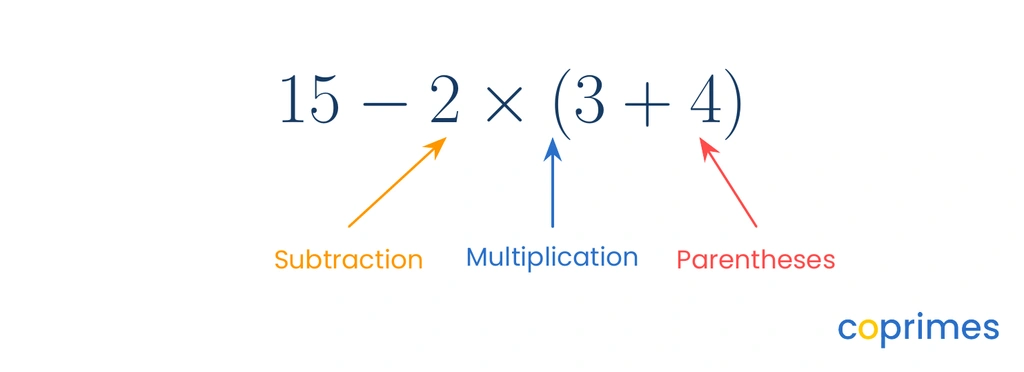
Identifying the operations first helps you map out the steps required to evaluate the expression properly.
Apply the order of operations
To ensure everyone gets the same result when calculating, mathematicians use the order of operations. This is a strict hierarchy of steps.
Depending on where you live, you might use an acronym like PEMDAS, BODMAS, or BEDMAS to remember these steps. All of these acronyms represent the exact same mathematical rules.
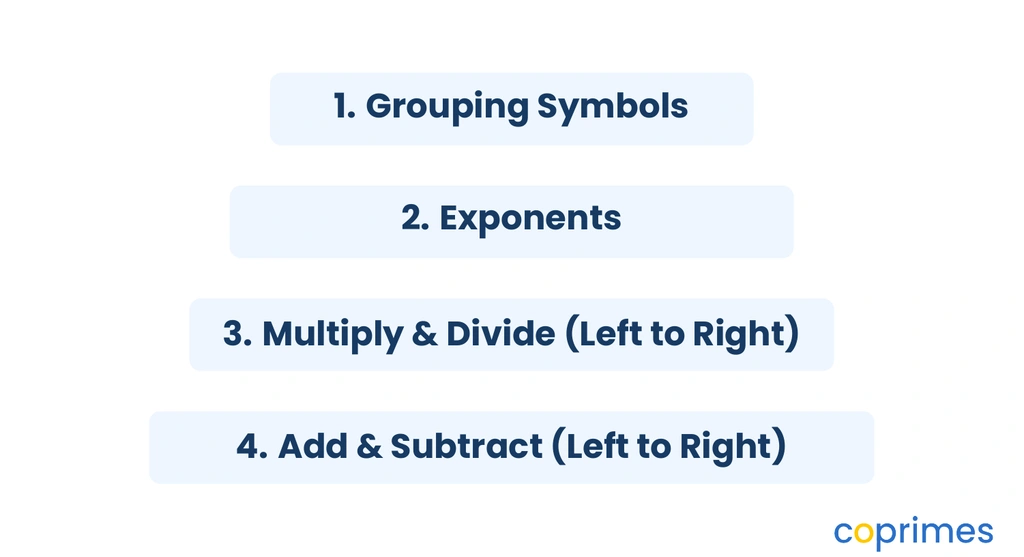
The four critical levels of the order of operations are:
- Grouping Symbols: Evaluate everything inside parentheses , brackets , or braces first. If there are nested symbols, start with the innermost set.
- Exponents: Evaluate powers, roots, and indices next.
- Multiplication and Division: These operations share the exact same priority level. Evaluate them from left to right as they appear in the expression.
- Addition and Subtraction: These operations also share the same priority level. Evaluate them from left to right as they appear.
Multiplication does not automatically come before division. They are evaluated together from left to right.

Keep each step clear
When an expression has multiple operations, perform exactly one operation per step. After completing that step, rewrite the rest of the expression exactly as it was.
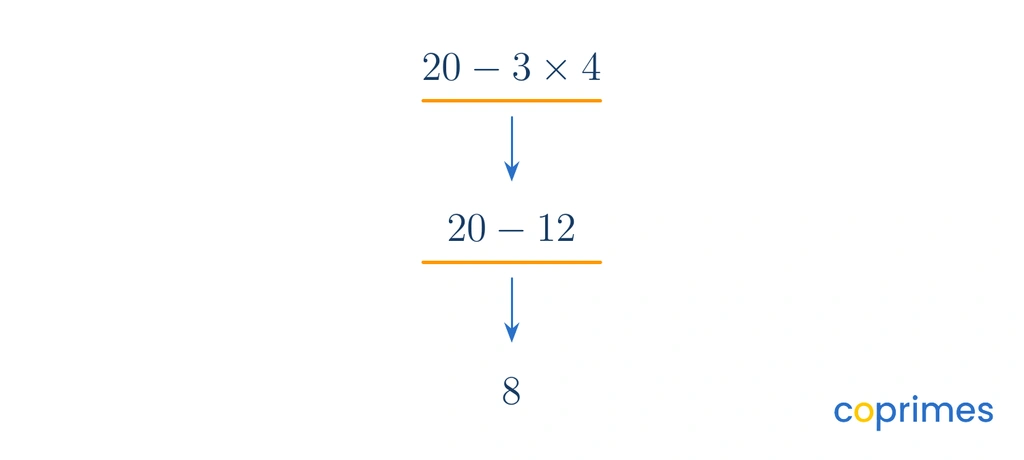
Rewriting the expression creates a clear funnel shape, making it much easier to track your progress and locate errors if you make a mistake.
How to check an answer
After evaluating, you can review your work by checking reasonableness of answers. Quickly round the numbers and estimate the final result mentally.
If your exact evaluation produces but your rough mental estimate suggests the answer should be closer to , you have likely performed operations out of order. Look back at your written funnel to verify whether you performed multiplication before addition.
Worked examples
Example 1: Basic multiplication and addition
Question: Evaluate .
Method:
- Identify the operations: addition and multiplication.
- According to the rules, multiply before adding. Calculate .
- Rewrite the expression with the calculated value.
- Perform the remaining addition.
Answer:
Check: An estimate confirms , which matches our answer.
Example 2: Expressions with exponents
Question: Evaluate .
Method:
- Identify the operations: subtraction, exponents and powers, and multiplication.
- Evaluate the exponent first. Calculate .
- Rewrite the expression: .
- Multiply before subtracting. Calculate .
- Rewrite the expression: .
- Perform the final subtraction.
Answer:
Check: If we mistakenly subtracted first, we would get . By strictly following the rules, is the only correct answer.
Example 3: Nested grouping symbols
Question: Evaluate .
Method:
- Identify the innermost grouping symbols first. Calculate the parentheses .
- Rewrite the expression: .
- Evaluate the remaining brackets. Calculate .
- Rewrite the expression: .
- Perform the final division.
Answer:
Check: If we ignored the brackets, we would calculate . We would divide first to get , then multiply by to get , which is incorrect. The brackets force the multiplication to happen first.
A learning plan shaped by your child, not the class
State-aligned Math plus our own Logic and English curriculum. An adaptive baseline test finds the gaps and fills them.
Common mistakes
Many calculation errors happen because learners intuitively read mathematics from left to right instead of looking for the highest priority operation.
Expression | Common Mistake | Correct Evaluation |
Subtracting first: | Multiplying first: | |
Multiplying first: | Left to right: | |
Adding first: | Exponents first: |
Always multiply and divide from left to right. Do not automatically multiply first just because the "M" comes before the "D" in PEMDAS or BODMAS.
Frequently asked questions
Do parentheses always come first?
Yes. Any operation placed inside parentheses, brackets, or braces must be evaluated before operations outside of them. If there are multiple sets of parentheses nested inside each other, always evaluate the innermost set first.
What if an expression has only addition and subtraction?
If an expression contains only addition and subtraction, perform the operations strictly from left to right. The same rule applies if an expression contains only multiplication and division.
Why do we need the order of operations?
Without standard rules, could equal (adding first) or (multiplying first). The rules guarantee that a numerical expression has exactly one correct value no matter who evaluates it.
Practice questions
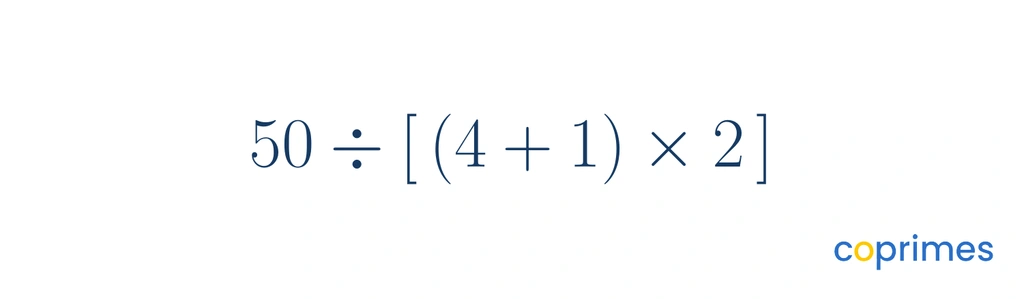
Which part of the numerical expression shown should be evaluated first?
Evaluate the expression .
Evaluate the expression .
A student evaluated and obtained a final answer of . Which mistake did the student make?
They added before multiplying.
They multiplied before adding.
They evaluated the operations correctly.
They ignored the addition sign entirely.
They added before multiplying.
Evaluate the expression .