
Decimal to Percent: Conversion Methods and Examples
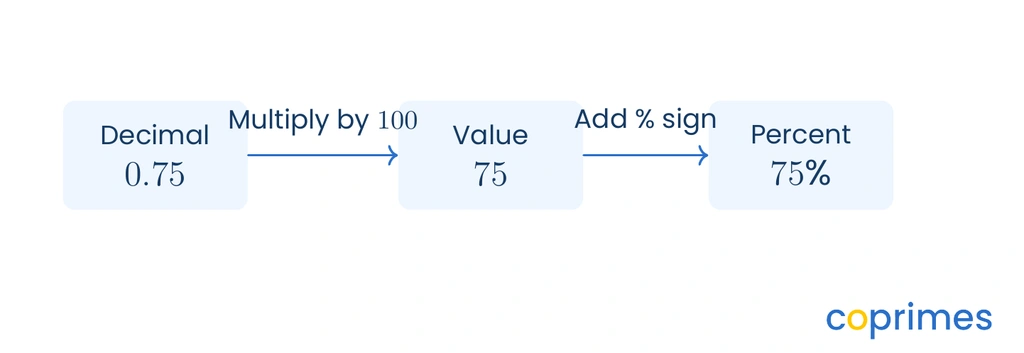
To convert a decimal to a percent, multiply by and write the percent symbol; this is equivalent to expressing the decimal as a number of hundredths.
Converting a decimal to a percent is representing the decimal as a percentages without changing its underlying mathematical value. The word percent translates directly to "for every one hundred", which is why scaling the decimal by produces the correct percentage. Understanding this fundamental decimal percent conversion ensures accurate calculation across many areas of mathematics.
How do you convert a decimal to a percent?
The process always involves two fixed procedural steps.
First, scale the number by multiplying it by . Second, append the percent symbol () to indicate that the new value is a percentage. Both actions must occur together to correctly complete a decimal to percentage transformation without altering the value of the number.
Connect decimals to hundredths
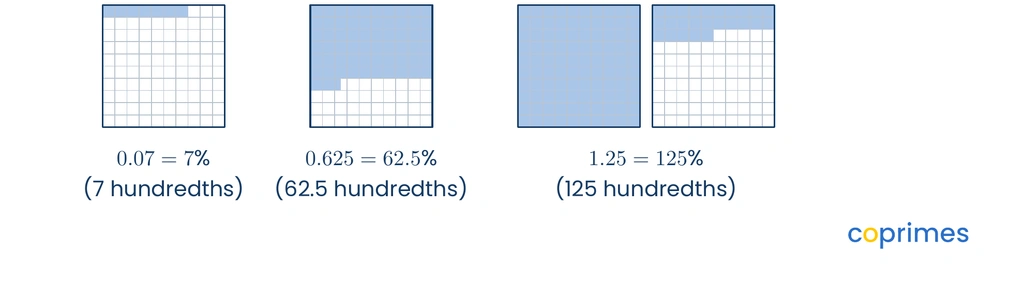
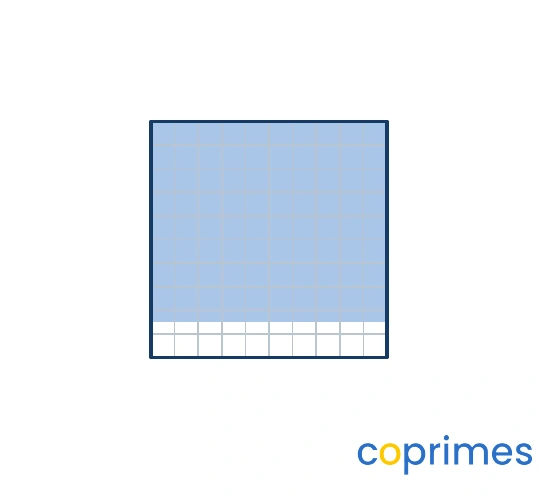
Use a hundredths grid and a place-value chart before relying on the calculation shortcut.
Since a percentage represents a part out of one hundred, any decimal can be evaluated by identifying how many hundredths it contains. This builds a strong foundation in decimal place value and prevents future calculation errors.
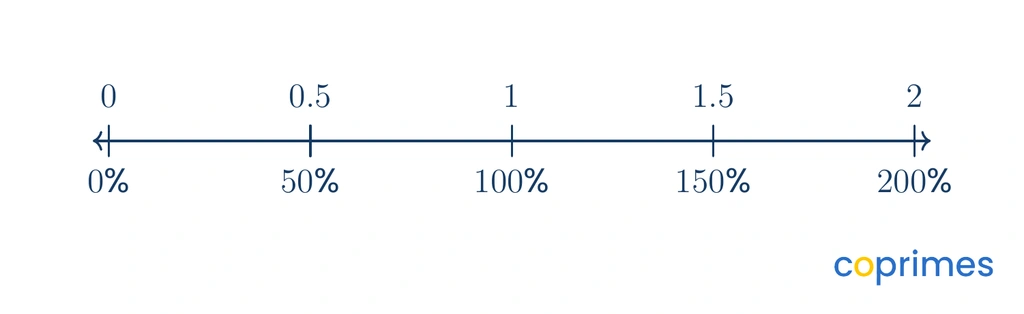
For instance, observe the decimals , , and represented on hundredths grids. These visual models reveal how leading zeros behave, how decimal percentages appear, and why a result can extend above .
Multiply by one hundred
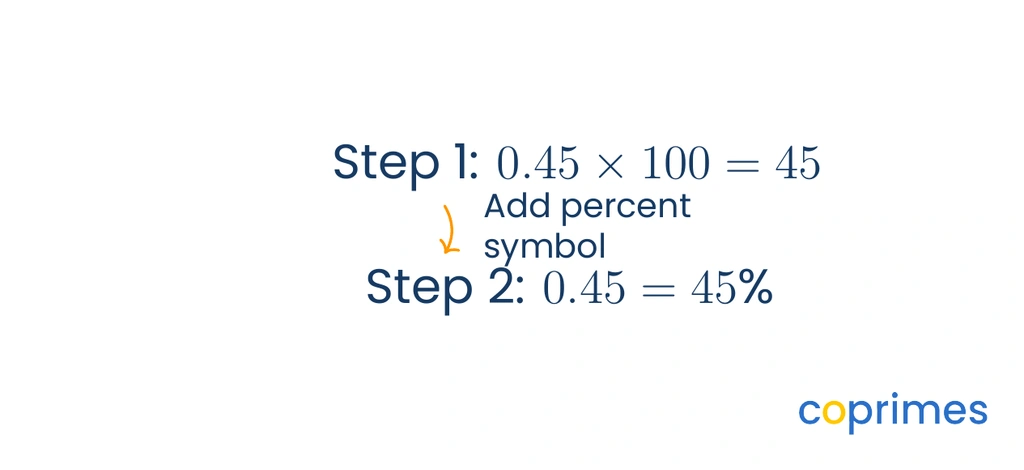
To perform the conversion algebraically, multiply the decimal by and attach the percent sign ().
Always clearly state the final answer in a complete equation format showing the original decimal equal to the new percent. Mastering this mathematical operation is also critical for understanding general fractions decimals and percents conversion as well as solving word problems.

Use place value rather than a shortcut alone
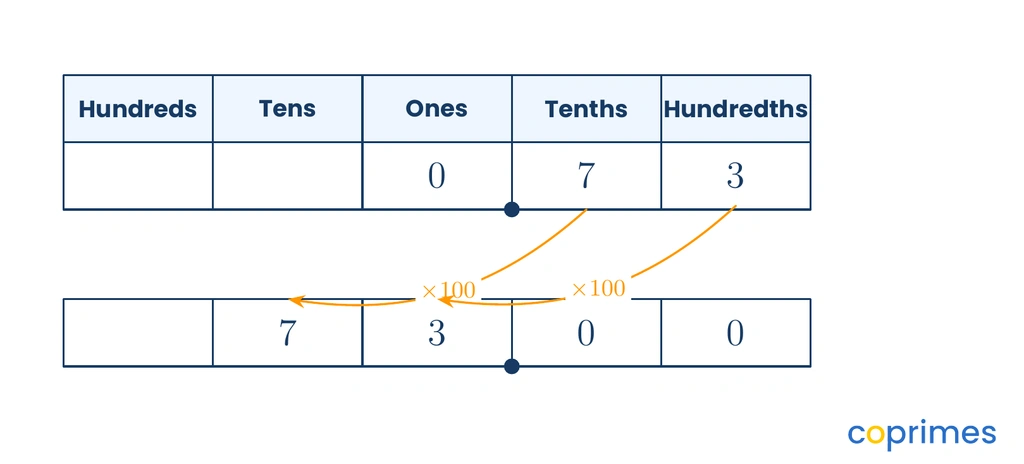
Many learners memorize the rule to move the decimal point two places to the right, but this can lead to mistakes if the underlying mechanics are misunderstood.
The decimal point does not physically move; rather, when a number is multiplied by , its digits shift two places to the left on the place-value chart. This distinction is vital when reversing the process for percent to decimal conversions. For example, in the decimal , multiplying by shifts the from the tenths column to the tens column, and the from the hundredths column to the ones column.
Convert decimals greater than one
Whenever a decimal is strictly greater than , its equivalent percentage will exceed .
The integer corresponds exactly to , which signifies one whole. Thus, values such as represent more than one whole and convert to percentages like . Understanding values over is highly beneficial when computing a percent of a number in compound growth contexts.
Worked examples
Here are three progressively challenging examples of when you write decimals as percents.
Example 1: Standard decimal conversion
Question: Convert to a percent.
Method:
- Multiply the decimal value by .
- Write the percent sign after the product.
Answer: .
Check: means hundredths, which is written directly in decimal form as .
Example 2: Thousandths conversion
Question: Convert to a percent.
Method:
- Multiply the decimal value by .
- Write the percent sign after the product.
Answer: .
Check: is less than . Since is , must be , which matches the original decimal.
Example 3: Repeating decimal conversion
Question: Convert to a percent.
Method:
- Multiply the decimal value by , remembering that the digit repeats infinitely as . Shifting the digits left leaves the infinite repeating string intact.
- Write the percent sign after the product.
Answer: .
Check: The fraction equals . Scaling by yields , which is , and that is equivalent to .
A learning plan shaped by your child, not the class
State-aligned Math plus our own Logic and English curriculum. An adaptive baseline test finds the gaps and fills them.
Common mistakes
- Add a percent sign without scaling by one hundred: A frequent error is attaching the percent sign directly to the original decimal without multiplying by . For example, writing is mathematically false. The value must first be scaled, producing .
- Miscounting place-value shifts: When multiplying by , some learners shift the digits one place or three places instead of exactly two places to the left.
- Missing the percent sign: Writing the final answer simply as instead of . The value means fifty wholes, whereas means fifty hundredths.
- Not noticing a recurring decimal: Failing to recognize the repeating nature of a decimal. When converting an infinite sequence, the repeating pattern must be maintained after multiplying by .
Frequently asked questions
Review these common queries to reinforce the relationship between decimals and percentages.
How do you convert a decimal to a percent?
To convert a decimal to a percent, multiply the decimal form of the number by and append the percent symbol ().
In a repeating decimal, how many digits should be written behind the decimal point?
The repeating sequence should only be written once, covered by a horizontal line called a vinculum. If a single digit repeats, write it once with a line over it. If a sequence of digits repeats, write the complete sequence once with a line over the entire block.
How do I know when my answer will be greater than 100 percent?
If the original decimal is strictly greater than , the equivalent percentage will be greater than . If the decimal equals exactly , the percentage is .
Practice questions
Convert to a percent.
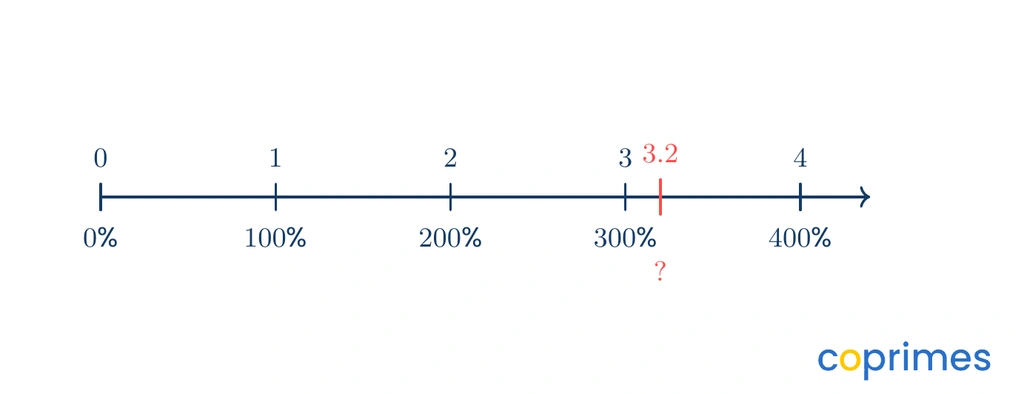
Convert to a percent.
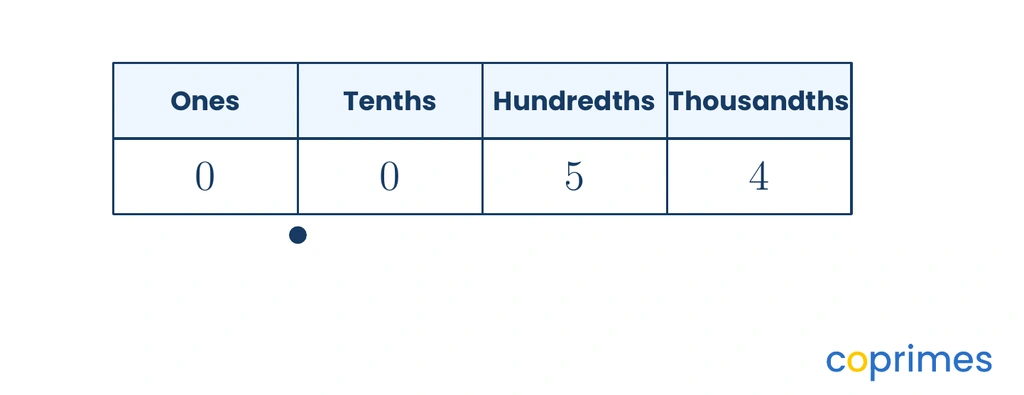
Convert to a percent.
Convert to a percent.
Which of the following equations demonstrates the common mistake of adding a percent sign without scaling by one hundred?