
Percentage Word Problems: Definition, Method and Examples
Percentage word problems describe a relationship between a part, a whole, and a percent. To solve them, identify which quantity is unknown, model the relationship with a diagram, table, or equation, calculate the missing value, and check that the result fits the context.
Many real-life percentage problems involve shopping, test scores, or population changes. Translating these scenarios into clear mathematical steps is the foundation for how to solve percentage word problems accurately.
What are percentage word problems?
Percentage word problems are mathematical scenarios that require you to find a missing value based on a proportional relationship out of .
Like all math word problems, they require translating written text into a mathematical equation. In a percentage problem, the key is understanding how the given numbers relate to a whole amount, which represents .
These percent story problems generally ask you to find one of three missing pieces of information: the part, the whole, or the percentage itself.
Identify the part, whole and percent
Every standard percentage application problem involves three main components. Identifying which two are given and which one is missing is the most important step in the problem-solving process.
The basic relationship is defined by this equation: .
The whole is the total amount, original price, or starting value. It always corresponds to .
The percent is the rate given per . In equations, it must be written as a decimal or a fraction.
The part is the portion of the whole. It is the result of taking the percent of a number.
Always convert the percentage into a decimal or fraction before multiplying or dividing.
Choose a representation
Visual representations, such as bar models, help organize the information in percentage word problems and clarify which operation to use.
A bar model aligns the whole amount with and maps the part to its corresponding percentage.
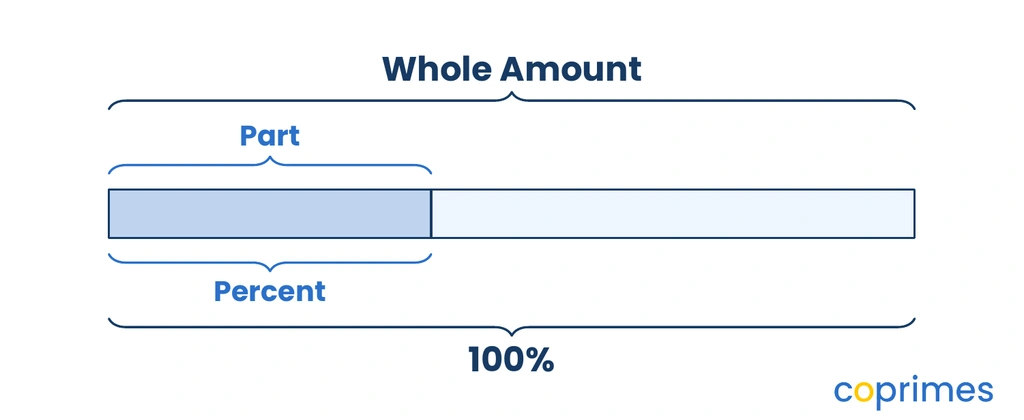
Drawing a quick diagram ensures you do not accidentally multiply when you should divide. It is especially useful when a percentage is greater than or when working with fractional percentages.
A learning plan shaped by your child, not the class
State-aligned Math plus our own Logic and English curriculum. An adaptive baseline test finds the gaps and fills them.
Find a part, whole or percent
Once you have identified the given information, choose the correct calculation method.
To find the part, multiply the whole by the decimal form of the percentage. This method also applies when calculating a percent increase or a percent decrease.
To find the percent, divide the part by the whole to get a decimal. Then, multiply that decimal by to convert it into a percentage.
To find the whole, divide the part by the decimal form of the percentage. Problems that ask you to find the original amount before a change occurred are known as reverse percentages.
Check units and reasonableness
Always compare your final answer to the context of the percentage application problem to ensure it makes logical sense.
Use estimation to verify your result. If you are finding of an amount, your answer should be slightly less than half of the whole. If you are calculating a part that is of an original amount, your final answer must be larger than the starting value.
Check your units. If the question involves length, ensure your answer is in meters or centimeters. If the problem asks for a percentage, verify that you multiplied your final decimal by and included the percent symbol.
Worked examples
Example 1: Finding the part
Question: A local library has books. Of these books, are nonfiction. How many nonfiction books are in the library?
Method:
- Identify the given information: the whole is books, and the percent is .
- Convert the percentage to a decimal: .
- Multiply the whole by the decimal: .
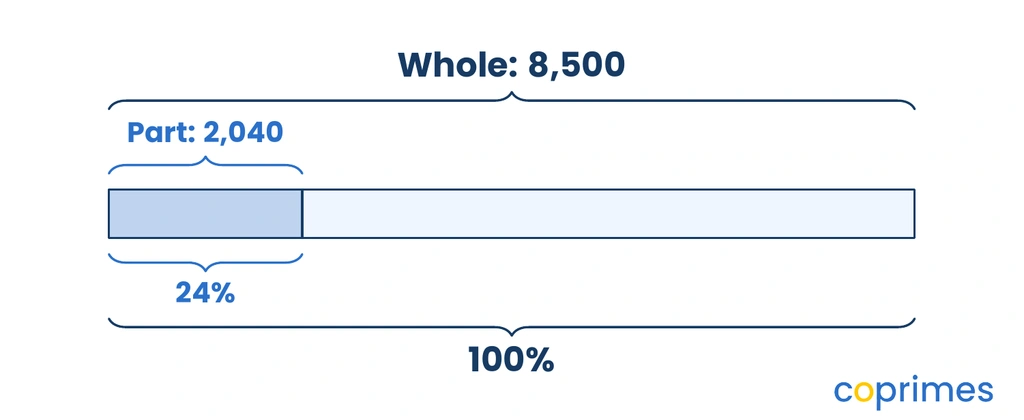
Answer: There are nonfiction books in the library.
Check: Since is one quarter, one quarter of is . The answer is slightly less than , making it reasonable for .
Example 2: Finding the percent
Question: A baker prepares loaves of bread. By noon, loaves are sold. What percentage of the bread was sold by noon?
Method:
- Identify the given information: the whole is , and the part is .
- Set up the fraction of the part over the whole: .
- Divide to find the decimal: .
- Multiply by to convert to a percentage: .
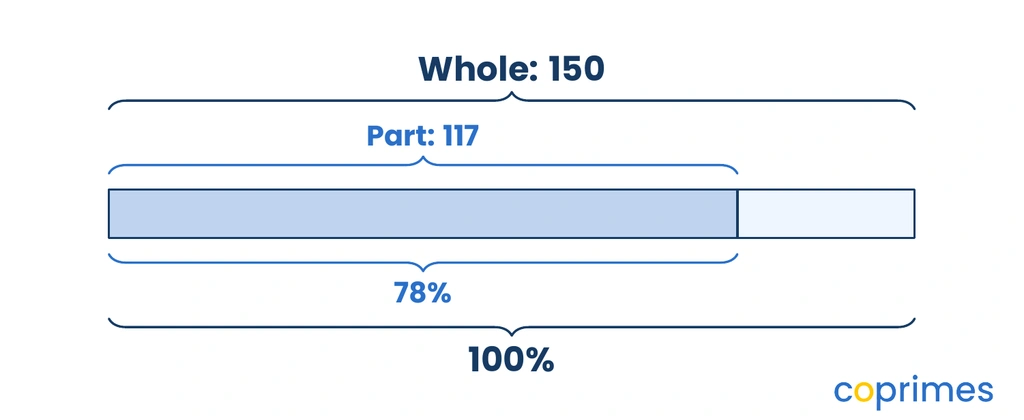
Answer: By noon, of the bread was sold.
Check: Since , half is . The value is substantially larger than , so the percentage must be greater than . The calculation is reasonable.
Example 3: Multi-step reverse percentage
Question: A youth sports club has junior and senior members. Of the total members, are seniors. If there are junior members, how many total members are in the club?
Method:
- Determine the percentage of junior members. Since the total is , subtract the senior percentage: .
- Identify the given information for the reverse calculation: the part is members, and this represents of the whole.
- Convert the percentage to a decimal: .
- Divide the part by the decimal to find the whole: .
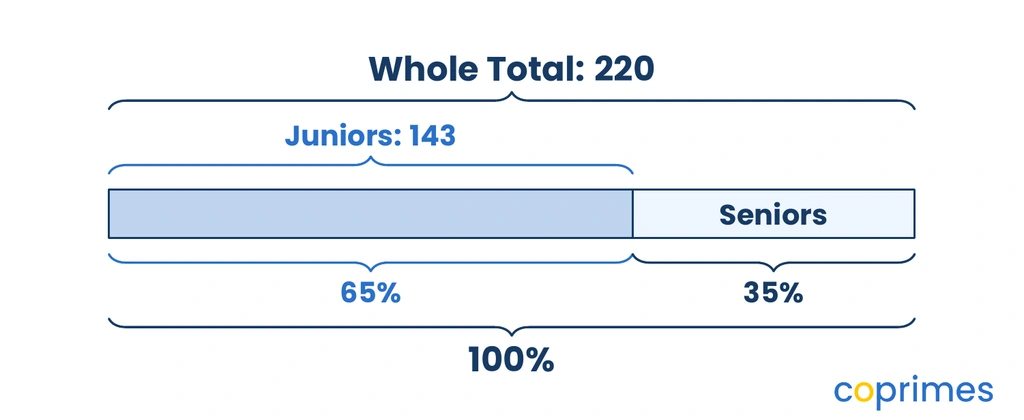
Answer: There are total members in the club.
Check: Finding of : . This matches the original number of juniors in the problem.

Common mistakes
One common error is multiplying the given percentage by the part instead of dividing. If you know the part and the percent, you must divide to find the whole. A bar model makes it clear when the whole is missing.
Another mistake is forgetting to convert the percentage to a decimal. Multiplying a whole by instead of will result in an answer that is times too large.
Finally, in multi-step problems, a common mistake is finding the percentage of the wrong whole. In compound percentage problems, the new value becomes the starting point for the next calculation. Do not add percentages together if they apply to different starting amounts.
Frequently asked questions
How do I know if I need to multiply or divide?
Multiply when you are given the whole and need to find the part. Divide when you are given the part and the percentage and need to find the whole.
Can a percentage be greater than ?
Yes. If an amount increases, the new amount can be greater than of the original. For example, a increase means the final amount is of the starting amount.
What is the fastest way to find a percentage of a number?
The most efficient method is converting the percentage to a decimal multiplier and multiplying it by the whole amount.
Practice questions
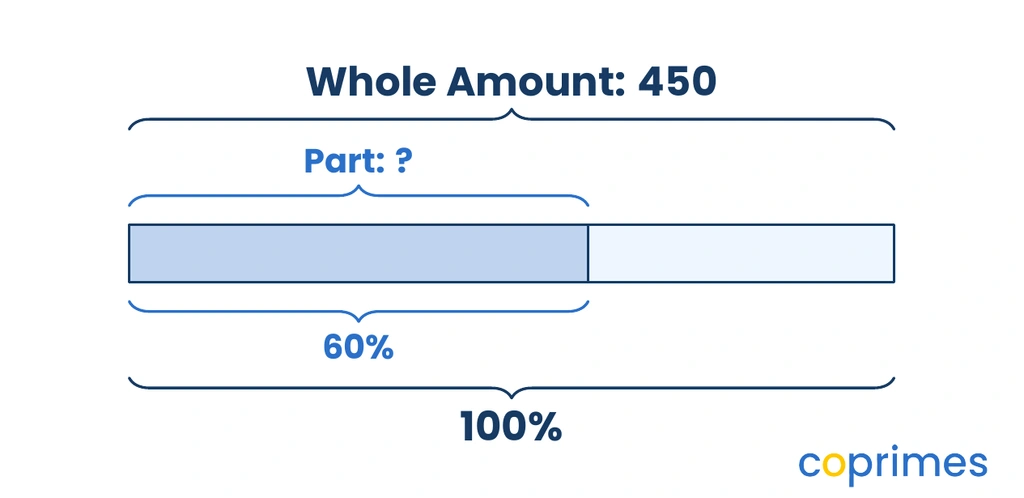
Based on the visual model, what is the value of the missing part?
A machine produces defective parts in one day. This represents of the total parts produced. How many total parts did the machine produce that day?
A mobile phone is priced at dollars. It is reduced by during a sale. What is the new price of the phone?
dollars
dollars
dollars
dollars
dollars
A town's population increases by in one year. The next year, the new population increases by another . What is the total percentage increase over the two years?
Which equation correctly models the problem: "What percentage of is ?"