
Solving Fraction Word Problems: Methods and Examples
Fraction word problems describe a real situation involving fractional quantities. To solve these problems accurately, you must identify the total amounts, understand the missing values, and construct an equation that represents the story.
Unlike basic arithmetic exercises where the operation is provided, math word problems require you to independently determine whether to add, subtract, multiply, or divide. This means reading the context carefully and applying the correct mathematical rules to the fractions involved.
What are fraction word problems?
Fraction word problems are mathematical scenarios written as text that require manipulating fractional quantities to find a solution. They translate everyday situations—such as measuring ingredients, cutting lengths of material, or splitting resources—into mathematical expressions.
To answer a fraction word problem correctly, you must translate the written text into a valid mathematical equation. Once the equation is established, solving the problem relies strictly on the standard arithmetic rules for working with fractions.
Identify the whole and the unknown
The first step in analyzing a fraction word problem is determining what represents the complete unit, or the "whole."
The whole can be a single continuous object, such as one pizza, or a group of items, such as a class of students. Once the whole is established, you must identify the unknown value the problem asks for. The unknown may be a combined total, a missing fractional part, a difference between two amounts, or the number of smaller groups that fit into a larger amount.
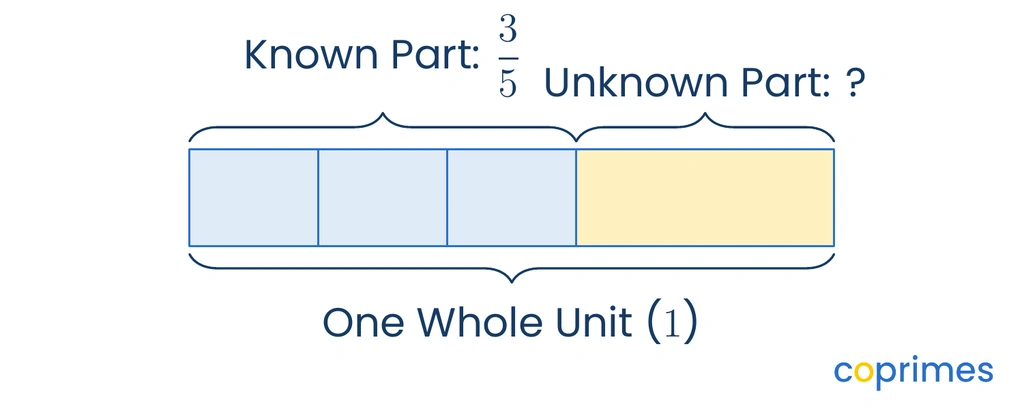
Choose an operation from the relationship
A common mistake is relying entirely on specific keywords to pick an operation. Instead, focus on the mathematical relationship unfolding in the story.
If the problem involves combining distinct parts into a larger total, this indicates adding fractions. If the text asks for a difference, or how much remains after a part is removed, this requires subtracting fractions.
Always identify the mathematical action happening in the story before constructing the equation.
When a problem asks for a part of another part, or scales an original amount by a fractional factor, use the rules for multiplying fractions. Finally, if a total quantity is being split into equal-sized fractional pieces to see how many fit, this indicates dividing fractions.

Draw a model or write an equation
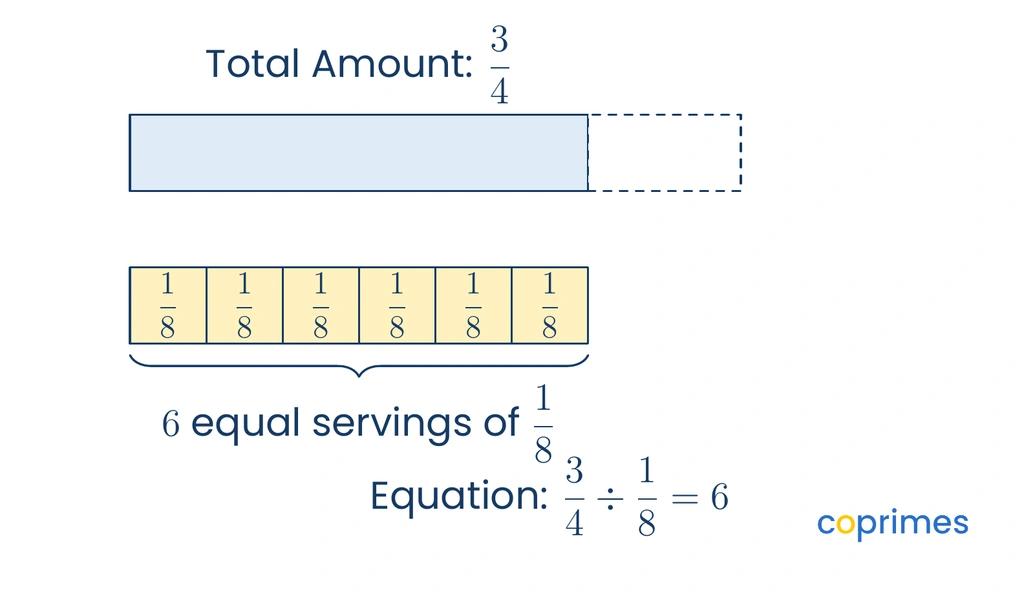
Visualizing the problem helps confirm that the chosen operation matches the context perfectly. You can use tape diagrams, area models, or visual groups to map out the mathematical relationship.
Once the relationship is clear, translate the model into an exact equation. Assign the numbers from the text to their correct positions. The order matters heavily in division, where you must distinguish between the total being split and the size of the share.
Check units and reasonableness
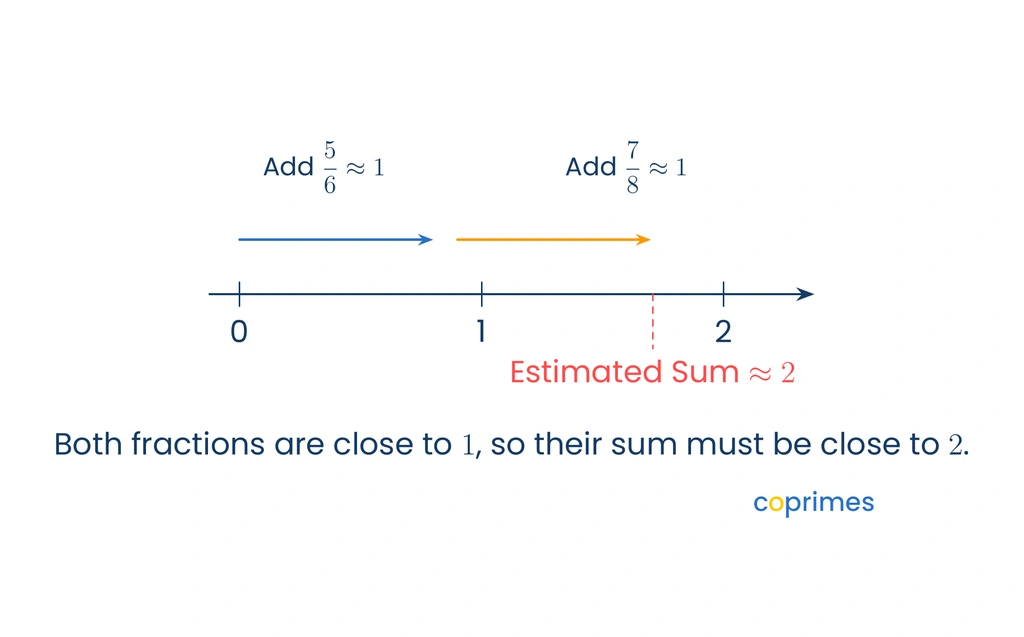
After completing the calculation, verify that the result makes logical sense in the real world. Estimation is a powerful tool for catching fundamental setup errors.
If you add two proper fractions, the result must be larger than either starting piece. If you multiply a positive whole number by a proper fraction, the answer must be smaller than the original whole number. Additionally, ensure the final answer explicitly states the correct units provided in the problem, such as liters, meters, or hours.
Worked examples by operation
Reviewing step-by-step methods reveals how the mathematical rules stay the same regardless of the context.
Example 1: Combining different lengths
Question: A carpenter uses of a meter of oak and of a meter of pine. What is the total length of wood used?
Method:
- Identify the relationship: "Total length" means combining the amounts, which requires addition.
- Write the equation: .
- Find a common denominator to add the fractions. The lowest common multiple of and is .
- Convert both fractions to equivalent forms: and .
- Add the numerators while keeping the denominator the same: .
Answer: The total length of wood used is of a meter.
Check: Since is more than half and is a quarter, the total should be slightly more than three-quarters. The fraction is just under whole, which makes logical sense.
Example 2: Finding a fraction of a fraction
Question: A baker has of a block of butter left. They use of the remaining butter for a cake. What fraction of the original block is used?
Method:
- Identify the relationship: The baker is taking a part () of an existing fraction (). This requires multiplication.
- Write the equation: .
- Multiply the numerators together and the denominators together.
- Calculate the product: .
- Simplify the result by dividing the numerator and denominator by their greatest common factor, which is .
Answer: The baker uses of the original block of butter.
Check: Finding half of four equal pieces leaves two pieces. Therefore, half of four-fifths is precisely two-fifths.
Example 3: Splitting a total into equal servings
Question: A large jug contains of a liter of juice. How many -liter servings can be poured from the jug?
Method:
- Identify the relationship: A total amount is being split into equal-sized smaller groups. This requires division.
- Write the equation: .
- Multiply the dividend by the reciprocal of the divisor.
- Calculate the product: .
- Simplify the improper fraction by dividing the numerator and denominator by , giving .
- Convert to a mixed number to clearly state the number of full and partial servings.
Answer: Exactly servings can be poured.
Check: Use multiplication to verify. If you pour servings that each hold of a liter, the total is of a liter.
A learning plan shaped by your child, not the class
State-aligned Math plus our own Logic and English curriculum. An adaptive baseline test finds the gaps and fills them.
Common mistakes
Fraction word problems combine reading comprehension with mathematical rules, leaving room for several common errors.
- Ignoring unlike denominators: Learners often attempt to add or subtract straight across without finding a common denominator first, which violates the core rules of fractional addition.
- Multiplying instead of dividing: When a problem asks how many fractional pieces fit into a whole, learners sometimes multiply the total by the fraction instead of properly dividing by it.
- Applying keywords blindly: Words like "more" can appear in subtraction contexts, and "total" can appear in multiplication contexts. Relying on isolated keywords rather than the action in the story usually leads to the wrong operation.
- Forgetting to simplify: Many academic word problems require the final answer to be expressed in its simplest form or as a mixed number when the result is an improper fraction.
Frequently asked questions
What are fraction word problems?
They are mathematical scenarios described in everyday text that require you to manipulate fractional quantities using addition, subtraction, multiplication, or division to reach a solution.
How do you know whether to multiply or divide in a fraction word problem?
Multiply when you need to find a fraction of another fraction, or when scaling an original amount by a fractional factor. Divide when you are splitting a known total into equal fractional parts, or finding out how many times a fractional group fits into another total.
Why is finding the common denominator important?
You cannot add or subtract fractions unless their parts represent the exact same size. Finding a common denominator ensures you are comparing and combining mathematically equivalent pieces.
Practice questions
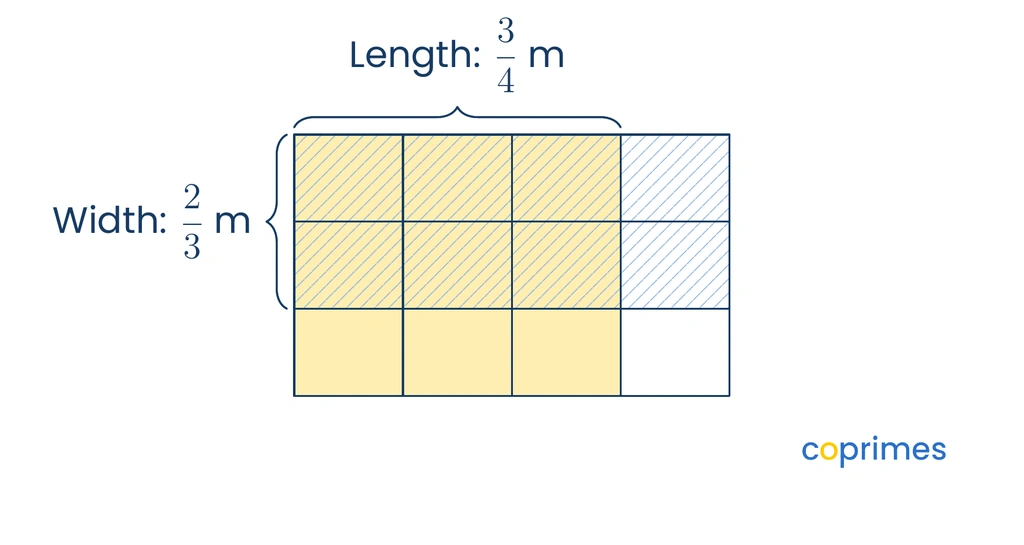
The area model represents a rectangular garden. The garden has a length of of a meter and a width of of a meter. What is the total area of the garden?
square meter
square meter
square meters
square meter
square meter
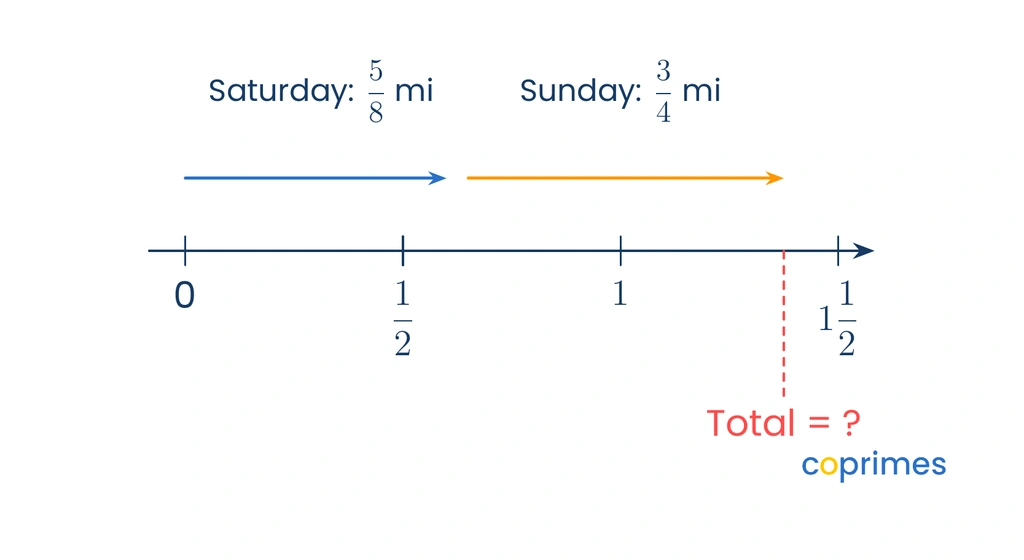
A cyclist rode their bike for of a mile on Saturday and of a mile on Sunday. What is the total distance the cyclist rode over the two days?
of a mile
miles
of a mile
of a mile
miles
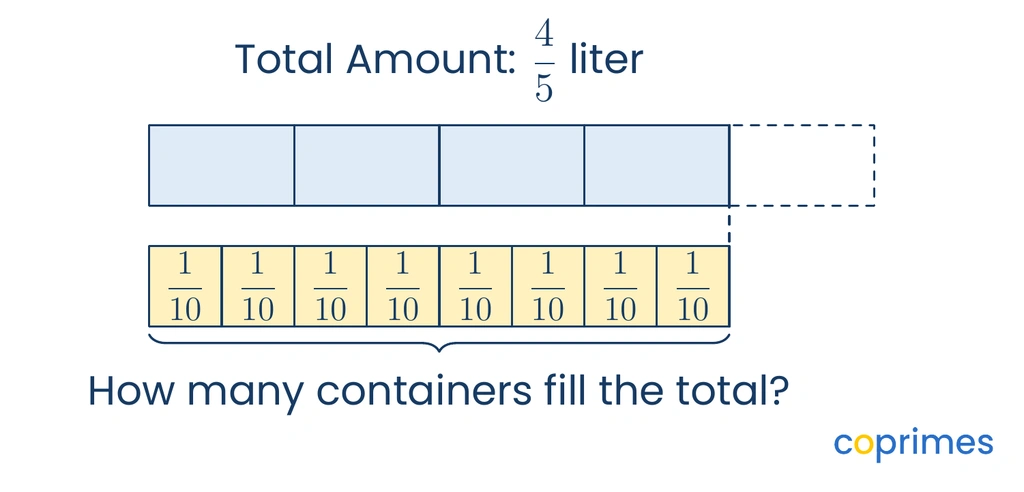
A painter has of a liter of blue paint. They pour the paint equally into small containers that each hold of a liter. Which equation accurately represents how to find the number of containers filled?
An athlete completes a training circuit. They spend of an hour running. If they stop to drink water exactly every of an hour, how many times do they stop during the run?
A recipe for a full batch of cookies requires of a cup of sugar and of a cup of flour. If a chef wants to make exactly half of a batch, what is the total amount of sugar and flour needed combined?
cups
of a cup
of a cup
cups
of a cup