
Fundamental Theorem of Arithmetic: Unique Prime Factorization
Every integer greater than is either a prime number or can be expressed as a product of prime numbers in exactly one way, apart from the order of the factors. This core principle, known as the fundamental theorem of arithmetic, ensures that prime numbers are the unique building blocks of all whole numbers.
What Is Fundamental Theorem of Arithmetic?
The fundamental theorem of arithmetic states that prime decomposition is unique for every integer greater than .
To understand this theorem, we can break it into three main parts. First, it applies only to integers greater than . Second, it guarantees that any composite number can be broken down into a product of prime factors. Third, and most importantly, it guarantees that there is exactly one specific set of prime factors for each number.
No two different numbers share the exact same prime factorization.
For example, the number is factored as . There are no other prime numbers that can be multiplied together to yield .
Key Ideas and Vocabulary
To apply the theorem correctly, several mathematical concepts must be clearly defined.
- Prime Number: An integer greater than that has exactly two positive divisors: and itself. Examples include , and .
- Composite Number: An integer greater than that is not prime. It can be divided by numbers other than and itself. Examples include , and .
- Prime Factorization: The process of finding the specific set of prime numbers that multiply together to form the original composite number.
- Ignoring the Order: The theorem states the factorization is unique regardless of how the factors are arranged. Writing is considered the same prime factorization as .
- Exponent Notation: When a prime factor is repeated, we use exponents to write the product more efficiently. Instead of writing , we write .
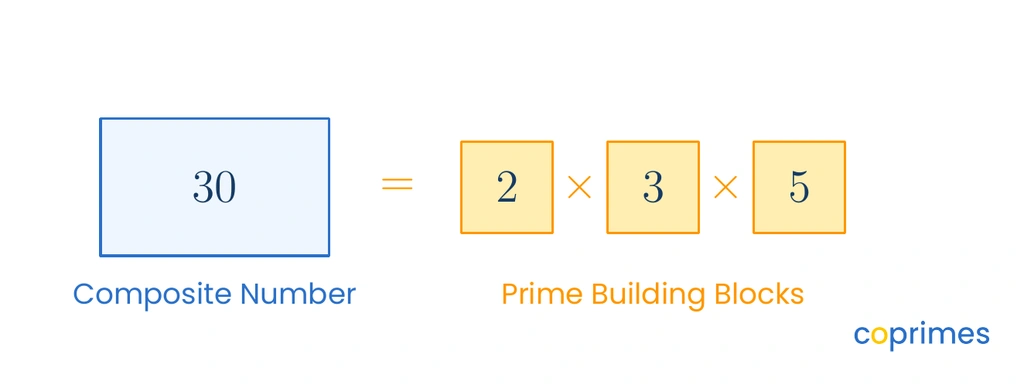
Visual Explanation
A factor tree provides an excellent visual model of the fundamental theorem of arithmetic. Because the prime factorization is unique, you can start a factor tree with any valid pair of factors and you will always arrive at the exact same prime numbers at the bottom of the branches.
Consider the number . Two students might choose to break it down using different starting factors. One starts with , while the other starts with .
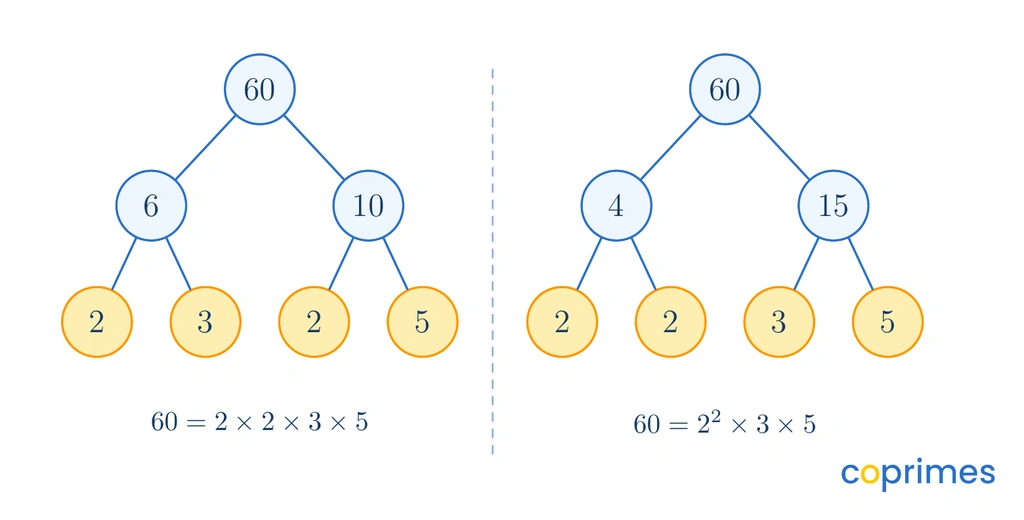
Even though the branches are different, both methods yield two s, one , and one . The final prime factorization is uniquely .

Worked Examples
The process of finding a unique prime factorization requires dividing by prime numbers until the final quotient is a prime number.
Example 1: Finding prime factors
Question: Write the prime factorization of .
Method:
- Divide by the smallest prime, which is . This gives .
- is not divisible by . The next smallest prime is . Divide by to get .
- Divide by again to get .
- is a prime number, so the process is complete.
- Gather all the prime divisors: , and .
Answer: The prime factorization is .
Check: Multiply the factors to confirm: , and .
Example 2: Repeated division for larger numbers
Question: What is the prime factorization of ?
Method:
- Since is even, divide by to get .
- Divide by again to get .
- Divide by again to get .
- is odd. The next prime is . Divide by to get .
- Divide by again to get .
- is a prime number, completing the division.
Answer: The prime factorization is .
Check: Calculate . Since , we find .
Example 3: Reconstructing a number from its factors
Question: A number has the prime factorization . What is the original number?
Method:
- Expand the exponents into a repeated multiplication: .
- Multiply the first pair: .
- Multiply by the next factor: .
- Multiply by the final factor: .
Answer: The original number is .
Check: Verify that divides evenly by its factors , and .
Common Mistakes and Non-Examples
When applying the fundamental theorem of arithmetic, avoid these common errors.
Including in the factorization
The number is not a prime number. Writing is incorrect because the theorem strictly defines a product of prime numbers. If were prime, factorizations would not be unique because you could include any number of s, such as .
Stopping at composite factors
A factorization is only complete when every factor is a prime number.
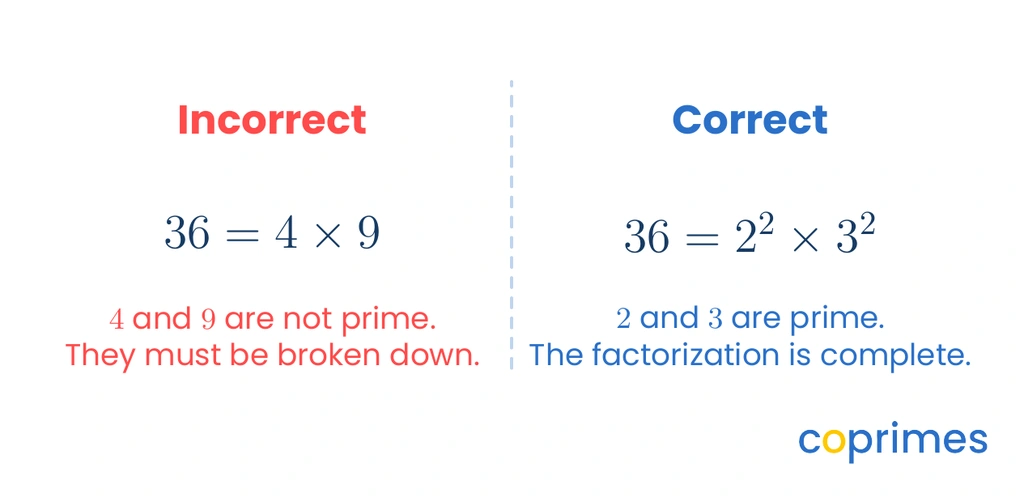
Treating reordered factors as unique
The order of multiplication does not create a new factorization. Writing is exactly the same as writing . By mathematical convention, we usually list prime factors in ascending order from smallest to largest to easily recognize the unique set.
Real-World Connections
The fundamental theorem of arithmetic is not just an abstract rule; it forms the foundation for many practical mathematical procedures.
When simplifying fractions, breaking the numerator and denominator into their prime factorizations reveals exactly which factors can be canceled. This makes finding the simplest form straightforward.
Prime factorization is also the most reliable method for finding the GCF and LCM of large numbers. By analyzing which prime factors two numbers share, you can immediately determine whether they are coprime numbers, meaning they share no prime factors other than .
Advanced applications include computer cryptography. Secure online communications rely heavily on the fact that while multiplying two large prime numbers is easy for a computer, determining the unique prime factors of an incredibly large composite number is extremely difficult and time-consuming. These concepts lay the groundwork for learning the Euclidean algorithm to compute the greatest common divisor efficiently, and analyzing perfect numbers through their exact divisors.
A learning plan shaped by your child, not the class
State-aligned Math plus our own Logic and English curriculum. An adaptive baseline test finds the gaps and fills them.
Practice questions
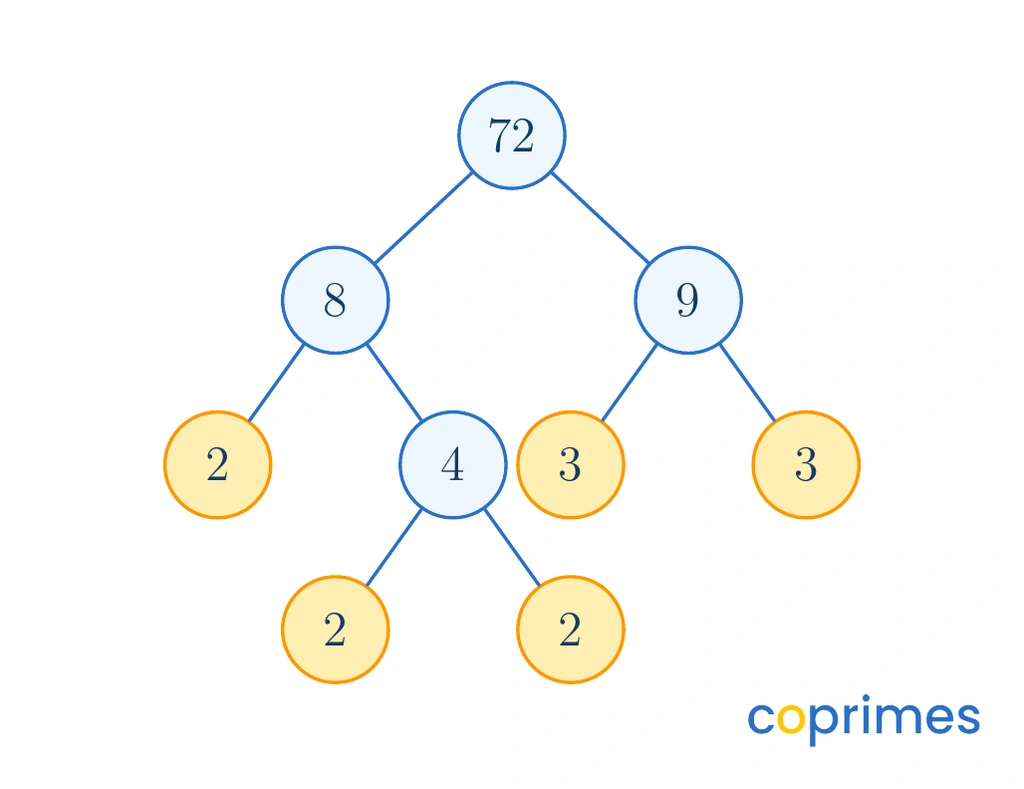
Based on the factor tree, what is the unique prime factorization of ?
Which of the following equations demonstrates the fundamental theorem of arithmetic for the number ?
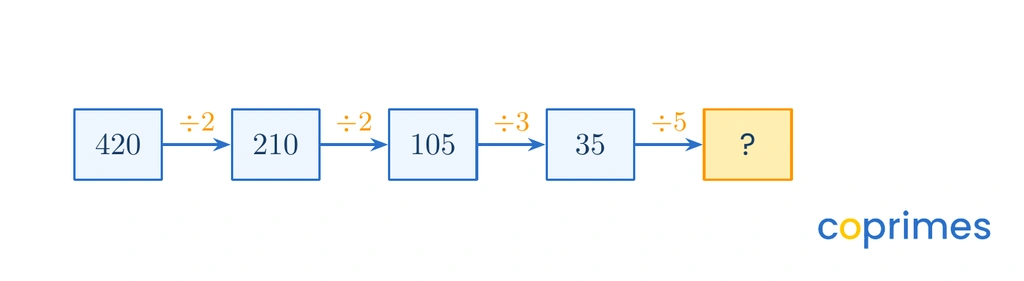
A student uses repeated division to find the prime factorization of . What is the final prime factor missing from the sequence, which will complete the prime factorization?
Why is excluded from the set of prime numbers according to the fundamental theorem of arithmetic?
Because is an even number.
Because can only be factored as .
If were prime, prime factorizations would no longer be unique.
Because is a composite number.
If were prime, prime factorizations would no longer be unique.
If two different composite numbers are decomposed into their prime factors, what must be true about their final factorizations?
They will always share at least one prime factor.
Their prime factorizations must contain the exact same quantity of prime numbers.
Their complete sets of prime factors will be entirely different from one another.
One prime factorization will be the reverse order of the other.
Their complete sets of prime factors will be entirely different from one another.