
Understanding Perfect Numbers: Guide and Examples for Grades 6-10
A perfect number equals the sum of its positive proper divisors, which exclude the number itself. Exploring these unique integers provides excellent practice in addition and multiplication, while introducing deeper patterns that have fascinated mathematicians for thousands of years.
What Are Perfect Numbers?
To determine if a number is perfect, you must first find all of its proper factors. A proper divisor (or proper factor) is any positive whole number that divides exactly into the original number, leaving a remainder of zero, except for the number itself.
Once you have identified every proper divisor, add them together. If the sum of these divisors is exactly equal to the original number, you have found a perfect number.
A perfect number is a positive integer that is exactly equal to the sum of its proper divisors.
For example, consider the number . Its proper divisors are , and . When we add them together (), the result is . Because the sum equals the original number, is the first perfect integer.
Key Ideas and Vocabulary
Every whole number greater than can be classified into one of three categories based on the sum of its proper divisors. This sum is known as the aliquot sum.
- Deficient Number: The sum of the proper divisors is strictly less than the original number.
- Perfect Number: The sum of the proper divisors is exactly equal to the original number.
- Abundant Number: The sum of the proper divisors is strictly greater than the original number.
Ancient mathematicians used early methods like the Euclidean algorithm to explore divisibility and study these perfect integers. Today, applying the fundamental theorem of arithmetic to find prime components is the standard first step in systematically discovering a number's divisors.
Visual Explanation
You can visualize perfect numbers by comparing the length of the original number to the combined lengths of its proper divisors. When the blocks representing the divisors are placed side by side, they create a line that perfectly matches the length of the original number.
We can also represent the classification of numbers using a side-by-side comparison of deficient, perfect, and abundant sums.
A learning plan shaped by your child, not the class
State-aligned Math plus our own Logic and English curriculum. An adaptive baseline test finds the gaps and fills them.
Worked Examples
Testing whether a number is perfect involves careful arithmetic. Missing even one proper divisor will lead to an incorrect conclusion. Use factor pairs to ensure you have found every divisor.
Example 1: Testing the number 28
Question: Is a perfect number?
Method:
- Find all factor pairs for : , , and .
- List all the factors in order: .
- Identify the proper divisors by removing the original number (). The proper divisors are , and .
- Find the sum: .
Answer: Yes, is a perfect number because the sum of its proper divisors is exactly .
Check: We can confirm we did not miss any factors by checking divisibility rules. The number is not divisible by (since , which is not divisible by ), not divisible by (does not end in or ), and not divisible by (not divisible by ). Our list is complete.
Example 2: Testing a deficient number
Question: Is a perfect number?
Method:
- Find all factor pairs for : and .
- List the proper divisors, excluding . They are , and .
- Calculate the sum of the proper divisors: .
- Compare the sum to the original number. Since , the number is deficient.
Answer: No, is a deficient number, not a perfect number.
Check: Check for missing factors. is an odd number, so it cannot be divided by even numbers like , or . The list of proper divisors () is correct.
Example 3: Testing an abundant number
Question: Is a perfect number?
Method:
- Find all factor pairs for : , , and .
- List the proper divisors, excluding . They are , and .
- Calculate the sum of the proper divisors: .
- Compare the sum to the original number. Since , the number is abundant.
Answer: No, is an abundant number, not a perfect number.
Check: Verify the addition: . Then . Finally, . The sum is correct.
Common Mistakes and Non-Examples
The most frequent mistake when testing for perfect numbers is accidentally including the original number in the final sum. The definition specifically requires adding only the proper divisors. If you include the original number, the sum will always be twice the original value.
Another common error is assuming that prime numbers can be perfect. A prime number has only two factors: and itself. Its only proper divisor is . Therefore, the proper divisor sum for any prime number is always . Since a prime number is always greater than , all prime numbers are deficient.
Real-World Connections
While perfect integers do not frequently appear in everyday arithmetic, they act as an important benchmark in advanced number theory. Mathematicians have been fascinated by them since ancient times, noting mystical or philosophical properties due to their rarity.
In modern mathematics, discovering new perfect numbers is an extreme computational challenge. They are closely linked to a special group of prime numbers called Mersenne primes. Every time a supercomputer discovers a new Mersenne prime, mathematicians can use it to calculate a massive new perfect number that has millions of digits.

Practice questions
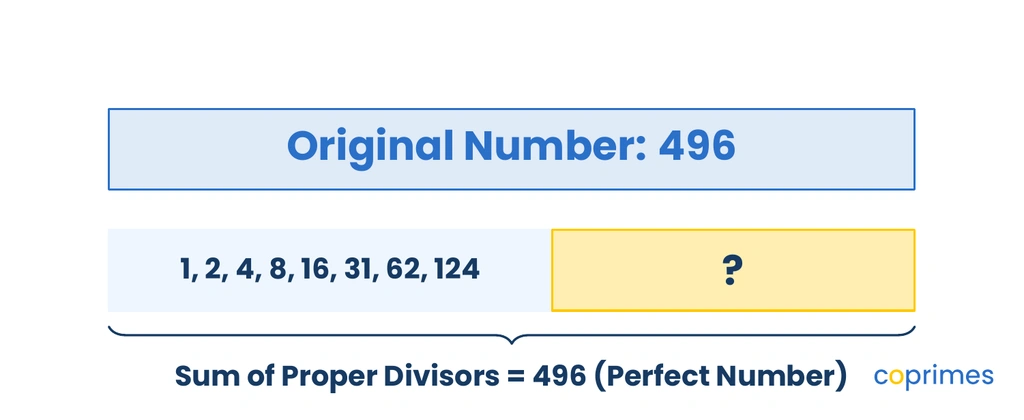
The diagram models the third perfect number, , and lists almost all of its proper divisors. The sum of the listed proper divisors () is . Which proper divisor belongs in the missing block to prove is perfect?
Which of the following numbers is the first perfect integer?
How do you determine if a number is abundant?
The sum of its proper divisors is strictly less than the original number.
The sum of all its factors, including the number itself, equals the original number.
The sum of its proper divisors is strictly greater than the original number.
It has more than five proper divisors.
The sum of its proper divisors is strictly greater than the original number.
What are the proper divisors of the number ?
A student claims that all prime numbers are perfect numbers because they are whole and complete. Why is this claim mathematically incorrect?
A prime number's only proper divisor is , meaning its sum will always be deficient.
Prime numbers have too many proper divisors to sum accurately.
A prime number's only proper divisor is itself, which breaks the rule.
Prime numbers are always abundant because they cannot be divided into smaller parts.
A prime number's only proper divisor is , meaning its sum will always be deficient.