
Math Operation Words and Symbols: Reading and Translating Expressions
Math operation words and symbols express the same relationships in different forms, such as sum for addition, difference for subtraction, product for multiplication, and quotient for division. Understanding how to read math expressions accurately helps to translate spoken or written language into formal mathematical equations.
Knowing the correct math operation keywords is essential for solving word problems and writing expressions correctly.
Math operation words and symbols
Every mathematical operation has a specific symbol and a formal name for its result. When translating words into math, identifying these key terms is the first step in building a correct equation or numerical expression.
The four core operations each have a primary formal word that describes the final result of the calculation.
Here are the primary terms for the four basic operations:
- Addition (): The result is called the sum.
- Subtraction (): The result is called the difference.
- Multiplication (): The result is called the product.
- Division (): The result is called the quotient.
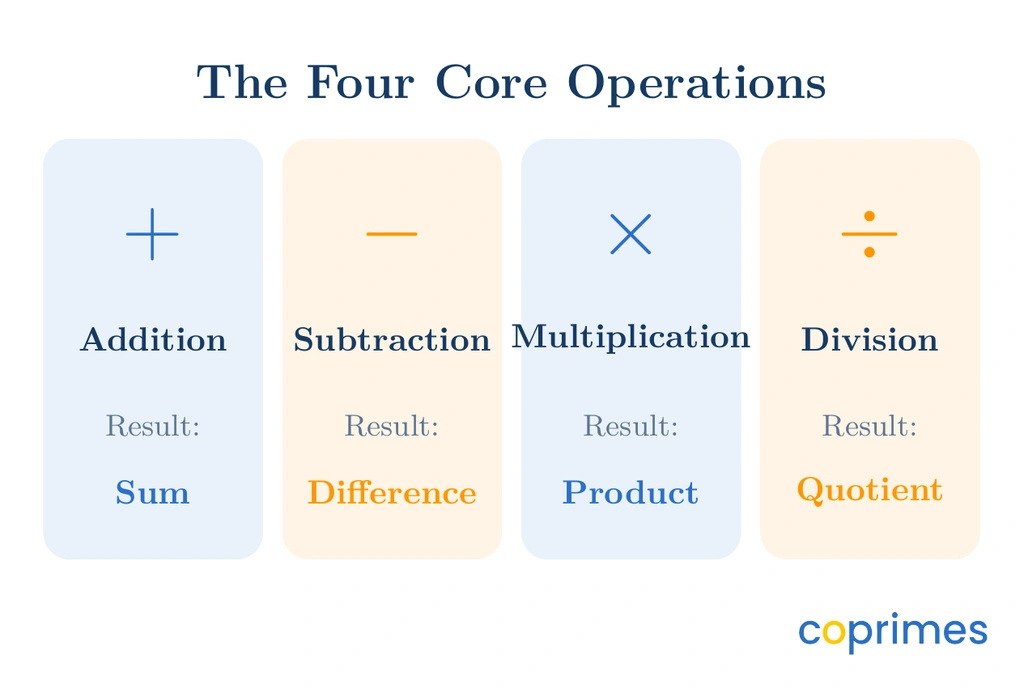
Recognizing these words and math symbols in words helps when translating words into math to solve real-world problems.
Addition phrases
Addition involves bringing two or more amounts together to make a larger total. The words used for addition phrases usually suggest combining or increasing.
Common addition words include:
- Sum
- Plus
- Added to
- More than
- Increased by
- Total
- Altogether
- Combined
For example, "the sum of and " is written as . The phrase " increased by " translates to . Addition is commutative, meaning the order of the numbers does not change the result, so " more than " can be written as or .
Subtraction phrases and order
Subtraction finds the difference between two values or removes an amount from a starting value. Unlike addition, subtraction is not commutative, meaning the order of the numbers is strictly important.
Common subtraction words include:
- Difference
- Minus
- Subtract
- Less than
- Decreased by
- Take away
- Reduced by
The phrase "less than" reverses the order of the numbers in the written expression.
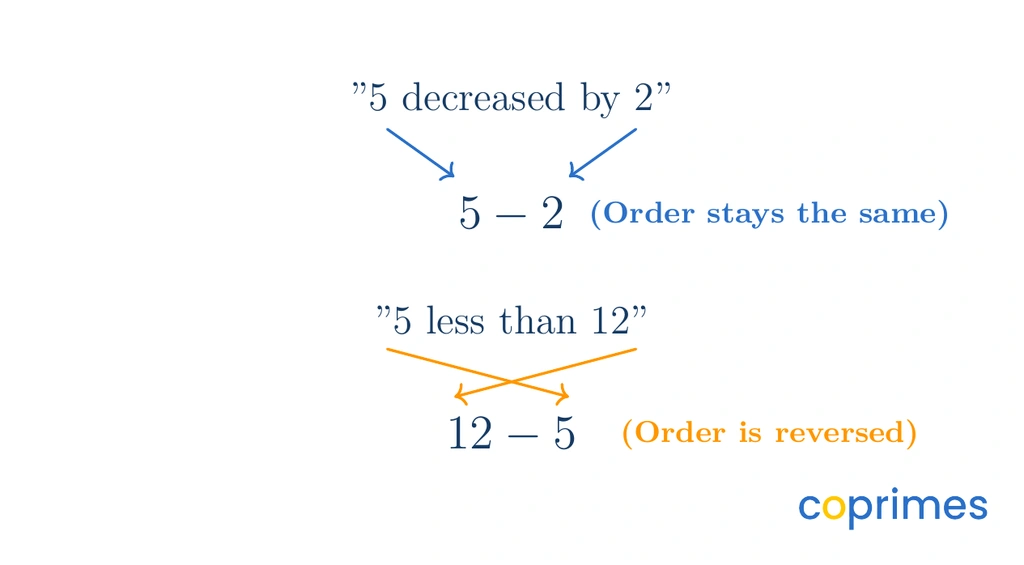
When a problem says " decreased by ", the expression is written exactly in that order: . However, if a problem says " less than ", you start with and take away . The correct expression is . Writing would be incorrect.

Multiplication phrases
Multiplication words indicate repeated addition, scaling, or finding a fraction of an amount. Knowing these math operation keywords is crucial when choosing operations in word problems.
Common multiplication words include:
- Product
- Times
- Multiply
- Twice (multiply by )
- Double (multiply by )
- Triple (multiply by )
- Of (when used with fractions or percentages)
For example, "the product of and " is written as . The phrase "twice the value of " translates to . The word "of" is frequently used when finding parts of a whole, such as "half of ", which means .
Division phrases
Division involves separating a quantity into equal parts or finding out how many times one number is contained within another. Like subtraction, division is not commutative, so the numbers must be placed in the correct order.
Common division words include:
- Quotient
- Divided by
- Ratio
- Half (divide by )
- Per
- Out of
When building numerical expressions, the phrase "the quotient of and " strictly means is the dividend (top number) and is the divisor (bottom number), written as or . The word "per" is common in rates, such as "miles per hour", which means miles divided by hours.
Grouping language
Sometimes a math sentence involves more than one operation and requires parentheses to ensure the calculations happen in the correct sequence. Grouping language overrides the standard order of operations by forcing addition or subtraction to happen before multiplication or division.
Phrases that indicate grouping often include the formal result words (sum, difference) paired with another operation:
- Times the sum of
- Times the difference of
- Divided by the sum of
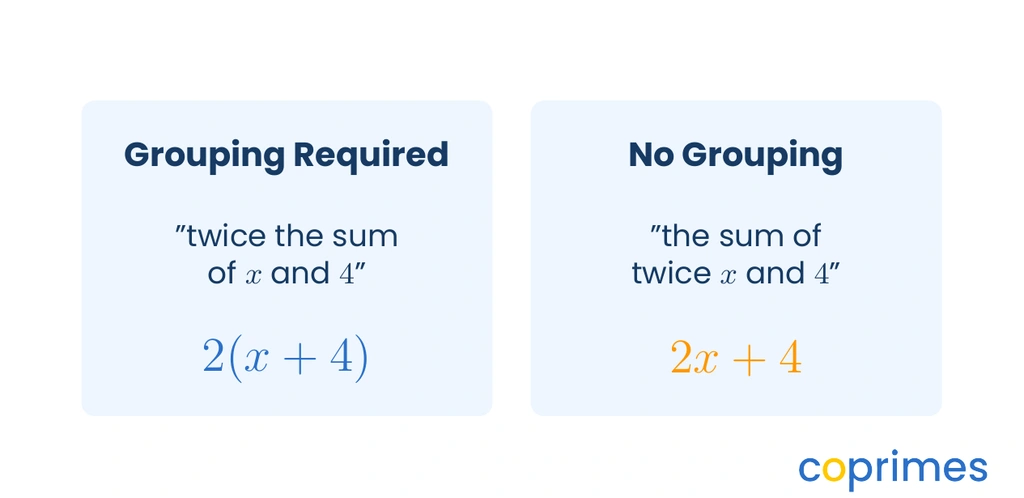
If a phrase says "three times the difference of and ", the difference must be calculated first. The correct translation uses parentheses: . Without parentheses, would mean "the difference of three times and ", which is a completely different calculation.
A learning plan shaped by your child, not the class
State-aligned Math plus our own Logic and English curriculum. An adaptive baseline test finds the gaps and fills them.
Worked examples
Translating addition subtraction multiplication division words into numbers requires reading carefully and applying the correct math operation keywords.
Example 1: Translating a subtraction expression
Question: Write an algebraic expression for "eight less than a number ".
Method:
- Identify the operation indicated by "less than", which is subtraction.
- Recall that "less than" reverses the order of the values given.
- Place the starting value first, and subtract from it.
Answer: .
Check: If is , "eight less than " is . The expression gives , which matches.
Example 2: Translating a division expression
Question: Write an expression for "the quotient of and ".
Method:
- Identify that "quotient" means division.
- Keep the order strictly as written. The first number is the dividend and the second is the divisor.
- Write the division using a fraction bar or division symbol.
Answer: .
Check: The first value named is the numerator, which matches the definition of a quotient.
Example 3: Translating a grouped expression
Question: Write an expression for "half of the sum of and ".
Method:
- Identify "sum", which means addition ().
- Identify "half of", which means multiplying by or dividing by .
- Because the half applies to the entire sum, enclose the sum in parentheses.
Answer: or .
Check: The addition is correctly grouped before the division occurs.
Frequently asked questions
How to read math expressions out loud correctly?
To read an expression clearly, use the formal operation words. For example, read as "four times the difference of and two" rather than "four bracket minus two close bracket". Using formal math words makes the order of operations clear.
What is the difference between "less" and "less than"?
The word "less" maintains the order of the numbers, while "less than" reverses it. For example, " less " means , but " less than " means .
What does "is" mean in a math sentence?
Words like "is", "equals", "yields", "gives", and "results in" all represent the equals sign () in an equation. For example, "the sum of and is " translates to .
Practice questions
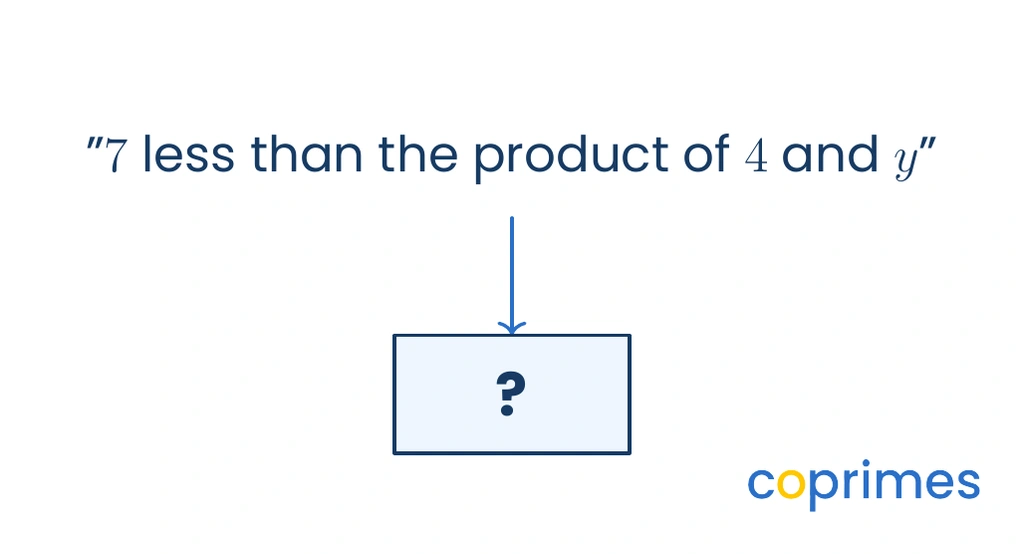
Which mathematical expression correctly represents the phrase in the diagram?
Which mathematical operation corresponds to the word "quotient"?
Addition
Subtraction
Multiplication
Division
Division
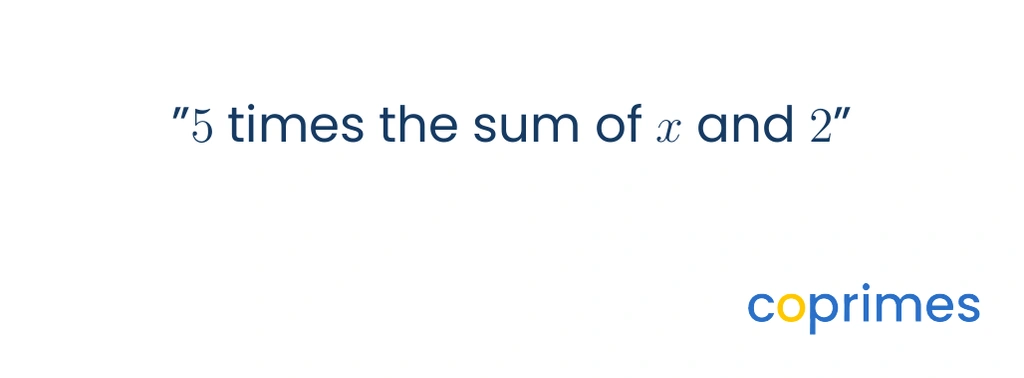
How is the phrase translated into a mathematical expression?
Which of the following phrases is correctly matched with its mathematical expression?
" decreased by " translates to .
"The difference of and " translates to .
" less than " translates to .
" less " translates to .
" less than " translates to .
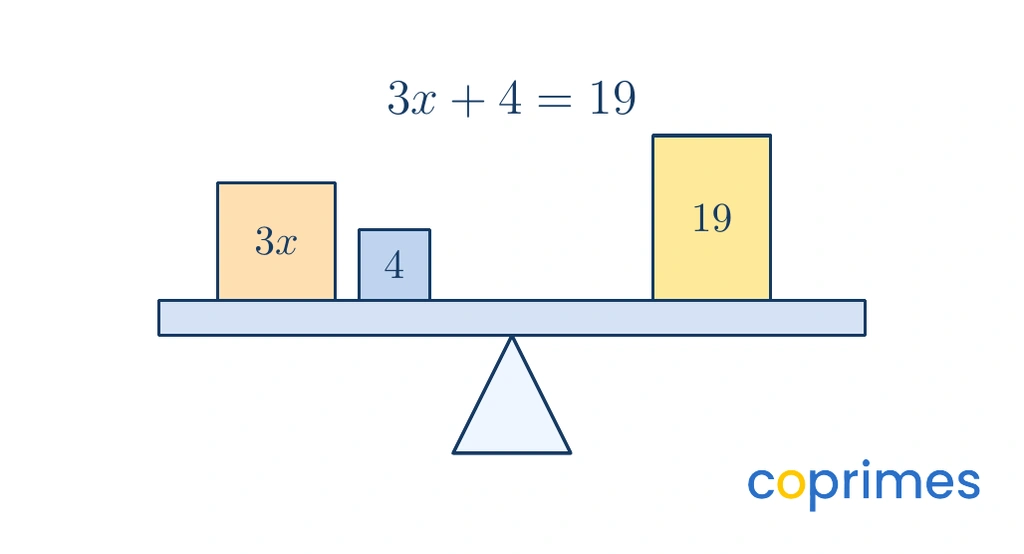
Which English sentence correctly translates the equation shown in the visual?
The product of and , less than , is .
Three times the sum of and equals .
Four more than the product of and yields .
The sum of and increased by is .
Four more than the product of and yields .