
Parts of Multiplication: Multiplicand, Multiplier, and Product
The multiplicand and multiplier are numbers being multiplied, and their result is called the product; both numbers are also factors of the product. Understanding these terms helps make sense of multiplication sentences and word problems.
What are the parts of multiplication?
Every multiplication operation is built using three main mathematical parts. When you write a basic calculation, you start with the numbers you are combining. These lead to a single final answer.
The three specific multiplication terms for these parts are the multiplicand, the multiplier, and the product. These labels define exactly what role each number plays in the operation.
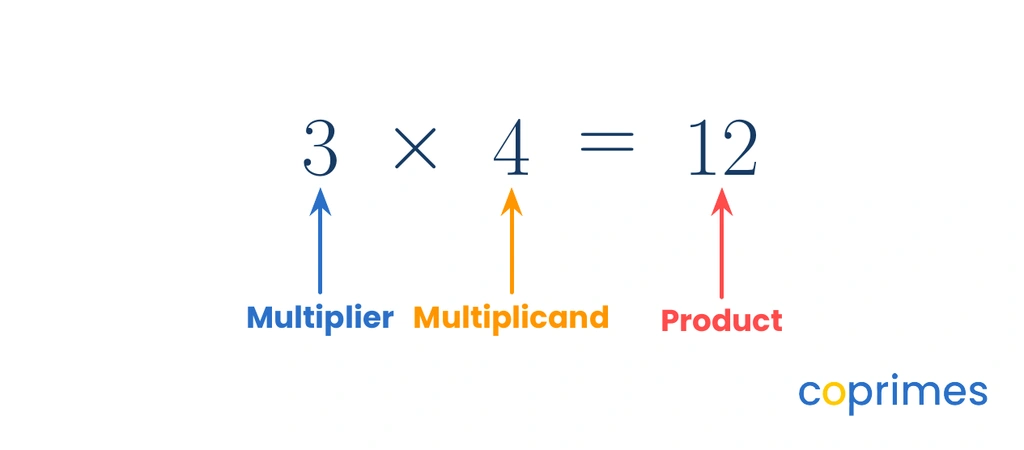
Depending on how you phrase the calculation, the first number is often treated as the multiplier and the second number as the multiplicand, or vice versa.
Multiplicand, multiplier and product
The multiplicand is the base quantity or the size of each group. It is the core number that is being multiplied.
The multiplier tells you the number of groups. It dictates how many times you are repeatedly adding the multiplicand to itself.
The product is the final mathematical result. It is the total value you reach after successfully completing the multiplication.
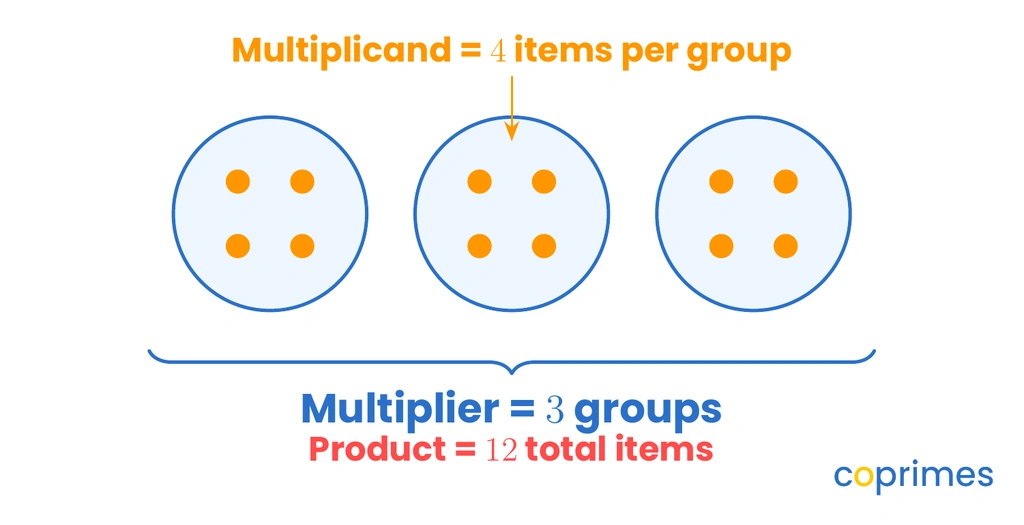
The product is always the final answer in a multiplication equation.
Factors and product
Because the multiplicand and multiplier work together to create the product, mathematicians often combine them under a simpler name: factors.
A factor is any number that you multiply by another number to yield a product. This means both the multiplicand and the multiplier are factors of the final answer.
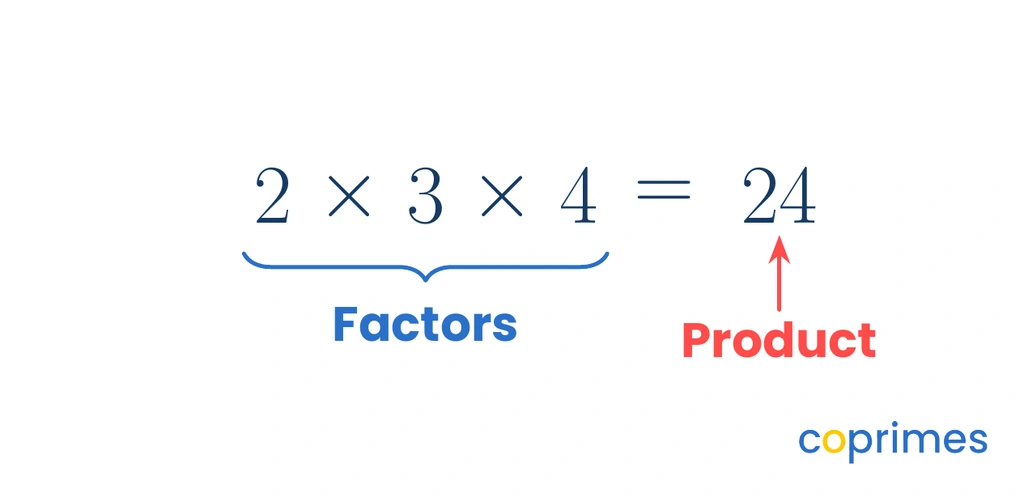
You can have more than two factors in a single calculation. For example, in , the numbers , , and are all factors, and is the product. Mastering these terms makes learning your multiplication facts and times tables much easier.

How order affects the names
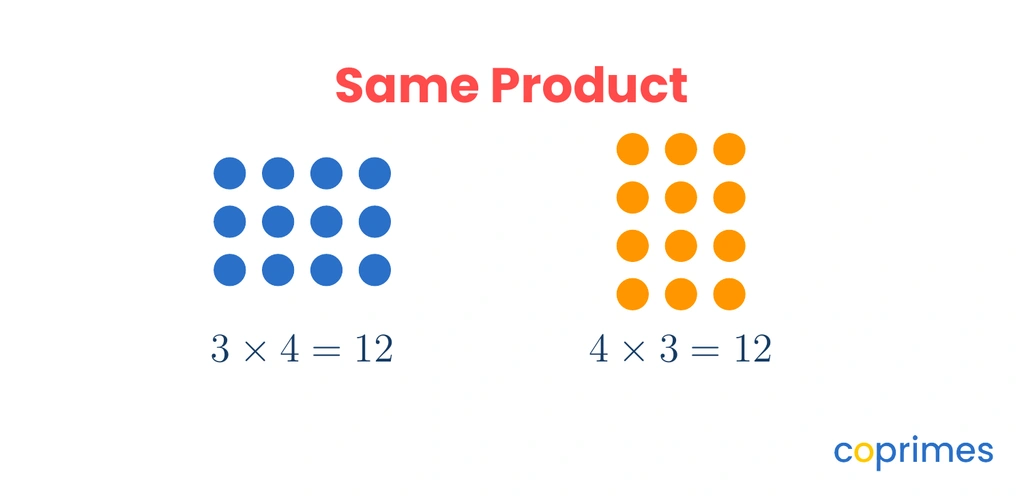
When you change the physical arrangement of the factors in an equation, the resulting product stays exactly the same. For example, and .
This mathematical rule is called the commutative property of multiplication. Because rearranging the values does not alter the final answer, the formal names swap roles depending on how the expression is written.
If you multiply groups of , the multiplier is and the multiplicand is . If you multiply groups of , the multiplier is and the multiplicand is . The product remains either way.
Worked examples
Example 1: Labeling horizontal and vertical equations
Question: Identify the multiplicand, multiplier, and product in the horizontal equation , assuming the first number acts as the multiplier. Then identify the parts in a standard vertical arrangement where is the answer, is the top number, and is the bottom number.
Method:
- For the horizontal equation, map the first value to the multiplier.
- Map the second value to the multiplicand.
- Map the calculated answer to the product.
- For the standard vertical calculation, identify the top number as the multiplicand and the bottom number as the multiplier.
Answer: In , the multiplier is , the multiplicand is , and the product is . In the vertical format, is the multiplicand, is the multiplier, and is the product.
Check: Both equations process the factors and to achieve . The terms are correctly assigned.
Example 2: Identifying parts from an array
Question: An array features rows and columns, containing total dots. Write the multiplication equation using the rows as the multiplier, and name the multiplicand and product.
Method:
- Determine the multiplier: the array has rows.
- Determine the multiplicand: there are columns, representing the items per row.
- Determine the product: the total count is .
- Build the expression in the sequence .
Answer: The equation is . The multiplicand is , and the product is .
Check: Calculating rows of gives , confirming the product is accurate.
Example 3: Solving a missing-factor equation
Question: In the equation , what is the missing multiplicand, and what is the product?
Method:
- Identify the given terms: acts as the multiplier, and is the total product.
- Divide the product by the multiplier to isolate the missing factor: .
- Calculate the division to solve for .
Answer: The missing multiplicand is . The product is .
Check: Multiply the known multiplier by the found multiplicand: . This restores the original statement.
Common mistakes
A frequent error is confusing the product with the sum. The product is the result when you multiply, but the sum is the result when you add. For instance, the product of and is , while their sum is .
Another mistake is ignoring the zero property of multiplication. The product of any number and zero is always zero, never the original number. For example, .
Learners also sometimes mix up the multiplicand and multiplier when setting up word problems. While and calculate to the same product, buying bags containing apples physically differs from buying bags containing apples.
A learning plan shaped by your child, not the class
State-aligned Math plus our own Logic and English curriculum. An adaptive baseline test finds the gaps and fills them.
Frequently asked questions
What does product mean in maths?
In mathematics, a product is the final result obtained when you multiply two or more numbers together. For example, when you multiply and , the product is .
How do you find the product in maths?
To find the product, you multiply the given numbers, which are known as factors. You can calculate them in any order to reach the final answer.
Is the product only used in multiplication?
Yes, the term product specifically identifies the result of a multiplication operation. It is not used to describe the outcome of addition, subtraction, or division.
What is the difference between a factor and a product?
Factors are the individual numbers you multiply together, while the product is the final outcome. In the calculation , the numbers and are the factors, and is the product.
Practice questions
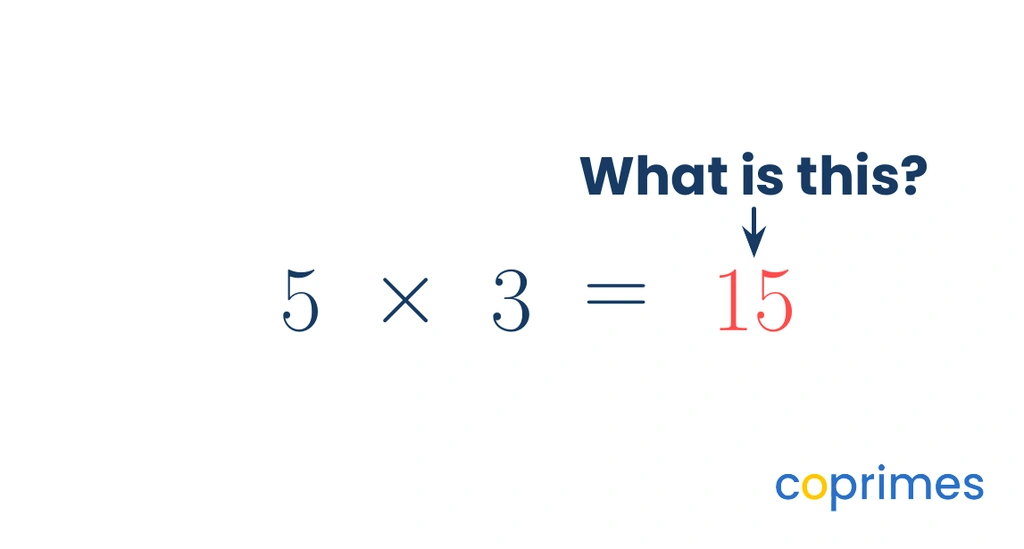
Which term correctly names the labeled part in the visual?
Product
Multiplier
Multiplicand
Sum
Product
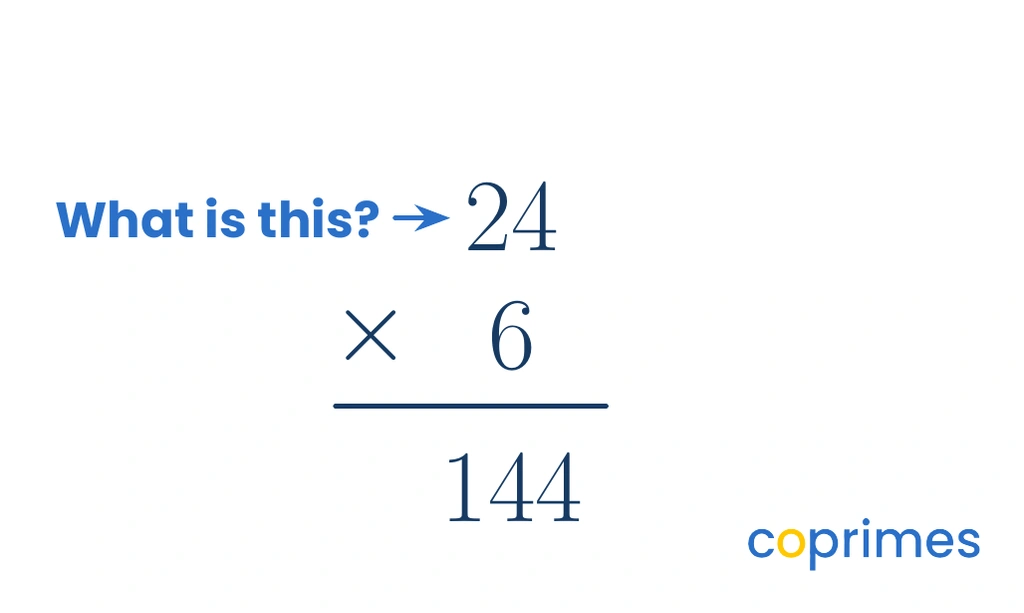
In this vertical calculation, what is the number formally called?
Product
Multiplicand
Multiplier
Difference
Multiplicand
Which two values act as the factors in the equation ?
and
and
and
only
and
What is the product of and ?
A builder places large bricks into each stack. He completes stacks in total. If the equation describing this situation is , which statement correctly identifies the parts?
is the product, and is the multiplier.
is the multiplicand, and is the product.
is the multiplicand, and is the product.
is the multiplier, and is the product.
is the multiplicand, and is the product.