
Multiplication With Regrouping: Methods and Examples
Multiplication with regrouping, often called carrying, is the process of exchanging ten units of one place value for one unit of the next larger place value when a partial product has more than one digit. This method allows us to find the product of larger numbers by organizing digits according to their place values.
What is multiplication with regrouping?
Multiplication with regrouping is an algorithm used when the product of digits in any place-value column is or greater. Because the base-ten number system only allows a single digit from to in each column, the extra value cannot stay in that position.
Instead, the extra value is carried over to the next larger place-value column on the left. The remaining digit is written below the line in the current column. This renaming process continues until all digits in the multiplicand have been multiplied.
Why regrouping works
Regrouping works because our number system is based on groups of ten. Ten ones are equivalent to one ten, and ten tens are equivalent to one hundred.
When a multiplication step produces a result of or more, we separate the value by its place value. For example, if multiplying the ones column yields , that represents tens and ones. The remains in the ones column, while the tens are carried over to join the other tens in the next column.
An alternative way to visualize this process without carrying digits is the area model for multiplication.
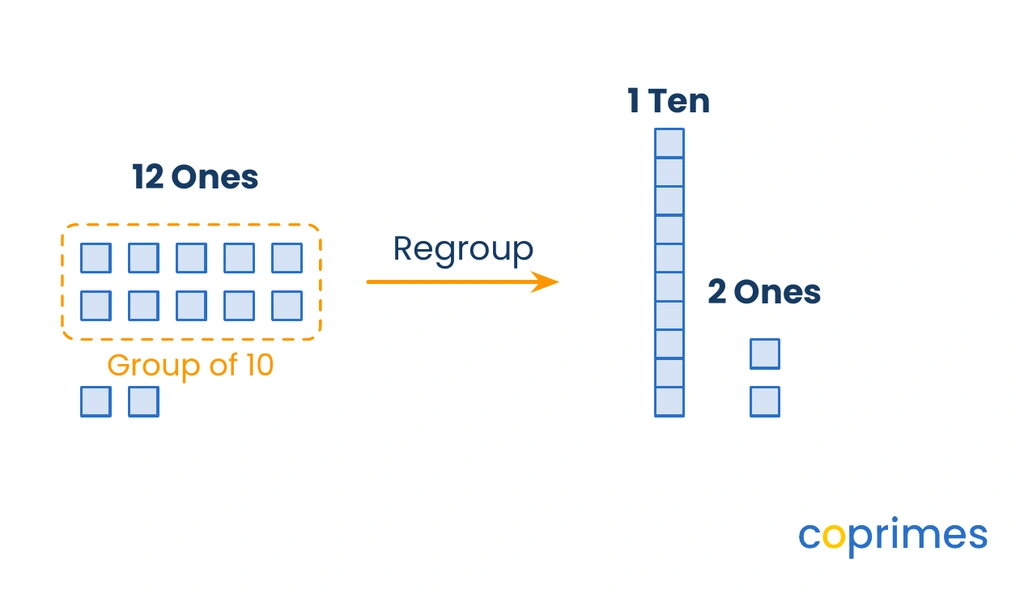
Set up by place value
To multiply accurately, set up the calculation in vertical columns based on place value.
Write the larger number, called the multiplicand, on the top row. Write the smaller number, called the multiplier, on the bottom row. Align the numbers so that their ones digits are in the same vertical column on the far right. The tens and hundreds digits will form their own columns to the left.
Draw a horizontal line below the multiplier to separate the problem from the partial products and the final answer.

Step-by-step method
Before applying this method, it is helpful to master multiplying by 10, 100 and 1,000, as it reinforces how digits shift across place-value columns.
To complete a multiplication problem with regrouping:
- Multiply the bottom digit by the ones digit of the top number.
- If the product is or less, write it below the line in the ones column.
- If the product is or more, write the ones digit below the line and write the tens digit above the next column to the left.
- Multiply the bottom digit by the next digit to the left in the top number.
- Add the carried digit to this new product.
- Write the final sum below the line, carrying again if the sum is or more.
Multiply a multi-digit number by one digit
When multiplying a larger number by a single digit, apply the regrouping steps from right to left.
Multiply the multiplier by the ones digit first, carrying any extra value to the tens column. Then, multiply the multiplier by the tens digit and add the carried value. If the new sum requires regrouping, carry its extra value to the hundreds column. Repeat this cycle until you have multiplied the bottom digit by every digit in the top number.
Once you are comfortable multiplying by a single digit, you can apply the exact same regrouping rules to long multiplication with larger multi-digit numbers.
Worked examples
The following vertical calculations show how carried values are recorded during multiplication.
Example 1: Multiplying a two-digit number
Question: What is ?
Method:
- Setup the numbers vertically.
- Multiply ones by : . Write in the ones column and carry the tens.
- Multiply tens by : .
- Add the carried : . Write below the line.
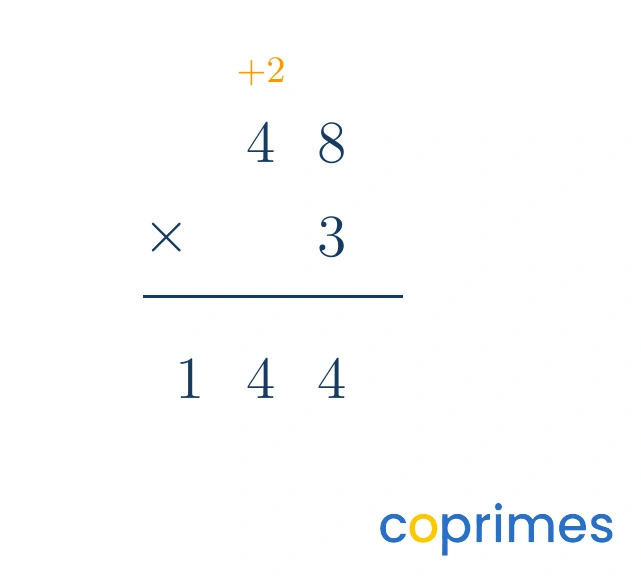
Answer: .
Check: You can estimate using compatible numbers: . The product is close to the estimate.
Example 2: Multiplying a three-digit number
Question: What is ?
Method:
- Multiply ones by : . Write and carry .
- Multiply tens by : .
- Add the carried : . Write and carry .
- Multiply hundred by : .
- Add the carried : . Write .
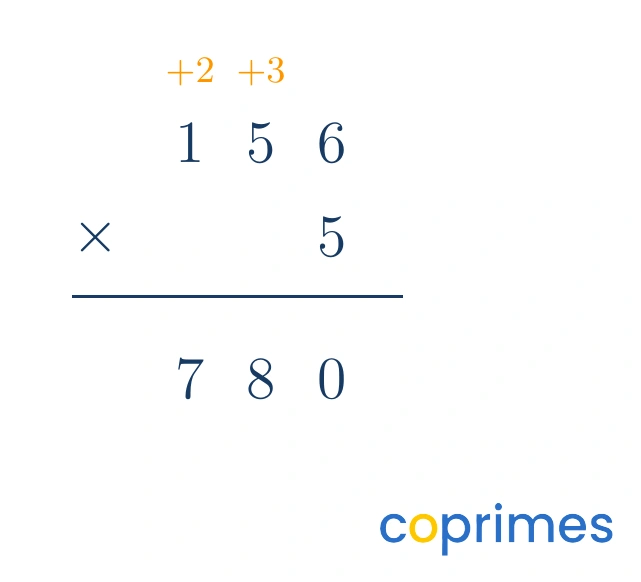
Answer: .
Check: . The answer is reasonable.
Example 3: Carrying to a new place value
Question: What is ?
Method:
- Multiply . Write and carry .
- Multiply .
- Add the carried : .
- Since there are no more digits to multiply, write the complete below the line, placing the in the hundreds column.
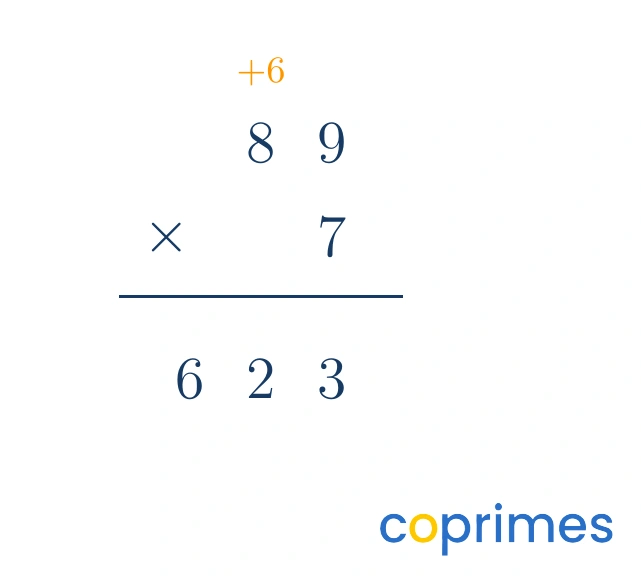
Answer: .
Check: Using compatible numbers: . The product is slightly less, which is exactly correct for .
A learning plan shaped by your child, not the class
State-aligned Math plus our own Logic and English curriculum. An adaptive baseline test finds the gaps and fills them.
Common mistakes
Many mistakes in regrouping occur because the steps are applied in the wrong order.
- Adding before multiplying: A frequent error is adding the carried digit to the top number before performing the multiplication. Always multiply the bottom and top digits first, then add the carried digit to that product.
- Forgetting to add the carried digit: You must remember to add the extra amount you placed above the column. Writing the carried digit clearly and crossing it out after using it can help prevent this mistake.
- Misplacing the carried digit: Always carry the tens digit to the next column on the left, not the ones digit. If the product is , carry the , not the .
Always multiply first, then add the carried digit.
Frequently asked questions
How do I regroup when multiplying two-digit numbers by two-digit numbers?
The regrouping process is exactly the same. You multiply the ones digit of the bottom number across the top number, regrouping as needed. Then, you place a zero as a placeholder in the ones column and multiply the tens digit of the bottom number across the top number, regrouping again as needed. Finally, you add the two partial products together.
How does regrouping work with decimal numbers?
When multiplying with decimals, you apply the same regrouping steps as whole numbers. Ignore the decimal point while multiplying. After you find the final product, count the total number of decimal places in both original numbers, and place the decimal point in the answer so it has the same number of decimal places.
How can I be sure my regrouped answer is correct?
You can verify your final product by checking multiplication and division relationships. Divide your final answer by the multiplier; if the result matches the multiplicand, your calculation is correct.
Practice questions
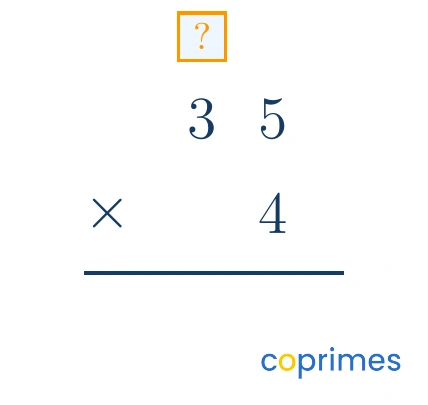
In the multiplication of , what digit should be carried to the tens column?
What is the final product of ?
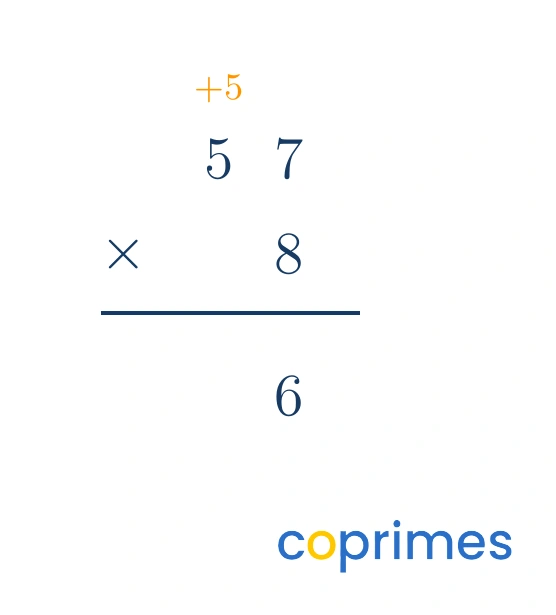
When multiplying , you find that . You write the in the ones column and carry the . What are the correct next steps to find the final digits for the tens and hundreds columns?
Multiply by to get , then add the carried to get .
Add the carried to the top to get , then multiply by to get .
Multiply by to get , then add to get .
Multiply by to get , and do not add the carried digit.
Multiply by to get , then add the carried to get .
A student multiplies and gets a product of . Which mistake caused this incorrect answer?
They added the carried digit to the tens place before multiplying by .
They multiplied the tens place incorrectly but added the carried digit properly.
They carried the wrong digit from the ones place.
They forgot to add the carried digit to the tens place.
They added the carried digit to the tens place before multiplying by .
A bakery packs cookies into each box. If they fill boxes, how many cookies are packed in total?