
Understanding Multiplying by 10, 100 and 1,000
Multiplying by , or makes each digit worth ten, one hundred or one thousand times as much through place-value shifts.
When you learn multiplication, understanding how to multiply by multiples of unlocks mental mathematics and helps you scale numbers quickly.
What happens when you multiply by 10, 100 and 1,000?
Every time a number is multiplied by , its overall value increases tenfold.
Because of how our number system works, this means every digit shifts one place to the left.
Multiplying by is the same as multiplying by twice, so the digits shift two places to the left.
Multiplying by is the same as multiplying by three times, so the digits shift three places to the left.
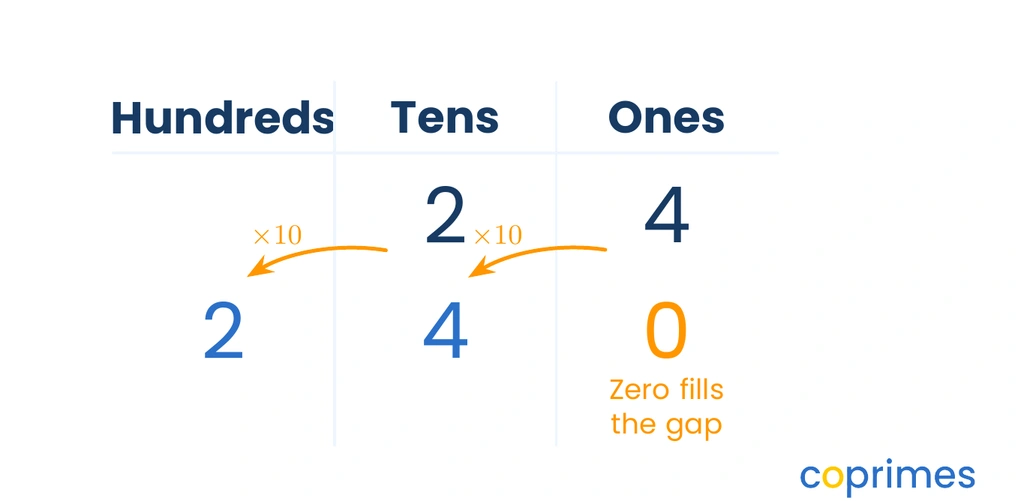
Place-value explanation
The base-ten number system relies entirely on place value.
Each column on a place-value chart is exactly ten times larger than the column to its right.
When you multiply a number by , every single part of that number becomes ten times larger.
For example, tens becomes hundreds, and ones becomes tens.
Moving one place to the left multiplies a digit's value by ten.
Whole-number patterns
When multiplying whole numbers by , or , a visual pattern emerges.
Because the numbers shift left, empty spaces are created on the right side of the number before the decimal point.
These spaces must be filled with zeros to hold the new place values.
- Multiplying by requires zero to fill the empty ones column.
- Multiplying by requires zeros to fill the empty tens and ones columns.
- Multiplying by requires zeros to fill the empty hundreds, tens and ones columns.
Multiplication | Digits Shifted Left | Zeros Needed on the Right | Example |
place | zero | ||
places | zeros | ||
places | zeros |

Use a place-value chart
A place-value chart keeps digits organized, especially when the starting number contains a zero.
A zero inside a number is an internal zero, and it must shift left just like any other digit.
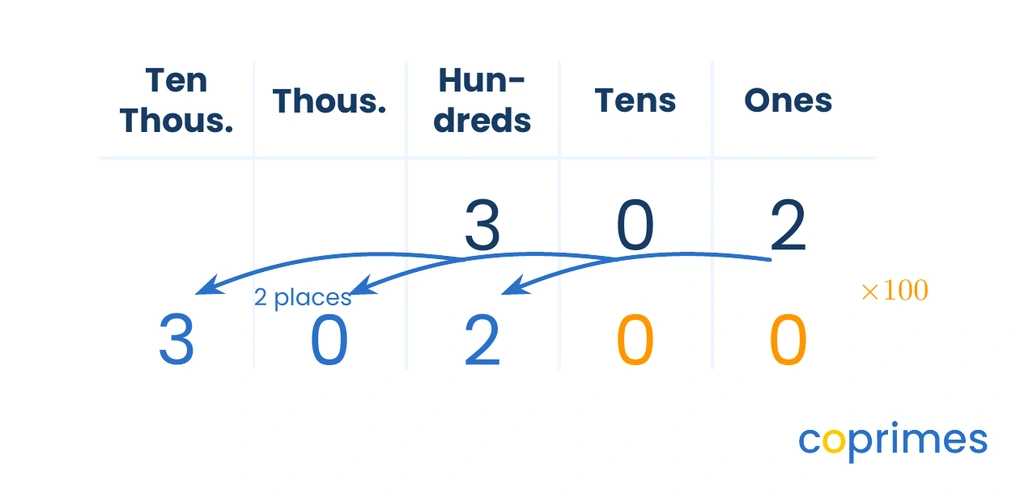
When calculating , the digits shift two places to the left.
The internal zero moves from the tens column to the thousands column, preserving the correct value. Two new zeros fill the empty tens and ones columns on the right.
Why adding zeros is not the rule
Many students memorize the whole-number pattern as "just add a zero to the end."
While this shortcut seems to work for whole numbers, it fails completely when multiplying decimals.
If you multiply by and simply attach a zero to the end, you get . The number is exactly the same value as . You have not multiplied the number at all.
Instead, apply the true rule: shift the digits one place to the left.
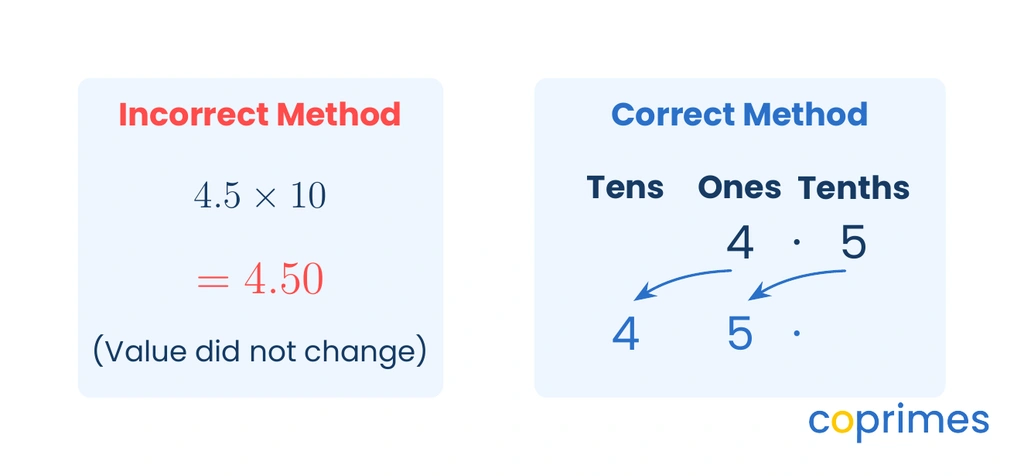
By shifting the digits one place to the left, ones become tens, and tenths become ones. The correct answer is .
Worked examples
Example 1: Retaining internal zeros
Question: Calculate .
Method:
- Identify the multiplier. Multiplying by requires a one-place shift to the left.
- Shift all digits one place to the left. The shifts to thousands, the shifts to hundreds, and the shifts to tens.
- Fill the empty ones column with a zero.
Answer: The result is .
Check: We shifted three digits left and added one zero. The internal zero is still present in the final number.
Example 2: Multiplying by 100
Question: Calculate .
Method:
- Multiplying by means shifting the digits two places to the left.
- The moves from tens to thousands. The moves from ones to hundreds.
- Place two zeros in the empty tens and ones columns.
Answer: The result is .
Check: We shifted two columns over, which matches the expected whole-number pattern of placing two zeros at the end.
Example 3: Multiplying by 1,000
Question: Calculate .
Method:
- Multiplying by requires shifting all digits three places to the left.
- The shifts from tens to ten thousands. The shifts from ones to thousands.
- Fill the remaining hundreds, tens and ones columns with three zeros.
Answer: The result is .
Check: The number scaled up correctly by three place values.
A learning plan shaped by your child, not the class
State-aligned Math plus our own Logic and English curriculum. An adaptive baseline test finds the gaps and fills them.
Common mistakes
Losing internal zeros
When shifting a number like by , you must keep the zero between the and the . Shifting makes it . If you drop the zero, you incorrectly end up with .
Adding zeros to decimals
Remember that writing is the exact same amount as . When multiplying a decimal by , you must physically shift the digits left relative to the decimal point to reach the correct answer of .
Miscounting place-value shifts
When calculating , students sometimes shift the number three places instead of two. Use a place-value chart to track the moves accurately: times is one shift, times is two shifts, and times is three shifts.
Frequently asked questions
What happens when you multiply by ?
The same rule applies. Multiplying by shifts the digits four places to the left, and multiplying by shifts them five places to the left. The pattern extends infinitely.
Does this rule apply to division?
Yes, but in reverse. When dividing by , or , the digits shift to the right, decreasing the value of the number.
How does this relate to powers of ten?
The numbers , and are all powers of ten. Multiplying by (which is ) shifts digits two places, while multiplying by (which is ) shifts digits three places.
What should I learn after this?
Once you can smoothly multiply by , and , you are ready to apply these shortcuts to multiplication with regrouping. Understanding place-value shifts makes large multi-digit problems much faster to solve.
Practice questions
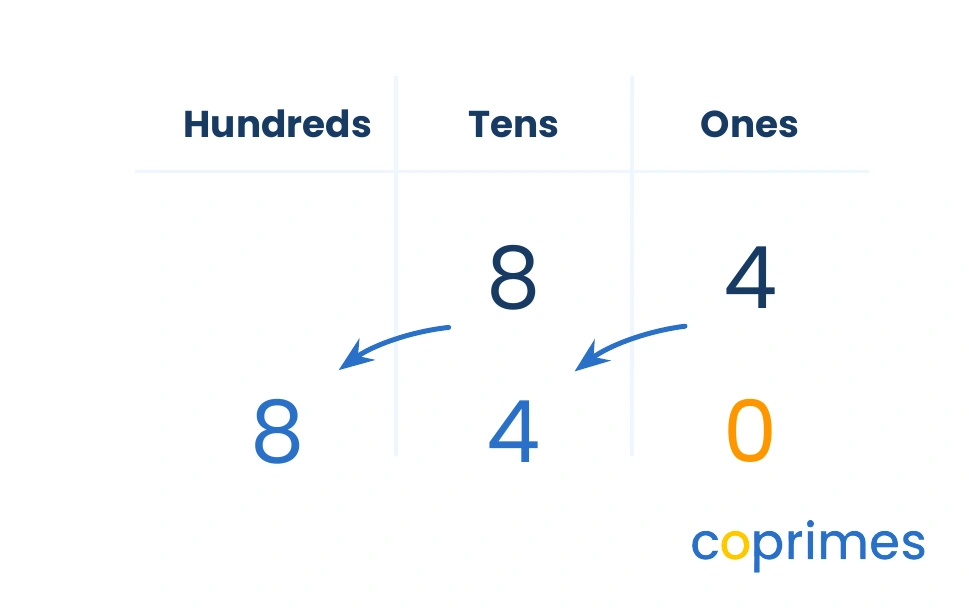
Which operation does this place-value chart represent?
What is the result of ?
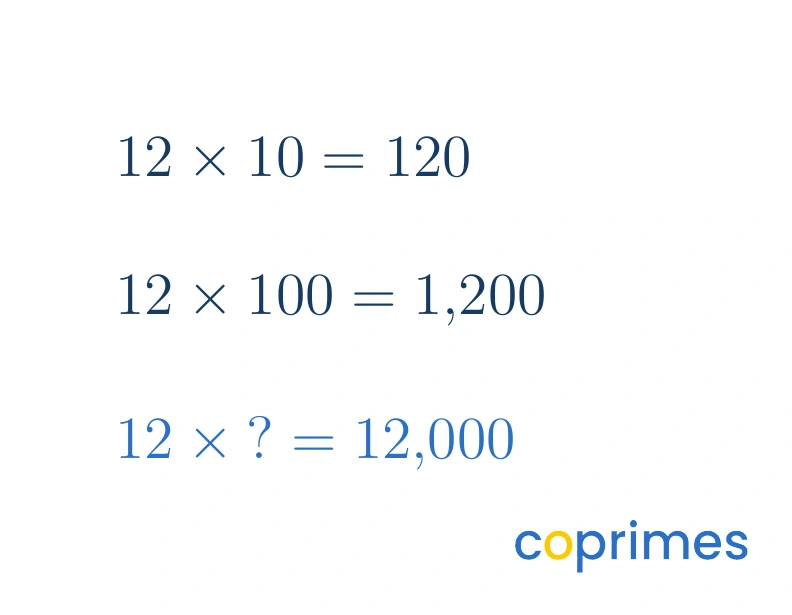
Look at the pattern in the visual. What number completes the final equation?
What happens when you multiply the decimal by ?
A zero is added to the end, making the result .
The digits shift one place left, making the result .
The digits shift two places left, making the result .
The digits shift one place right, making the result .
The digits shift one place left, making the result .
A school buys packages of markers. Each package contains markers. How many markers did the school buy in total?