
Even and Odd Numbers: Definitions and Rules
An even integer is divisible by with no remainder; an odd integer leaves a remainder of when divided by . Understanding even and odd numbers helps with grouping, division, and identifying predictable patterns in mathematics.
What Are Even and Odd Numbers?
Even and odd numbers classify integers based on their divisibility by . This mathematical classification is called parity.
An even number can be divided into two perfectly equal groups without any leftovers. When an even number is divided by , the remainder is always .
An odd number cannot be divided into two equal integer groups. When an odd number is divided by , there is always a remainder of .
Every integer is either even or odd, but no integer can be both.
Key Ideas and Vocabulary
The easiest way to determine the parity of any integer is to look at its ones digit.
- Even numbers always end in , , , , or .
- Odd numbers always end in , , , , or .
This rule works for both positive and negative numbers. For example, ends in a , so it is even. The number ends in a , so it is odd.
Parity applies to all integers. Zero is an even number because dividing by yields a quotient of with a remainder of . It is the first of the non-negative whole numbers, while the positive counting or natural numbers alternate starting with , which is odd.
Algebraically, mathematicians write the general form of an even number as , where is any integer. The general form of an odd number is or .
Visual Explanation
Visualizing numbers as arrays of paired objects quickly reveals whether they are even or odd.
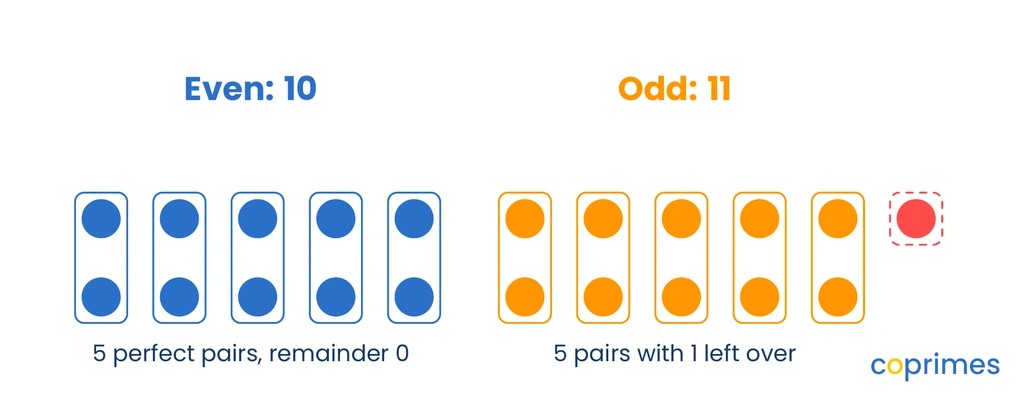
If a set of objects can be arranged into pairs with nothing left over, the total count is even. If exactly one object is left unpaired, the total count is odd.
On a number line, even and odd integers alternate perfectly. If you start at and jump by in either direction, you land exclusively on even numbers.
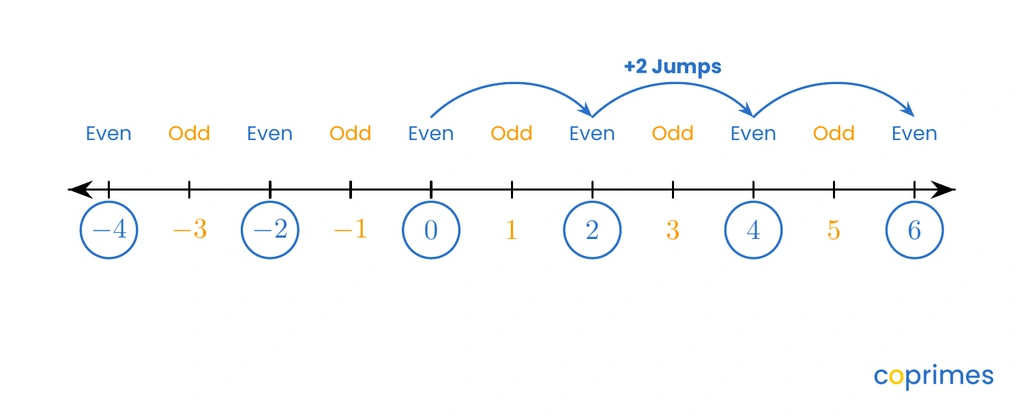

Rules for Parity Operations
When combining integers, predictable parity patterns emerge. These rules help check answers without completing full calculations.
Adding or subtracting two even numbers always produces an even result. This demonstrates the closure property of even numbers under addition and subtraction. Adding or subtracting two odd numbers also produces an even result, because the two remainders of combine to form a new complete pair.
Addition and Subtraction | Result | Example |
Even + Even | Even | |
Odd + Odd | Even | |
Even + Odd | Odd |
Multiplying integers follows its own logic. An even number multiplied by any integer results in an even number. An odd number multiplied by another odd number is the only way to produce an odd product.
Multiplication | Result | Example |
Even Even | Even | |
Even Odd | Even | |
Odd Odd | Odd |
Worked Examples
Apply the definitions and rules to solve these common parity problems.
Example 1: Identifying even and odd digits
Question: Which of the following numbers are even? , , , ,
Method:
- Look only at the ones digit of each number.
- If the digit is , , , , or , the number is even; if it is , , , , or , it is odd.
- The number ends in , so it is odd.
- The number ends in , so it is even.
- The number ends in , so it is odd.
- The number is perfectly divisible by , so it is even.
- The number ends in , so it is even.
Answer: The even numbers are , , and .
Check: Divide each even number by . The results (, , and ) are integers with no remainders.
Example 2: Determining the parity of a sum
Question: Without calculating the exact sum, is even or odd?
Method:
- Identify the parity of the first number. The number ends in , so it is odd.
- Identify the parity of the second number. The number ends in , so it is odd.
- Apply the parity rules for addition. The sum of two odd numbers is always an even number.
Answer: The sum is even.
Check: Calculate the exact sum: . The number ends in , confirming it is even.
Example 3: Consecutive even numbers
Question: The sum of three consecutive even numbers is . What are the three numbers?
Method:
- Use the general algebraic form for even numbers, setting the first number as .
- Write the next two consecutive even numbers as and .
- Set up the equation for their sum: .
- Combine the like terms to simplify the equation: .
- Subtract from both sides to isolate the variable term: .
- Divide by to solve for , which gives .
- Substitute back into the original expressions: , , and .
Answer: The three numbers are , , and .
Check: Verify that they are consecutive even numbers and add them together: . The solution is correct.
Common Mistakes and Non-Examples
A frequent misconception is assuming that parity applies to all types of numbers. Even and odd classifications apply only to integers.
Fractions, such as , and decimals are non-examples of parity. For instance, is neither even nor odd. Although it ends in a , the parity rule for the last digit only applies to whole integers, not to tenths or hundredths.
Another common mistake is claiming that negative numbers cannot be even or odd. Parity is symmetric around zero. The number is even because with a remainder of .
A learning plan shaped by your child, not the class
State-aligned Math plus our own Logic and English curriculum. An adaptive baseline test finds the gaps and fills them.
Real-World Connections
Even and odd numbers organize daily tasks. For instance, creating equal sports teams without leftover players requires an even number of participants.
Digital systems and computer programming rely heavily on parity. A "parity bit" is an extra binary digit added to data to ensure the total number of -bits is either consistently even or odd. This acts as an automated answer-check method to detect transmission errors.
Street addresses also use parity. In many cities, houses on one side of a street are assigned even numbers, while houses on the opposite side receive odd numbers, making navigation logical and predictable.
Practice questions
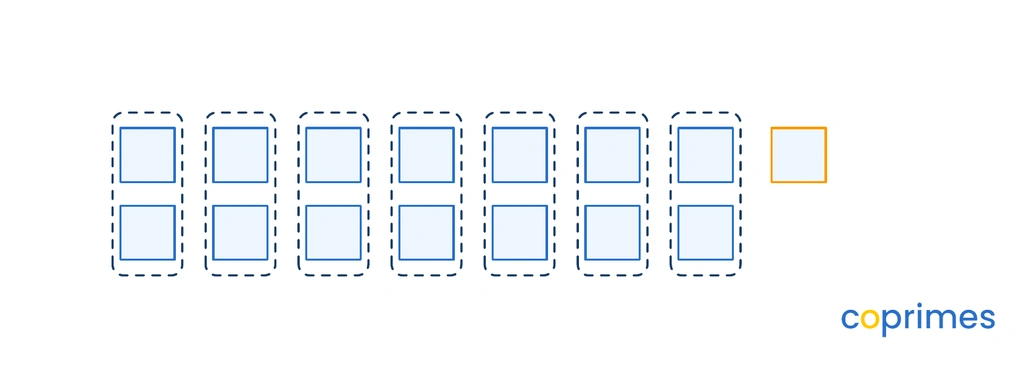
Based on the grouping in the visual, what is the parity of the total number of blocks?
Even, because the blocks can be divided into equal rows.
Even, because is perfectly divisible by .
Odd, because there are exactly pairs with block left unpaired.
Odd, because all of the blocks are perfectly paired.
Odd, because there are exactly pairs with block left unpaired.
Which of the following numbers is an even integer?
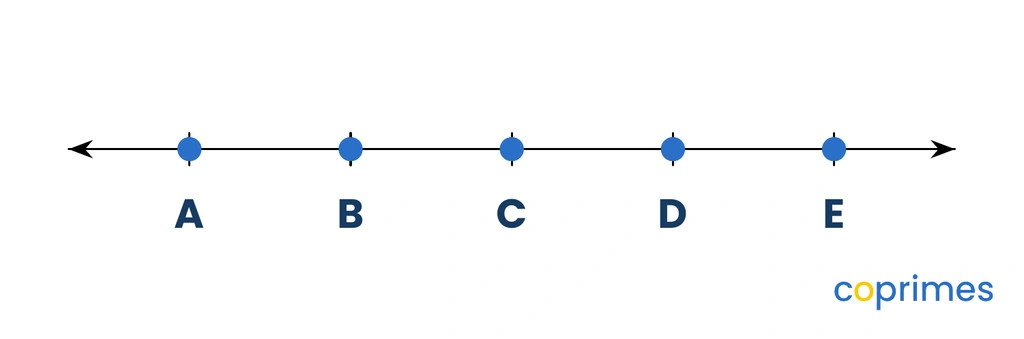
The number line shows five consecutive integers. If point represents an odd number, which point represents an even number?
Point
Point
Point
None of these
Point
If is an even integer and is an odd integer, which expression always results in an even integer?
A teacher wants to divide students into two perfectly equal teams. Why is this impossible?
Because ends in , which makes it an even number.
Because is a fraction, not a whole integer.
Because leaves a remainder of , meaning it is an odd number.
Because zero is an even number.
Because leaves a remainder of , meaning it is an odd number.