
Whole Numbers: Guide and Examples
Whole numbers are and the positive counting numbers, with no negative, fractional, or decimal part.
They represent complete, undivided quantities. In mathematics, the set of whole numbers is foundational for arithmetic operations and forms the basis for more complex number systems.
What Is Whole Numbers?
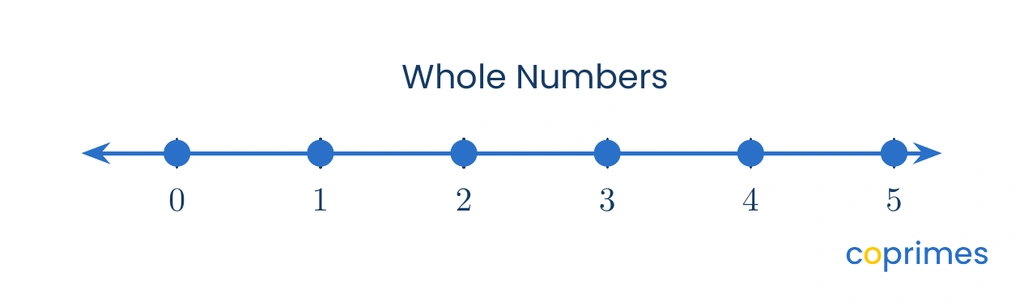
The set of whole numbers includes . It begins at zero and increases by one continuously without end. They are often referred to as nonnegative integers.
Whole numbers never include partial values like halves or quarters, and they never fall below zero. They are closely related to natural numbers, which are the counting numbers . The only difference between the two sets is that whole numbers include the number .
Key Ideas and Vocabulary
Whole numbers follow specific mathematical rules when you add or multiply them. They can also be classified into even and odd numbers.
The mathematical rules that apply to whole numbers include:
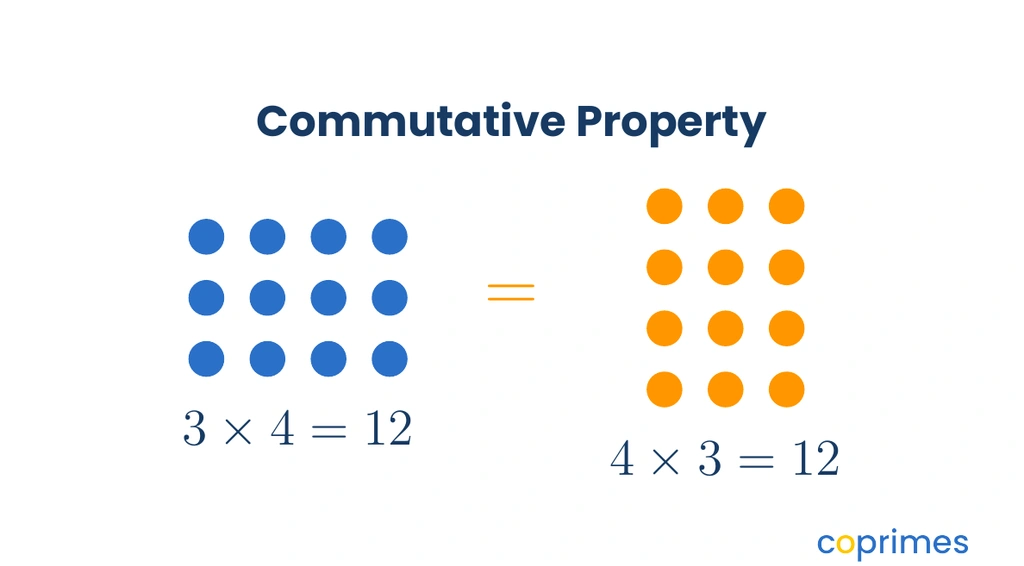
- Commutative Property: The order in which you add or multiply two whole numbers does not change the result. For example, , and .
- Associative Property: The way you group three or more whole numbers during addition or multiplication does not affect the final answer. For example, .
- Distributive Property: Multiplying a whole number by a sum is the same as multiplying it by each part of the sum and then adding the results. For example, .
- Closure: The closure property states that adding or multiplying any two whole numbers will always produce another whole number.
The closure property applies to addition and multiplication, but not subtraction or division.
Visual Explanation
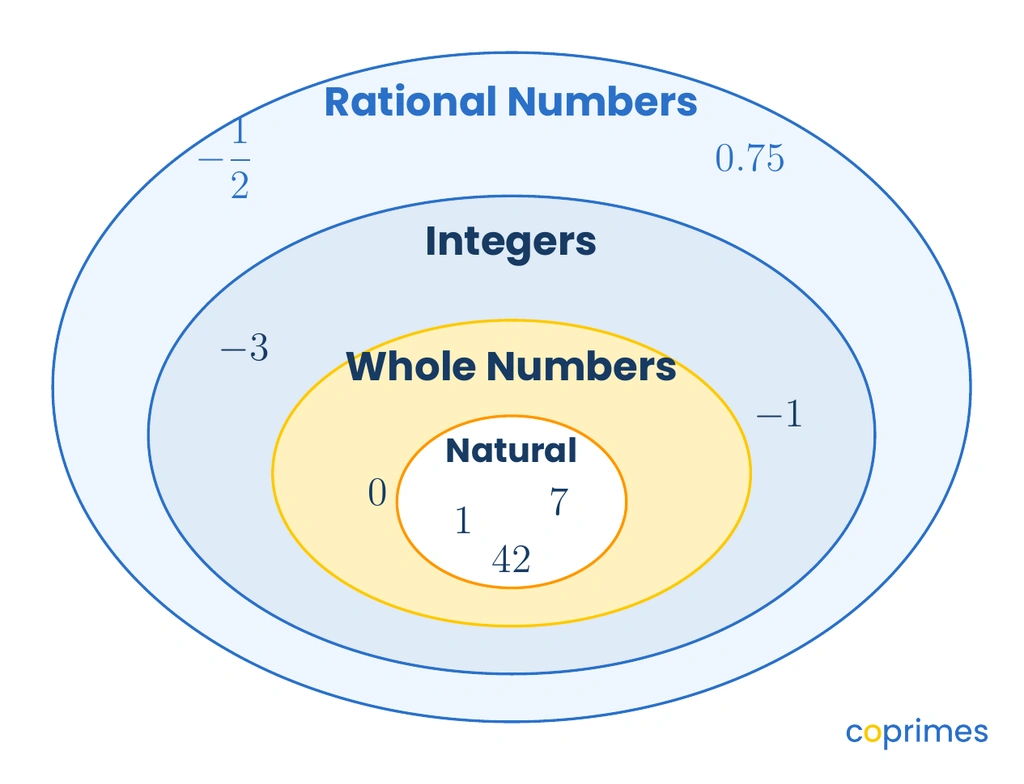
Number sets build on one another. Whole numbers include all natural counting numbers, but they also introduce zero as a valid value representing an empty quantity.
When exploring positive and negative numbers, you encounter integers. Whole numbers fit entirely inside the set of integers because every whole number is an integer, but negative integers are not whole numbers.

Worked Examples
To identify whole numbers or use their properties, check whether a value contains fractional parts, decimals, or negative signs.
Example 1: Identifying whole numbers in a list
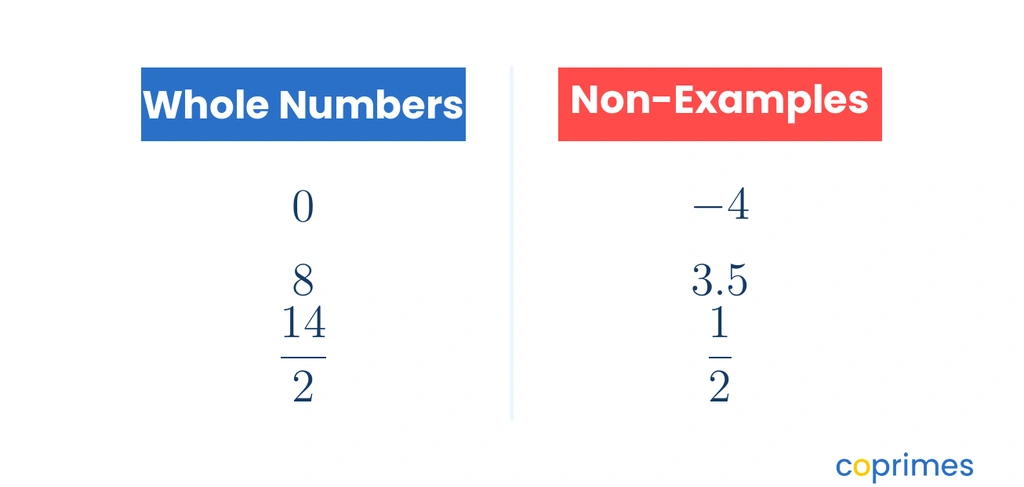
Question: Which numbers in the list , , , , and are whole numbers?
Method:
- Review the definition of whole numbers: they must be non-negative and contain no fractional or decimal parts.
- Eliminate negative numbers: remove .
- Eliminate decimals and fractions: remove and .
- Identify the remaining numbers: and .
Answer: The whole numbers are and .
Check: Both and represent complete counting quantities without negative signs.
Example 2: Applying the distributive property
Question: What whole number fills in the blank to make the equation true?
Method:
- Recall the distributive property: .
- Match the given values to the formula: , , and .
- Distribute the to both terms inside the parentheses: .
- The missing value is .
Answer: The missing whole number is .
Check: Calculate both sides. Left side: . Right side: . The results match.
Example 3: Interpreting values on a number line
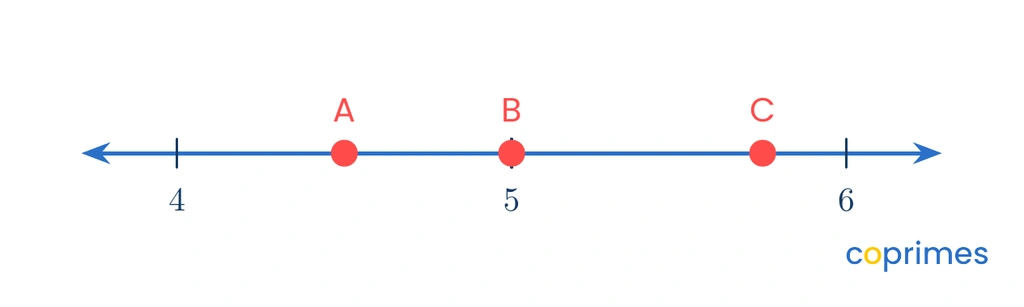
Question: Which point on the number line represents a whole number?
Method:
- Look at the position of each point relative to the whole numbers marked on the line.
- Point A is halfway between and , representing , which is a decimal.
- Point B is located exactly on the tick mark for .
- Point C is between and , representing a fractional value.
Answer: Point B represents the whole number .
Check: Because has no fractional part and is greater than zero, it perfectly satisfies the definition of a whole number.
Common Mistakes and Non-Examples
It is easy to confuse whole numbers with other number types if you ignore zero or negative signs.
A frequent mistake is forgetting that is a whole number. While natural numbers start at , the set of whole numbers must always begin with .
Another common misconception is assuming that all fractions and decimals are non-examples. While it is true that partial values are not whole numbers, a fraction can sometimes disguise a whole number. For instance, equals , making it a whole number despite its fractional appearance.
Negative numbers are never whole numbers, even if they have no decimal part.
Always simplify numerical expressions fully before determining if they belong to the whole number set.
Real-World Connections
Whole numbers are primarily used for counting distinct objects where partial quantities do not make sense.
If you are counting the number of students in a classroom, cars in a parking lot, or pages in a book, you naturally use whole numbers. You cannot have students or pages. Zero represents the complete absence of an item, which is a practical starting point in many everyday situations.
Measurements, on the other hand, frequently involve continuous quantities like length, weight, and temperature. These scenarios often require decimals, fractions, or negative integers to be precise, rather than relying solely on whole numbers.
A learning plan shaped by your child, not the class
State-aligned Math plus our own Logic and English curriculum. An adaptive baseline test finds the gaps and fills them.
Practice questions
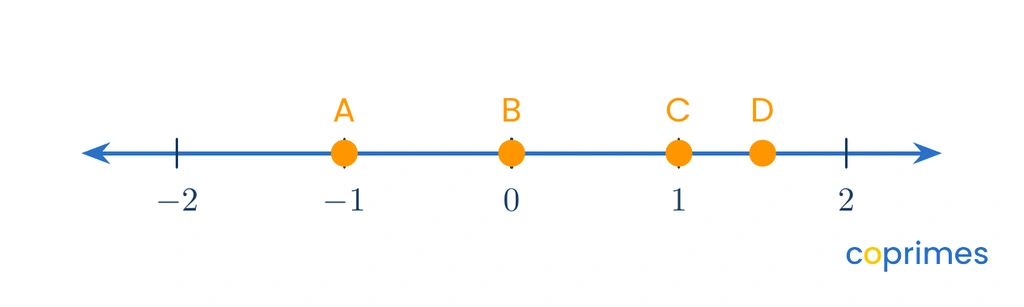
Which point on the number line represents the smallest whole number shown?
Point A
Point B
Point C
Point D
Point B
Which of the following lists contains only whole numbers?
Which mathematical property is shown by the equation ?
Associative property
Commutative property
Distributive property
Closure property
Commutative property
Which expression simplifies to a whole number?
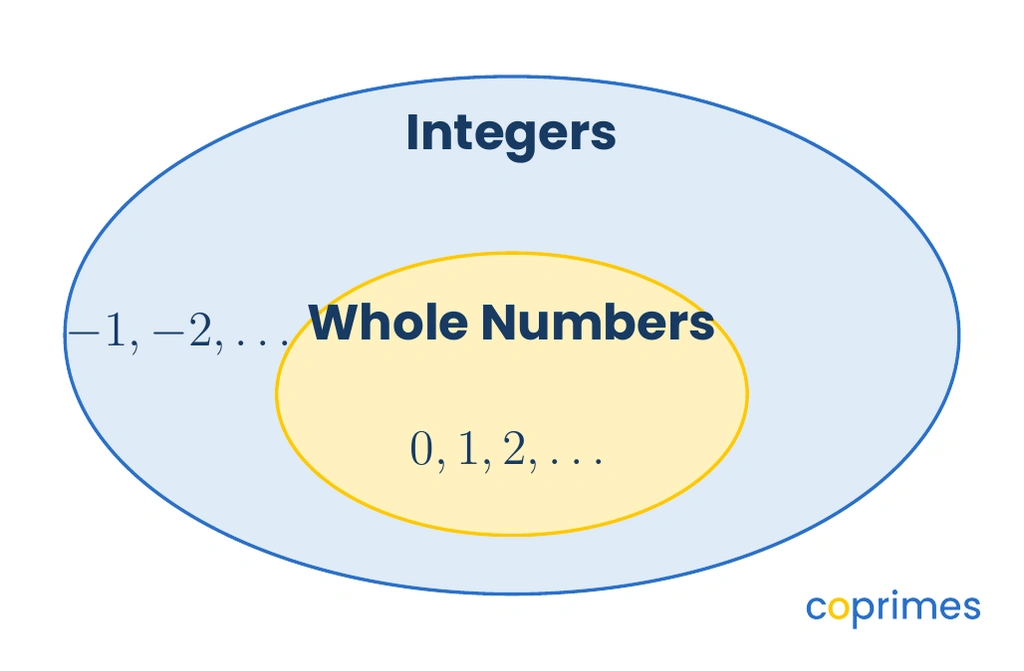
Look at the set diagram. Which statement correctly describes the relationship shown?
All integers are whole numbers.
All whole numbers are integers.
Whole numbers and integers are entirely separate sets.
Whole numbers include negative values.
All whole numbers are integers.