
Divisibility Rules: Guide and Examples
Divisibility rules are quick tests that determine whether one whole number divides another exactly without performing full division. A number is divisible by a second number if dividing them leaves a remainder of zero. These rules save time by using digit patterns, sums, and place-value properties instead of calculating long division.
Divisibility means a number can be split into equal groups with no remainder.
Divisibility Rules: Definition and Notation
A divisibility rule is a shortcut to discover whether a number is a factor of a larger number. When checking if a number divides perfectly without performing the division mathematically, we use these rules to inspect the number's individual digits.
In mathematics, a vertical bar symbol is used to denote divisibility. The notation is read as " divides ." This means that is divisible by , leaving a remainder of zero. If a number does not divide perfectly, we write a slashed bar, such as , which means " does not divide ."
Understanding these tests helps to quickly identify factors, simplify fractions, and determine whether a number is prime.
Rules or Reference Table
Different numbers have different tests based on their patterns. Some rules examine only the final digit, some check the sum of all digits, and others combine multiple rules.
Here is the reference table for the most common divisibility rules from to :
Divisor | Divisibility Rule | Example |
The last digit is even (). | is divisible by . | |
The sum of all digits is divisible by . | (divisible by ). | |
The last two digits form a number divisible by . | is divisible by . | |
The last digit is or . | is divisible by . | |
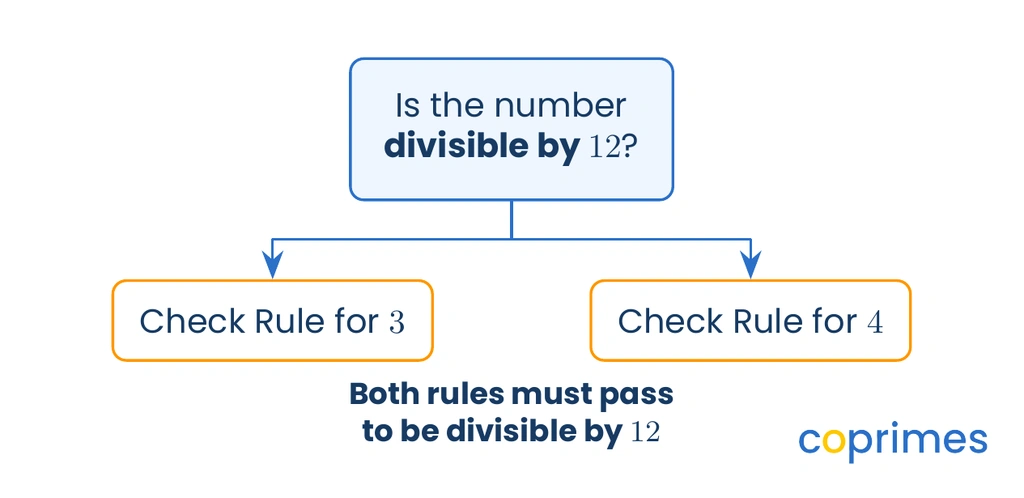
The number is divisible by both and . | is even and . | |
The last three digits form a number divisible by . | is divisible by . | |
The sum of all digits is divisible by . | (divisible by ). | |
The last digit is . | is divisible by . | |
The alternating sum and difference of the digits is or a multiple of . | . | |
The number is divisible by both and . | sum is (yes for ), ends in (yes for ). |
When a rule asks to check two other numbers (like the rule for checking and ), those two numbers must be coprime, meaning they share no common factors other than .
Why It Works
Divisibility rules work reliably because of the properties of the base-ten number system and place value.
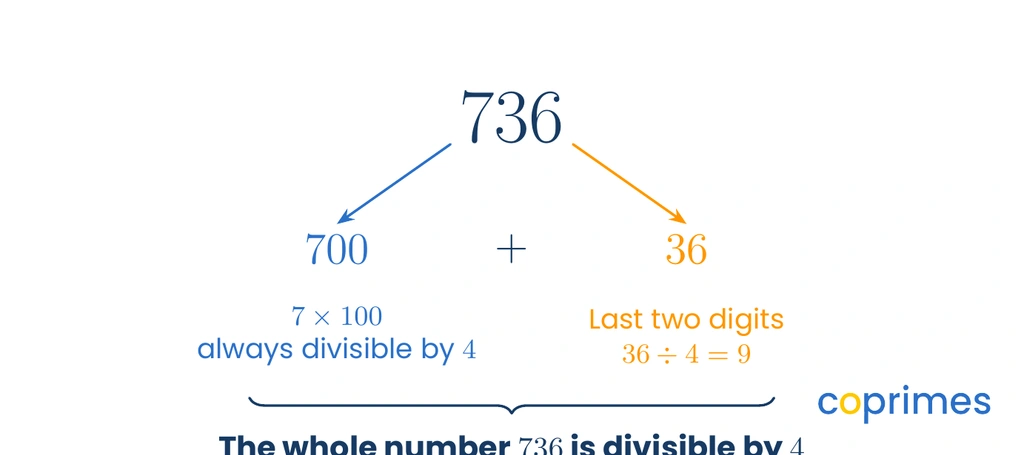
For example, when checking divisibility by , we only look at the last two digits. Why? Because every hundred is a multiple of , and is perfectly divisible by ().
Any number of hundreds, thousands, or millions will also be perfectly divisible by . The only part of the number that might not divide perfectly is the remainder formed by the tens and ones digits.
The structure of place value means large portions of a number are guaranteed to be divisible by certain factors.
Similarly, the rule for and works because every power of is exactly one more than a multiple of (, ). The multiples of are discarded, and only the sum of the remaining single digits needs to be tested to determine divisibility.
A learning plan shaped by your child, not the class
State-aligned Math plus our own Logic and English curriculum. An adaptive baseline test finds the gaps and fills them.
Visual Worked Examples
Using these tests prevents unnecessary long division and ensures accuracy.
Example 1: Divisibility by 9
Question: Is divisible by ?
Method:
- Find the sum of all digits in the number.
- The sum is .
- Calculate the total: .
- Check if is divisible by . Since , the rule passes.
Answer: Yes, is divisible by .
Check: , leaving no remainder.
Example 2: Composite rule
Question: Is divisible by ?
Method:
- A number is divisible by if it is divisible by both and .
- Check the rule for : The last digit is , which is even. The rule for passes.
- Check the rule for : Sum the digits .
- Since , the rule for passes.
- Because both rules pass independently, the entire number is divisible by .
Answer: Yes, is divisible by .
Check: .
Example 3: Alternating sum for 11
Question: Is divisible by ?
Method:
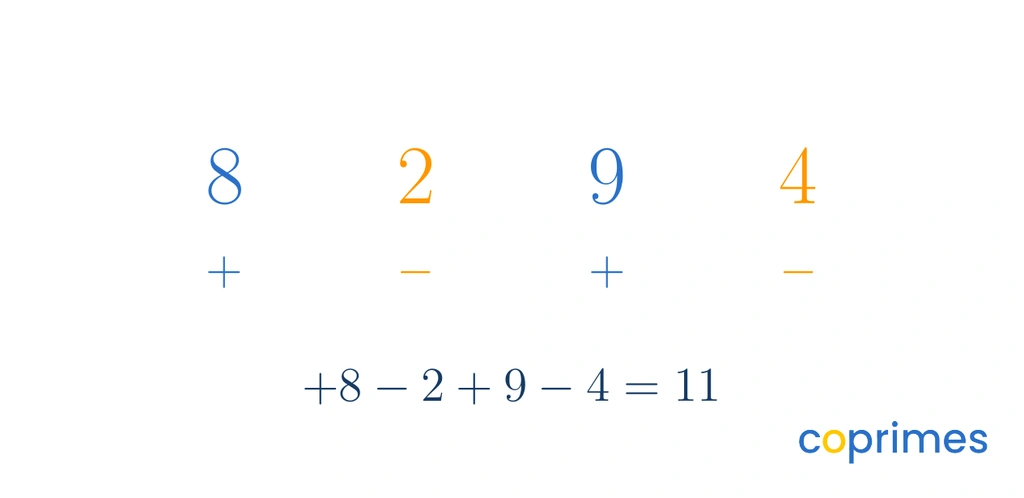
- The rule for requires an alternating sum. Add and subtract the digits in order from left to right.
- The sequence is: .
- Calculate the result step by step: , , .
- If the final answer is or a multiple of , the number is divisible by . The result is , which passes the test.
Answer: Yes, is divisible by .
Check: .
Common Mistakes and Exceptions
A frequent mistake is applying the rule for or to other numbers. Because divisibility by depends only on the last digit, some learners mistakenly assume that any number ending in is divisible by , or any number ending in is divisible by .
The rule for strictly requires checking the last two digits combined as a single number, not just the final digit alone.
Another common error happens when testing for divisibility by composite numbers like and . The factors used in a composite rule must be coprime. For example, testing for works by checking and (since they share no factors other than ).
You cannot test for by checking and , because and share a common factor of . The number is divisible by both and , but it is not divisible by .
Applications
Understanding these tests is highly useful when simplifying mathematical fractions and finding common denominators.
When searching for the factors of a number, applying divisibility rules guarantees that no factor is missed. They are incredibly helpful for distinguishing prime vs composite numbers. If any divisibility test (other than and the number itself) succeeds, you have successfully proven that the number is a composite number.
These rules also speed up finding the prime factorization of large values. Instead of guessing factors randomly when constructing a factor tree, you can immediately apply the tests for , , or to confidently discover the prime branches of your tree.

Practice questions

Based on the array model of items, which statement is true regarding divisibility?
is divisible by because it forms rows of .
is divisible by because there are full rows.
is not divisible by because there is a remainder of .
is perfectly divisible by because the remainder is .
is not divisible by because there is a remainder of .
Which of the following numbers is divisible by ?
A five-digit number is written as , where the last digit is missing. Which single digit can be placed in the box to make the number divisible by ?
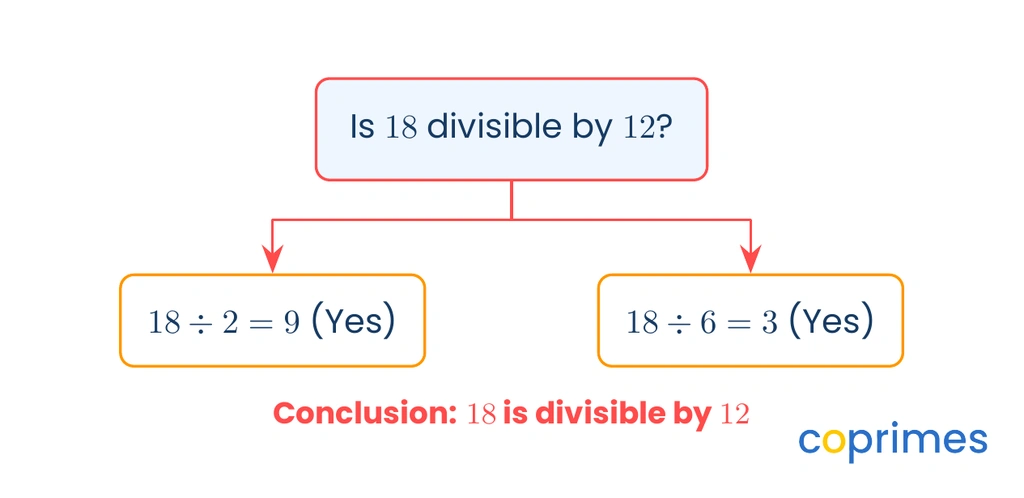
A student uses the flowchart above to test if is divisible by . They conclude that because is divisible by both and , it must be divisible by . Why is this reasoning mathematically incorrect?
The student calculated the division for and incorrectly.
A number can never be tested for divisibility using two smaller factors.
The factors and are not coprime, so they cannot be used to test for .
is actually divisible by , so the flowchart conclusion is true.
The factors and are not coprime, so they cannot be used to test for .
Which of the following numbers is divisible by both and ?