
What Are Composite Numbers? Definition, Examples, and Identification
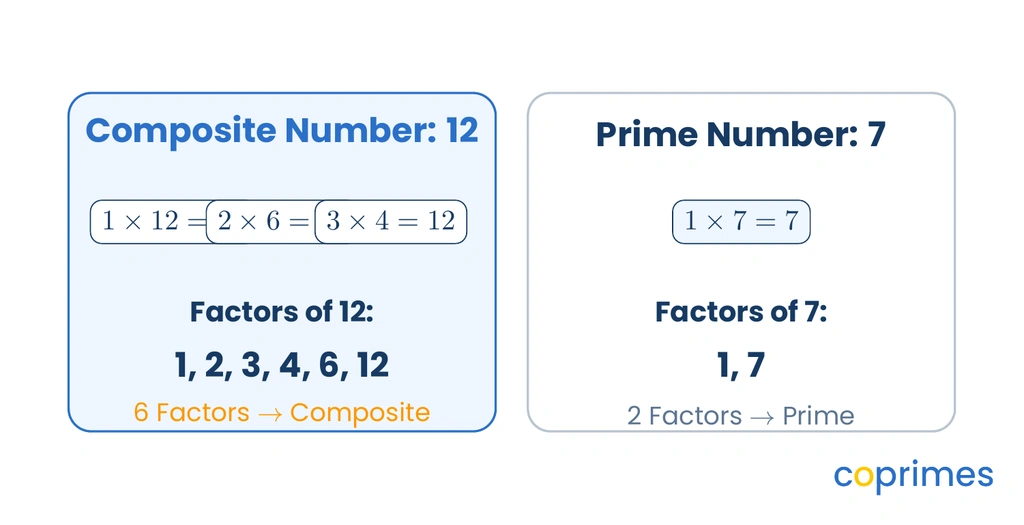
A composite number is a whole number greater than that has more than two distinct positive factors. Unlike a prime number, which can only be divided evenly by and itself, a composite number can be divided evenly by , itself, and at least one other positive integer. For example, is a composite number because its positive factors are , , , and . The smallest composite number is .
What Are Composite Numbers?
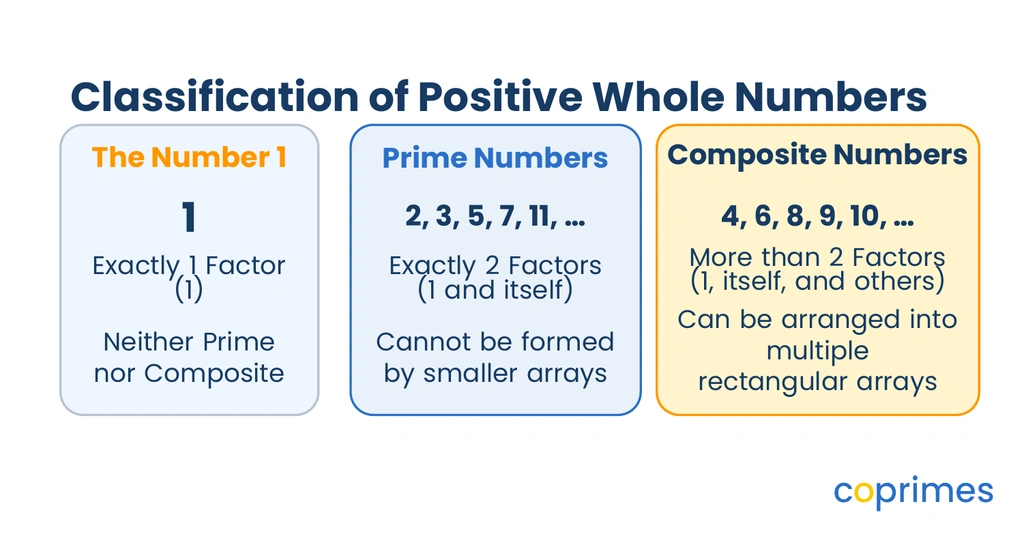
Composite numbers form a fundamental category of natural numbers along with prime numbers. Every positive integer greater than is classified as either prime or composite. A whole number is composite if it can be broken down into a product of smaller positive integers other than and itself.
To understand composite numbers, consider how numbers are built using multiplication. If a number can be arranged into a rectangular grid with more than one row and column (where both dimensions are greater than ), then is composite. For instance, can be arranged into rectangular arrays of , , and . Because has six distinct positive factors (), it is composite.
A whole number greater than 1 with more than two factors is composite.
Here is a list of the first composite numbers up to , along with their factors:
- (factors: )
- (factors: )
- (factors: )
- (factors: )
- (factors: )
- (factors: )
- (factors: )
- (factors: )
- (factors: )
- (factors: )
- (factors: )
Key Ideas and Vocabulary
Building a clear understanding of number theory requires distinguishing between closely related terms:
- Composite Number: A whole number greater than with three or more distinct positive factors.
- Prime Number: A whole number greater than with exactly two factors ( and itself).
- Factor: A whole number that divides another whole number completely without leaving a remainder.
- Factor Pair: Two whole numbers multiplied together to give a specific product.
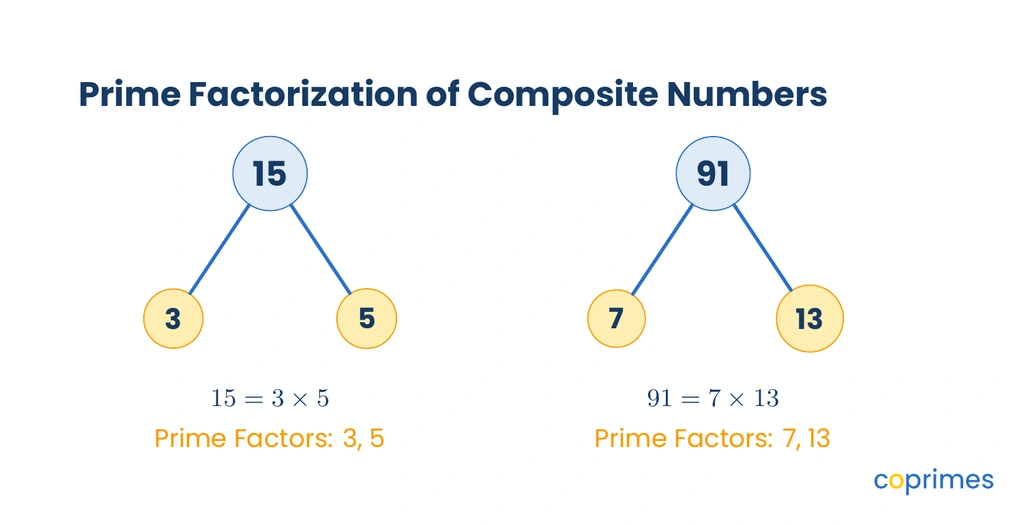
- Prime Factorization: Expressing a composite number as a product consisting only of prime numbers.
Understanding the distinction between factors vs multiples helps prevent confusion when identifying composite numbers. Factors divide into a number, whereas multiples are obtained by multiplying that number by integers.
Property | Prime Numbers | Composite Numbers | The Number 1 |
Factor Count | Exactly 2 distinct factors | More than 2 distinct factors | Exactly 1 factor |
Smallest Example | |||
Parity (Even/Odd) | is the only even prime | Includes even numbers () and odd numbers () | Neither |
Array Shapes | Single row array () | Multiple rectangular arrays | grid only |
Prime Factorization | Cannot be factored further | Unique product of prime factors | Not applicable |
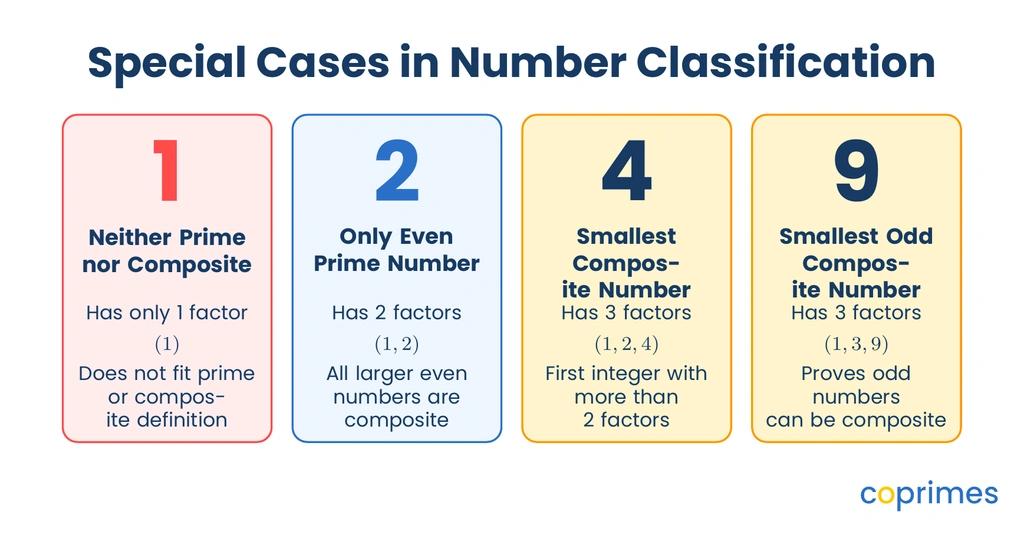
The number 4 is the smallest composite number.
Visual Explanation
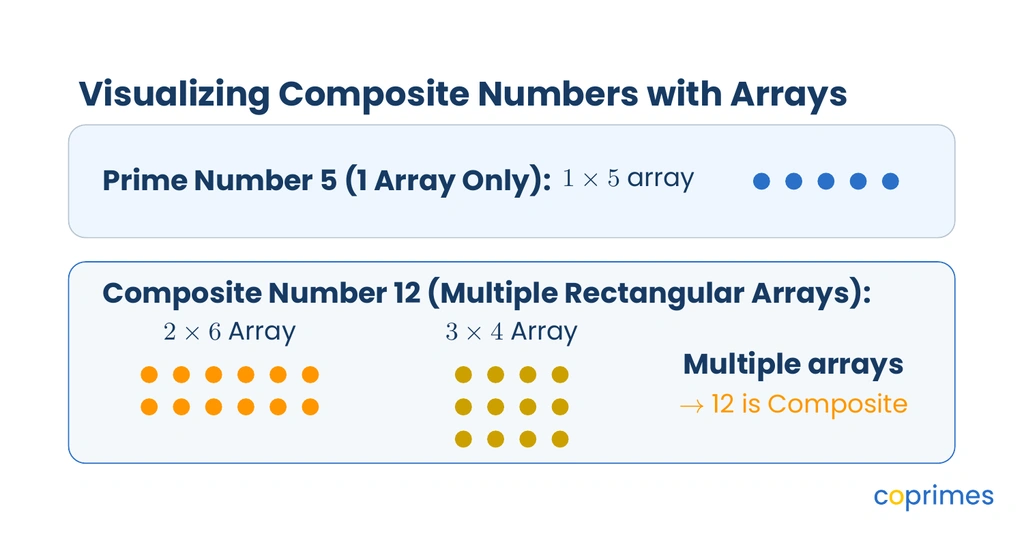
A practical visual method for identifying composite numbers is constructing dot arrays. An array arranges a quantity into equal rows and columns.
For any whole number :
- If you can form only one single-line array (), the number has only two factors ( and ) and is prime.
- If you can form two or more distinct rectangular arrays (such as , , or ), the number has more than two factors and is composite.
Consider comparing the number to the number :
- The number can only be arranged as a grid. It has no other equal row-and-column arrangements.
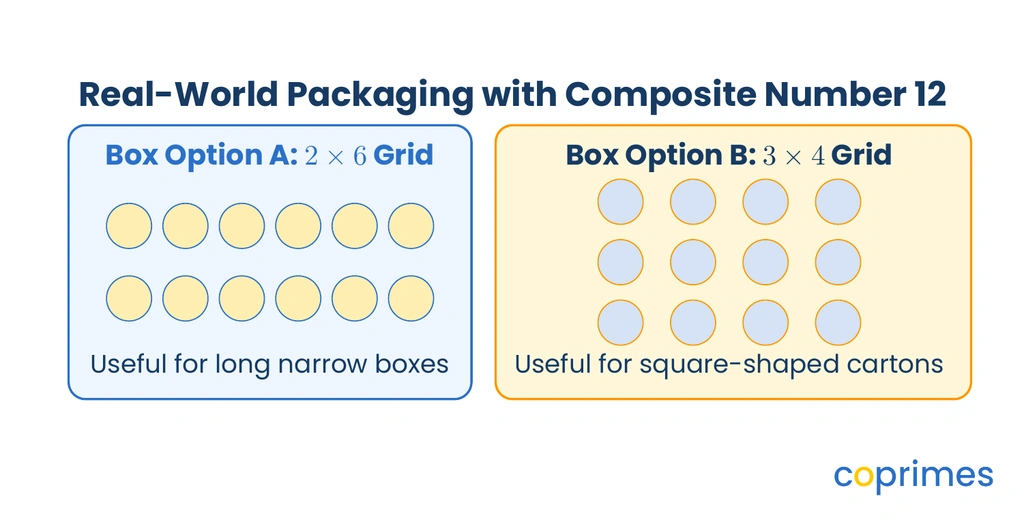
- The number can be arranged as , , or , demonstrating multiple factor pairs.

Worked Examples
Applying divisibility rules and systematic factor listing allows you to determine whether any number is composite.
Example 1: Identifying composite numbers using factor pairs
Question:
Determine whether is a prime number or a composite number by finding all of its factor pairs.
Method:
- Test division starting from up to the square root of ().
- Test : , so is a factor pair.
- Test : is an odd number, so is not a factor.
- Test : , so is a factor pair.
- List all unique positive factors in ascending order: .
Answer:
Because has four distinct factors (), it is a composite number.
Check:
Re-multiply the factor pairs: and . The total factor count is , which is greater than .
Example 2: Testing an odd number for compositeness
Question:
Is a prime number or a composite number?
Method:
- Check divisibility by : is odd, so is not a factor.
- Check divisibility by : The sum of digits is . Since is divisible by , is a factor ().
- Identify the factor pairs: and .
- List all factors in ascending order: .
Answer:
Since has four positive factors (), it is an odd composite number.
Check:
Verify that is not prime despite being odd: confirms a non-trivial factor pair exists.
Example 3: Testing larger numbers and checking counterexamples
Question:
Is a prime number or a composite number? Use an explicit answer-check method to confirm your result.
Method:
- Find the approximate square root of : .
- Test prime divisors less than : .
- Test : ends in (odd), so is not a factor.
- Test : The digit sum is , which is not divisible by .
- Test : does not end in or .
- Test : . Since is a whole number, and form a factor pair.
- List all positive factors: .
Answer:
The number is a composite number because its factors are , and .
Check:
Perform explicit answer-check verification:
- Verify multiplication: .
- Count factors: Total factors equal .
- Compare with definition: Since , meets the definition of a composite number.
Common Mistakes and Non-Examples
Learners frequently encounter misconceptions when classifying numbers. Understanding edge cases helps solidify number theory concepts.
Misconception 1: "All odd numbers are prime numbers."
Correction: Many odd numbers are composite. An odd number is composite whenever it has factors other than and itself. Examples include (), (), (), and ().
Misconception 2: "The number 1 is a prime or composite number."
Correction: The number is neither prime nor composite. By definition, a prime number has exactly two distinct factors, and a composite number has more than two distinct factors. The number has only one factor ().
Misconception 3: "All even numbers are composite numbers."
Correction: The number is an even number, but it is prime because its only factors are and . However, every even number greater than is a composite number because it is divisible by .
The number 1 is neither prime nor composite.
Real-World Connections
Composite numbers appear frequently in practical problem-solving, engineering, geometry, and computer science:
- Tiling and Architecture: Floor tiles and wall panels rely on composite quantities because they can be divided into equal rows and columns in multiple ways.
- Packaging and Commerce: Goods sold in cartons (such as egg packs of or bakery boxes of ) use composite numbers because can be arranged into or configurations.
- Timekeeping: Clocks use seconds in a minute, minutes in an hour, and hours in a day because and are composite numbers with many factors, allowing convenient division into halves, thirds, quarters, fifths, and tenths.
- Next Steps in Math: Once comfortable with composite numbers, studying prime vs composite numbers provides deeper insights into prime factorization and fraction simplification.
Frequently Asked Questions
What is the difference between prime and composite numbers?
A prime number is a whole number greater than with exactly two factors ( and itself). A composite number is a whole number greater than with more than two positive factors.
Is 1 a composite number?
No, the number is neither prime nor composite because it has only one positive factor ().
What is the smallest odd composite number?
The smallest odd composite number is , which has three positive factors ().
A learning plan shaped by your child, not the class
State-aligned Math plus our own Logic and English curriculum. An adaptive baseline test finds the gaps and fills them.
Practice questions
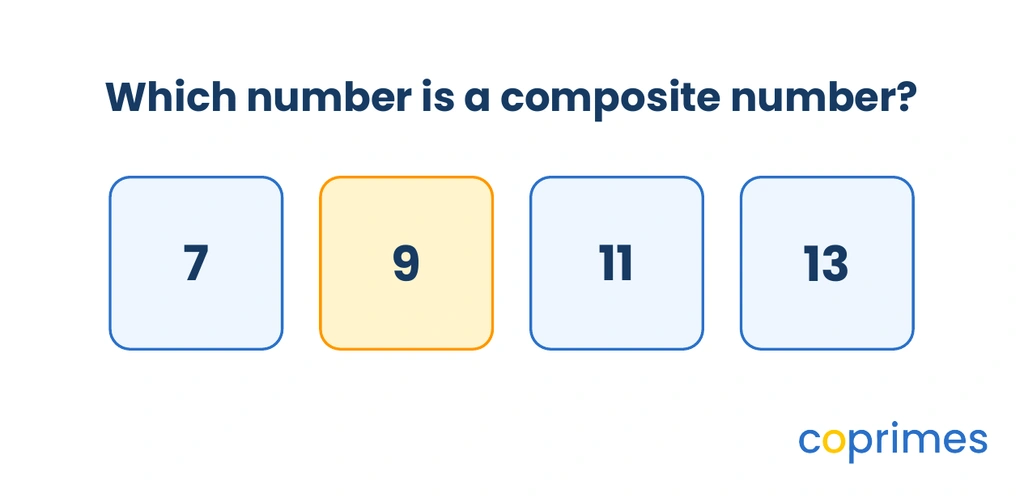
Which number shown in the visual is a composite number?
What is the smallest composite number?
Which statement regarding composite numbers is mathematically TRUE?
All even numbers are composite numbers.
All composite numbers are even numbers.
A composite number must have more than two positive factors.
The number 1 is the smallest composite number.
A composite number must have more than two positive factors.
How many total positive factors does the composite number have?
factors
factors
factors
factors
factors
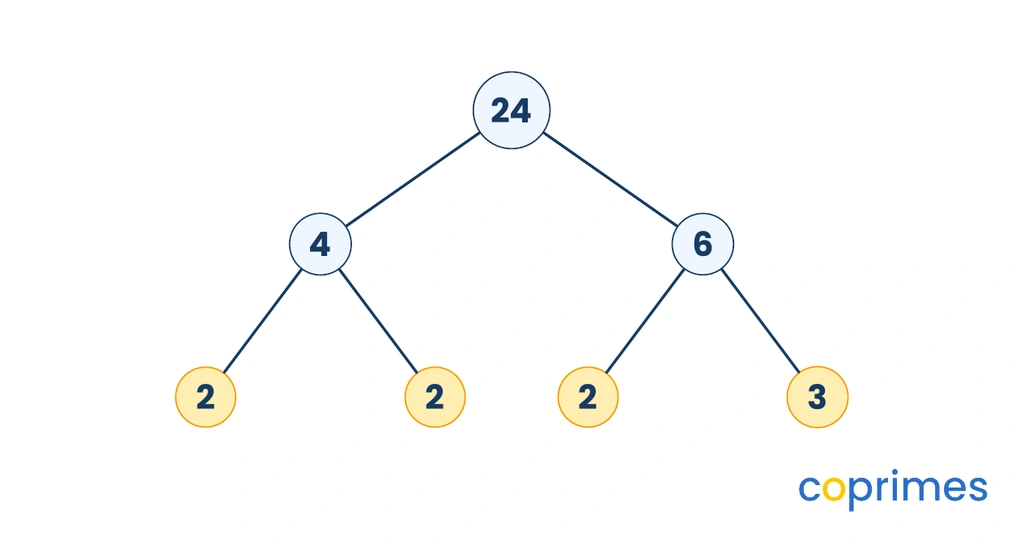
Based on the factor tree shown above, which list contains ALL the distinct prime factors of the composite number ?
, and
and
, and
, and
and