
Factor Trees: How to Find Prime Factorizations
A factor tree is a visual diagram used to repeatedly break down a composite number into its factors until every endpoint is a prime number.
By splitting the number into smaller branches step by step, factor trees provide an organized way to find the complete prime factorization of any integer.
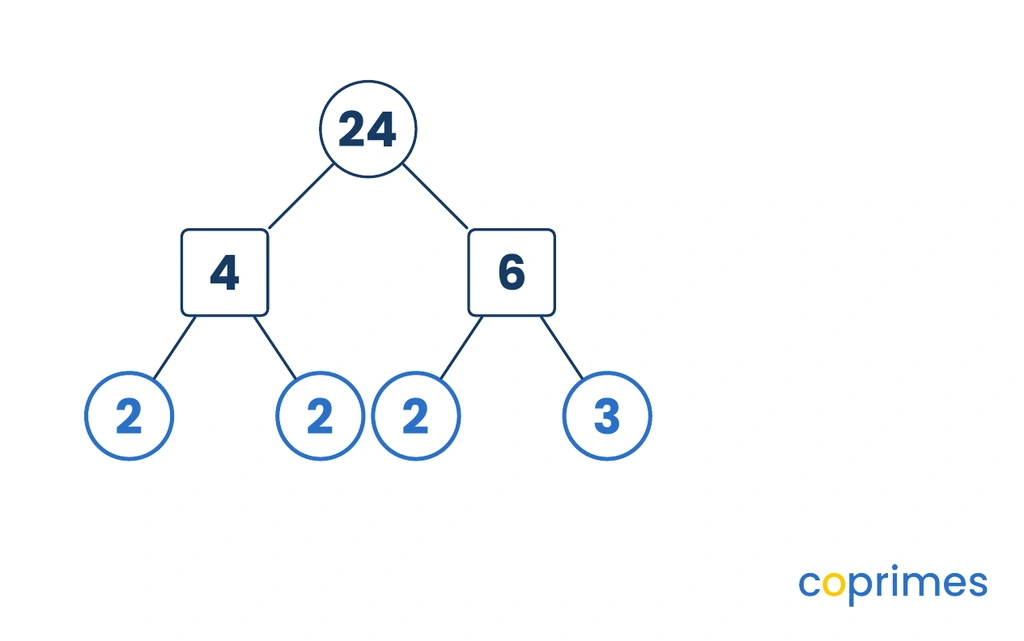
What Is a Factor Tree?
A prime factor tree begins with a single composite number at the top. Two branches are drawn downward to a pair of factors that multiply together to equal the original number.
If either of these new factors is a prime number, it is circled to show that that branch has ended. If a factor is composite, it is branched again into two smaller factors.
The process stops only when every final branch ends in a circled prime number.
This method guarantees that all the foundational prime building blocks of a number are found without missing any values.
When to Use It
Factor trees are the most reliable tool for finding the prime factorization of large composite numbers.
Once a number is written as a product of its prime factors, it becomes much easier to calculate the greatest common factors and least common multiples between multiple numbers.
These relationships are essential when simplifying fractions or adding fractions with different denominators.
Step-by-Step Method
To draw a factor tree and find the prime factorization of a number, follow a consistent sequence.
- Write the composite number at the top of the workspace.
- Find any two factors that multiply together to make that number. Draw two branches downward to these factors.
- Check each new factor. If a factor is a prime number, draw a circle around it. This branch is complete.
- If a factor is composite, draw two new branches downward to a new pair of factors.
- Repeat the branching process until every endpoint is a circled prime number.
- Multiply all the circled prime numbers together to write the prime factorization.
Using divisibility rules can help you quickly find the first pair of branches. For example, if the number ends in , you can immediately use as one of the factors.
A learning plan shaped by your child, not the class
State-aligned Math plus our own Logic and English curriculum. An adaptive baseline test finds the gaps and fills them.
Visual Worked Examples
The shape of a factor tree depends on the size of the number and the initial factors you choose. Larger numbers require deeper branches to reach all the prime numbers.
Example 1: Finding prime factors
Question: What is the prime factorization of ?
Method:
- Write at the top of the tree.
- Choose any two factors of , such as and .
- Break down into and . Since both are prime, circle them.
- Break down into and . Circle the . Break into and and circle them.
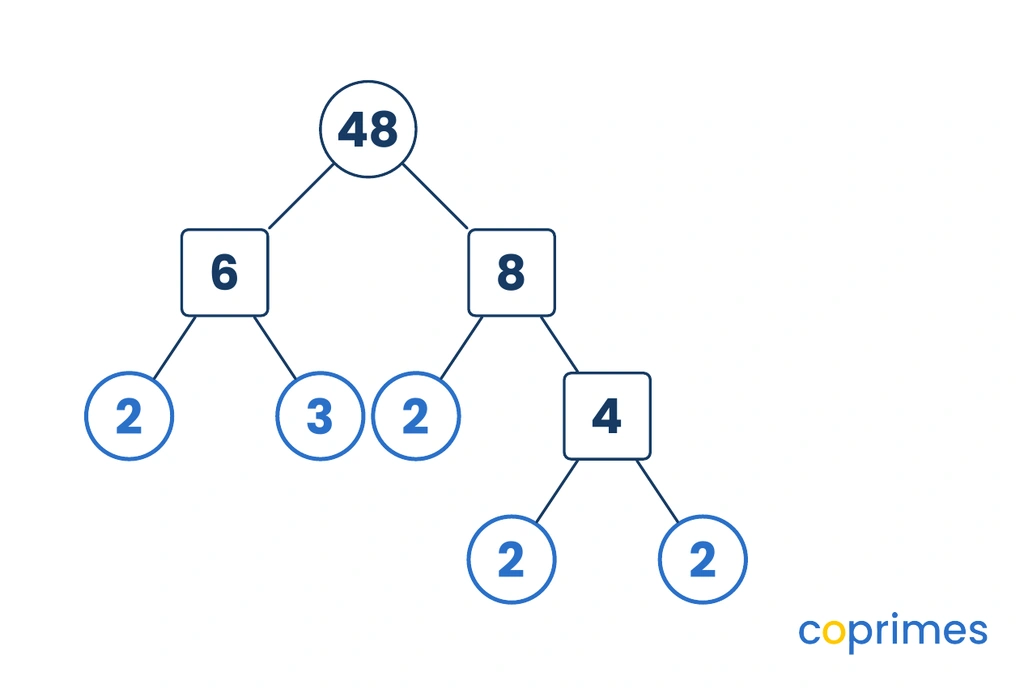
Answer: The prime factors are , , , , and . In index notation, .
Check: Multiply the primes together: , , , and .
Example 2: Repeated prime factors
Question: Use a factor tree to find the prime factorization of .
Method:
- Choose a factor pair for , such as .
- Write and branch it to and .
- Branch the left into and . Both are prime, so circle them.
- Branch the right into and . Both are prime, so circle them.
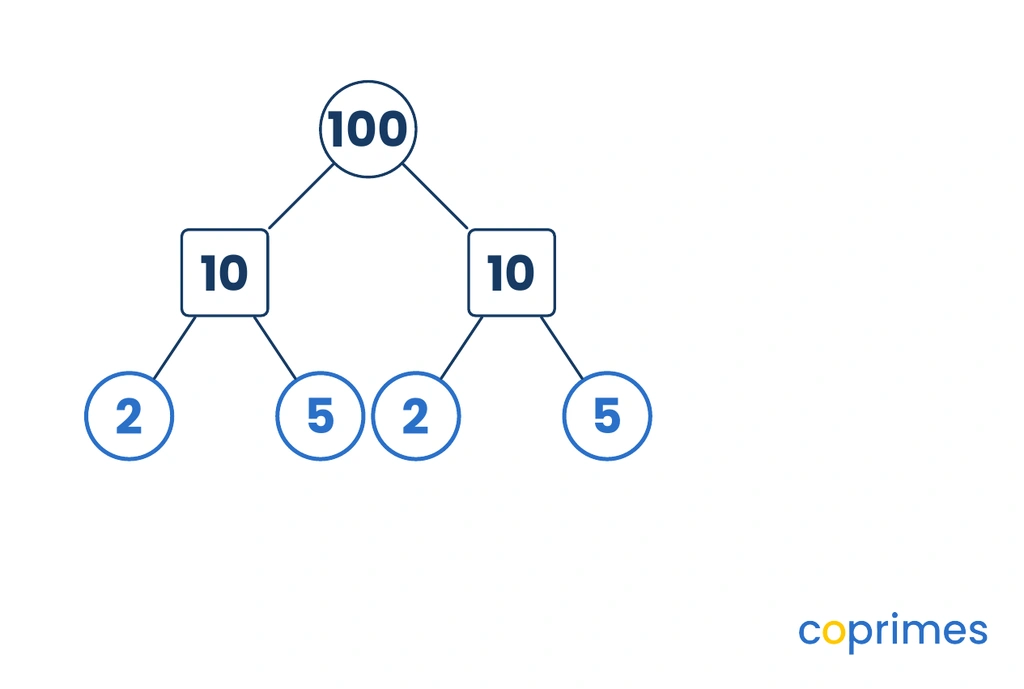
Answer: Written from smallest to largest, .
Check: Ensure all circled numbers are actually prime. and both have only two factors, so the branching is complete.
Example 3: Three-layer prime branches
Question: What is the prime factorization of ?
Method:
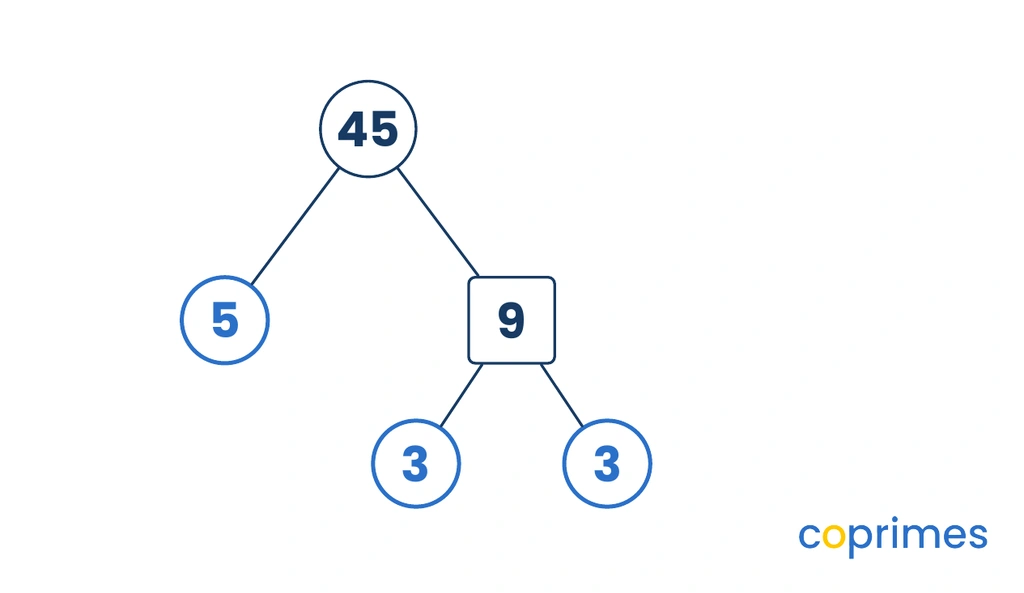
- Begin with . Since it ends in , it is divisible by .
- Branch into and .
- Branch into and . Both are prime. Circle them.
- Branch into and . Both are prime. Circle them.
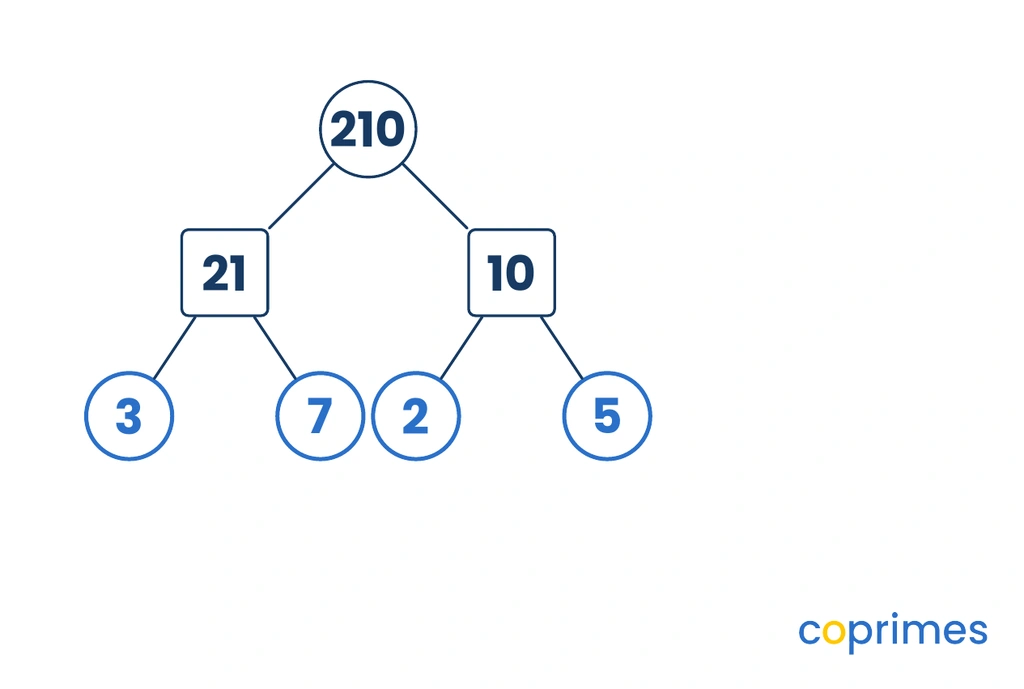
Answer: Sorting the primes from smallest to largest, .
Check: Multiply sequentially to confirm the total: , , and .
How to Check the Answer
To verify your factor tree is correct, multiply all the circled prime numbers together.
The final product must exactly equal the number at the top of the tree. If the result is smaller, you may have forgotten to write down one of the primes. If the result is larger, you may have included a composite number in your final list or used an incorrect initial factor pair.
Common Mistakes
When building a factor tree, watch out for these frequent errors that lead to incorrect factorizations.
Using as a factor
Because is not a prime number, placing and the number itself on the branches creates an endless loop. A branch splitting into and requires you to split again, achieving no progress. Never use in a factor tree.
Adding instead of multiplying
The branches on a factor tree must represent multiplication, not addition. Splitting into and is incorrect because . The correct split requires finding two numbers that multiply to , such as and .
Stopping before all branches are prime
It is easy to circle a number like or , mistaking it for a prime number. Always double-check your circled endpoints. If a circled number can be divided by , , , or any other integer besides , it is composite and the branch must be extended.

Practice questions
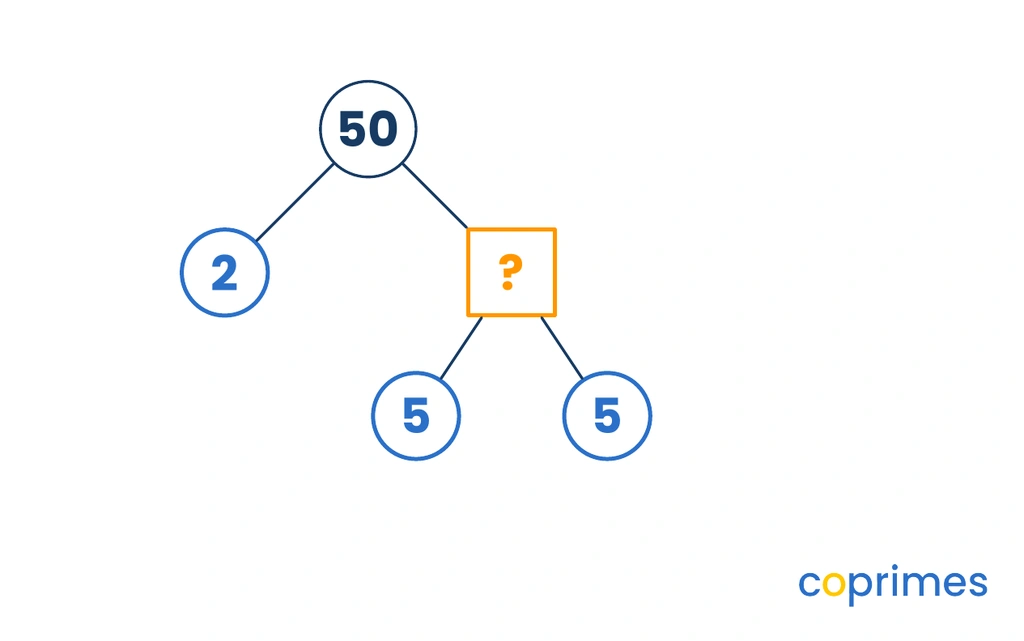
Based on the factor tree, what number belongs in the box with the question mark?
What is the completely simplified prime factorization of found using a factor tree?
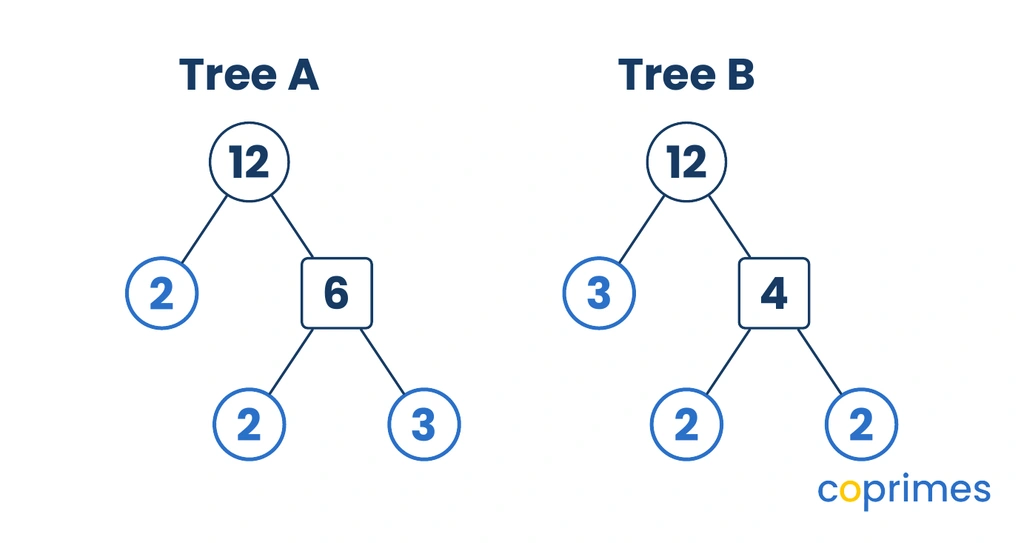
The diagram shows two different factor trees for . Which statement correctly describes the prime factorizations they produce?
Tree A produces , while Tree B produces .
Both trees produce the exact same prime factorization: .
Tree A produces a better factorization because it finds the smallest prime number first.
Tree B is incorrect because should always be split by first.
Both trees produce the exact same prime factorization: .
A student draws a factor tree for . They start by branching into and . Why is this an invalid step in a prime factor tree?
Because is not divisible by .
Because and add up to , not .
Because is not prime, and the branch does not break into smaller factors.
Because can only be branched into and .
Because is not prime, and the branch does not break into smaller factors.
When the prime factor tree for is fully complete, what is the largest prime number circled in the diagram?