
Estimating Products and Quotients
To estimate a product or quotient, replace the factors, dividend, or divisor with nearby compatible or rounded numbers that keep the calculation easy and the result useful. This provides a quick, approximate answer without performing complex arithmetic.
What does it mean to estimate a product or quotient?
Estimating a product or quotient means finding an answer that is close to the exact result of a multiplication or division problem. Instead of calculating the exact value, you adjust the numbers to make the mental math simpler.
Mastering estimating calculations helps you quickly verify if an exact answer makes sense. When solving real-world problems, an estimated product or quotient is often all that is needed to make a decision.
Estimation simplifies the problem while keeping the answer close to the exact value.
Choose compatible or rounded numbers
When estimating, you can adjust numbers by rounding them to a specific place value or by choosing compatible numbers that work well together.
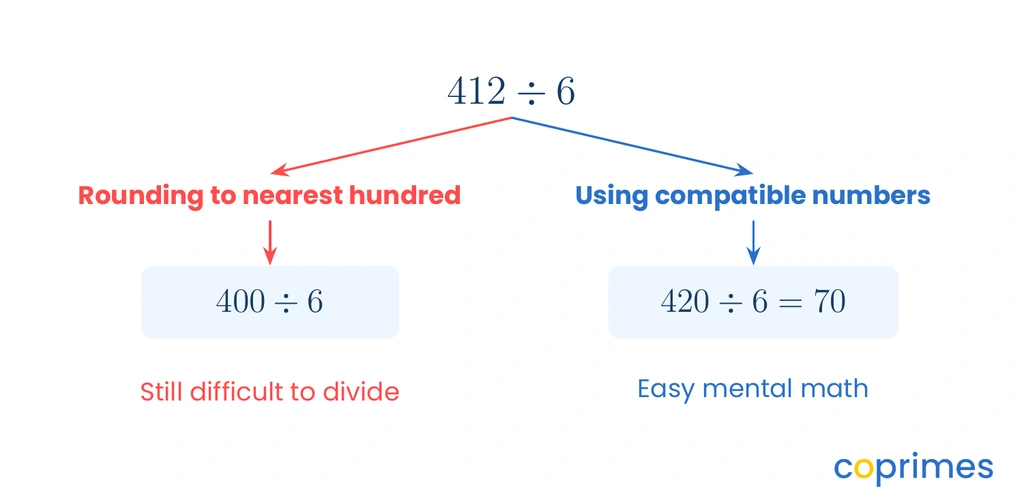
Rounding follows strict rules. You look at the digit to the right of the target place value and round up or down. This works well for estimating multiplication. For example, rounding and to the nearest ten gives and .
Compatible numbers are numbers that are easy to compute mentally. They are especially useful for division, where strict rounding might leave you with a calculation that is still difficult to solve mentally. Choosing a compatible number ensures the division produces a whole number.
Estimate products
To estimate a product, round one or both factors to their greatest place value before performing the multiplication. This changes difficult numbers into multiples of ten, one hundred, or one thousand.
Method:
- Identify the factors in the multiplication problem.
- Round each factor to its highest place value or a convenient place value.
- Multiply the rounded numbers, counting the zeros to place them in the final product.
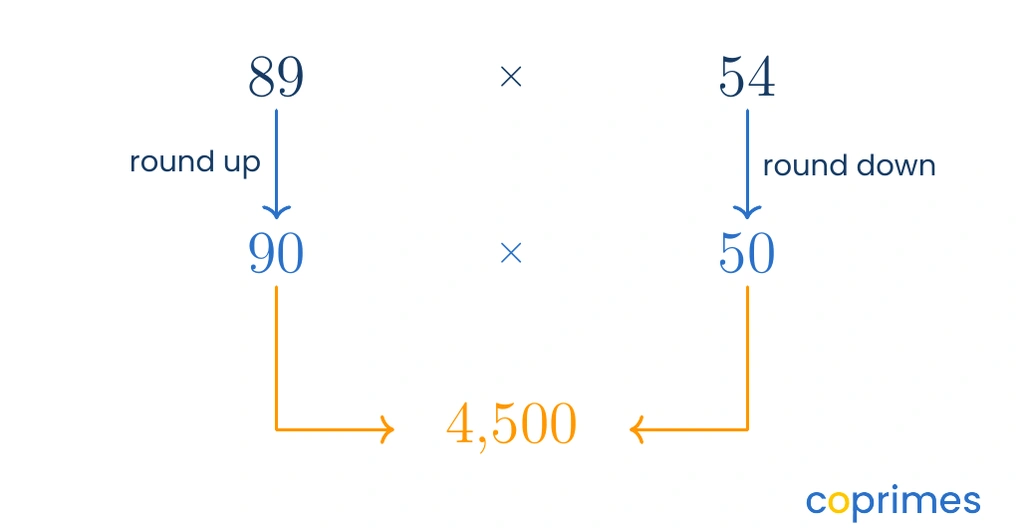
For example, to estimate , round up to and round down to . The estimated product is .

Estimate quotients
To estimate a quotient, change the dividend, the divisor, or both to compatible numbers so the division leaves no remainder. This requires knowing basic multiplication facts.
Method:
- Look at the divisor and the first digit or two of the dividend.
- Find a multiple of the divisor that is close to the dividend.
- Replace the dividend with this compatible number and divide.
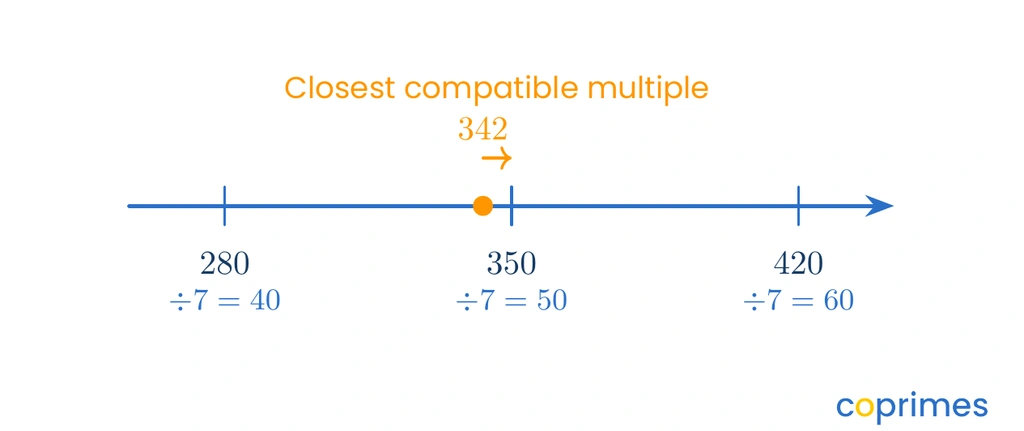
For example, to estimate , look for a multiple of close to . Since , the number is highly compatible. The estimated quotient is .
How to preserve useful size
An estimate is only helpful if it remains close to the actual value. If you round numbers too aggressively, the estimated product or quotient loses its useful size and becomes inaccurate.
When a factor is a single-digit number, do not round it. For example, to estimate , round to but keep the . The estimate is . If you rounded the to , the estimate would be , which provides no useful information.
Similarly, when estimating quotients, keep a single-digit divisor exact if possible. Finding a compatible dividend based on the exact divisor produces a more accurate result than rounding both numbers.
How to check the estimate
After estimating, you can evaluate whether your result is an overestimate or an underestimate by comparing your rounded numbers to the original values. This is an important part of checking reasonableness of answers.
If you rounded both factors up, your estimated product is an overestimate and will be larger than the exact answer. If you rounded both factors down, your estimate is an underestimate.
If one factor was rounded up and the other down, the estimate will be close to the exact answer, but determining if it is slightly over or under requires closer inspection of how much each number changed.
A learning plan shaped by your child, not the class
State-aligned Math plus our own Logic and English curriculum. An adaptive baseline test finds the gaps and fills them.
Worked examples
Example 1: Estimating a product
Question: Estimate the product of and .
Method:
- Identify the numbers to be multiplied.
- Round each factor to its highest place value. The number rounds down to , and rounds up to .
- Multiply the rounded numbers, .
Answer: The estimated product is .
Check: Since , attaching the two zeros gives .
Example 2: Estimating a quotient
Question: Estimate the quotient of .
Method:
- Identify the divisor, which is , and look at the first two digits of the dividend, .
- Find a multiple of close to . Since , the number is a highly compatible number.
- Replace with and divide.
- Calculate .
Answer: The estimated quotient is .
Check: , which is close to .
Example 3: Solving a real-world problem
Question: A library receives boxes of books. Each box contains books. Approximately how many books did the library receive?
Method:
- Set up the multiplication problem as .
- Round up to the nearest ten to get .
- Round down to the nearest ten to get .
- Multiply the rounded numbers, which is .
Answer: The library received approximately books.
Check: The exact answer is , so the estimate of is reasonable.
Frequently asked questions
Why do we use compatible numbers instead of rounding for division?
Strict rounding can create a dividend that is not easily divisible by the divisor, leaving a remainder and defeating the purpose of quick mental math. Compatible numbers guarantee a whole-number quotient.
Can an estimate be exactly equal to the actual answer?
No. An estimate is an approximation. Estimating changes the original numbers, so the result is almost always different from the exact answer.
When should I estimate rather than calculate the exact answer?
Estimate when you need a quick sense of size or cost, when verifying if an exact calculation makes sense, or when an exact answer is not necessary to solve a real-world problem.
Practice questions
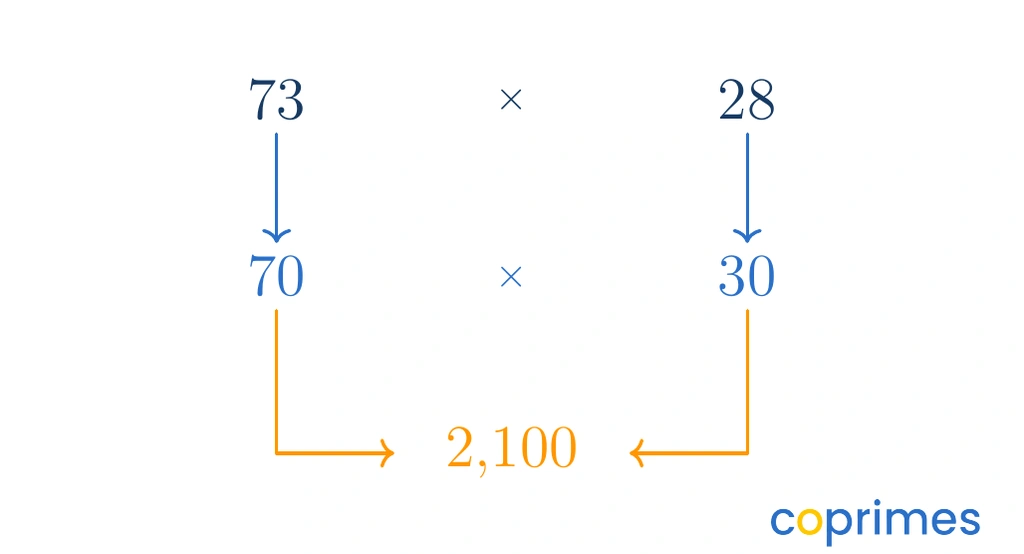
Which exact multiplication problem is being estimated in the diagram?
To estimate , which compatible number should replace the dividend?
A baker produces cookies and packs them into boxes of . Which expression provides the best estimate for the number of boxes needed?
A student estimates by calculating . How does the estimated product compare to the exact product?
The estimate is less than the exact product.
The estimate is greater than the exact product.
The estimate is exactly equal to the product.
The estimate cannot be compared without calculating.
The estimate is less than the exact product.
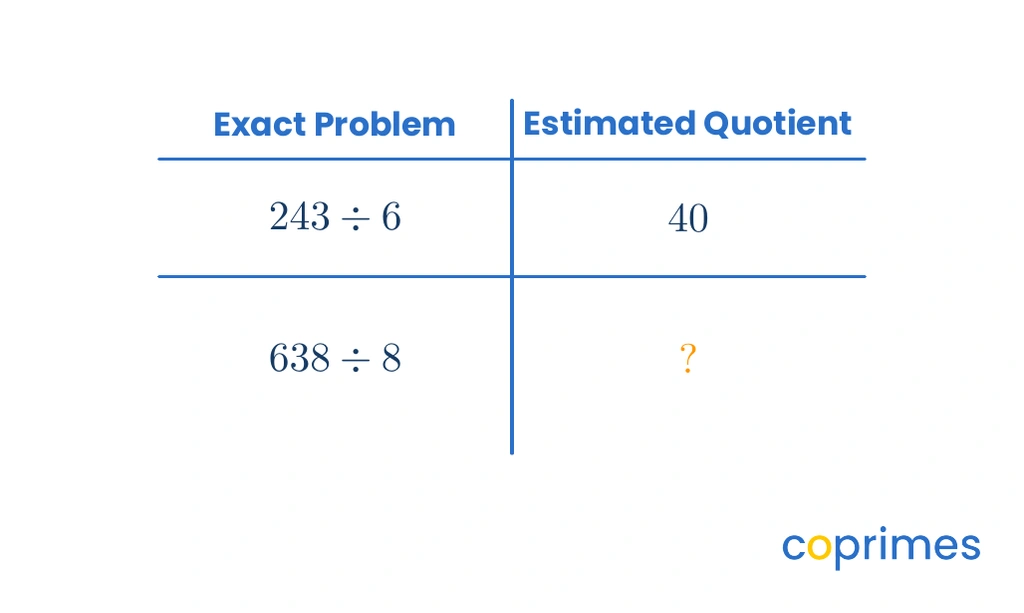
What is the missing estimated quotient in the table for ?