
What Are Prime Numbers? Definition and Examples
A prime number is a whole number greater than 1 with exactly two positive factors: 1 and itself. Because of this strict mathematical rule, the smallest prime number is , and the sequence of primes continues infinitely.
Every positive integer is either a prime number, a composite number, or the special unit . Understanding prime numbers helps you break down complex mathematical problems, simplify fractions, and even understand how digital information is kept secure.
What Are Prime Numbers?
A prime number is a fundamental building block in mathematics. Every whole number greater than is either prime or can be broken down completely into prime components. If a number has any divisors other than and itself, it is not prime.
For example, is a prime number because you can only divide it evenly by and . The number , however, is divisible by , , , and . Because it has four positive divisors, is not prime.
The list of prime numbers from to is: , , , , , , , and .
Key Ideas and Vocabulary
To master primality, you must confidently understand the difference between `factors vs multiples`.
- Factors: The whole numbers you multiply together to get a target number. For example, the `factors` of are , , , and .
- Multiples: The results of multiplying a target number by an integer. The `multiples` of are , , , and so on.
- Composite numbers: Any whole number greater than that has more than two factors.
When you compare `prime vs composite numbers`, a prime number stands alone with exactly two factors. In contrast, `composite numbers` always contain three or more factors.
Visual Explanation
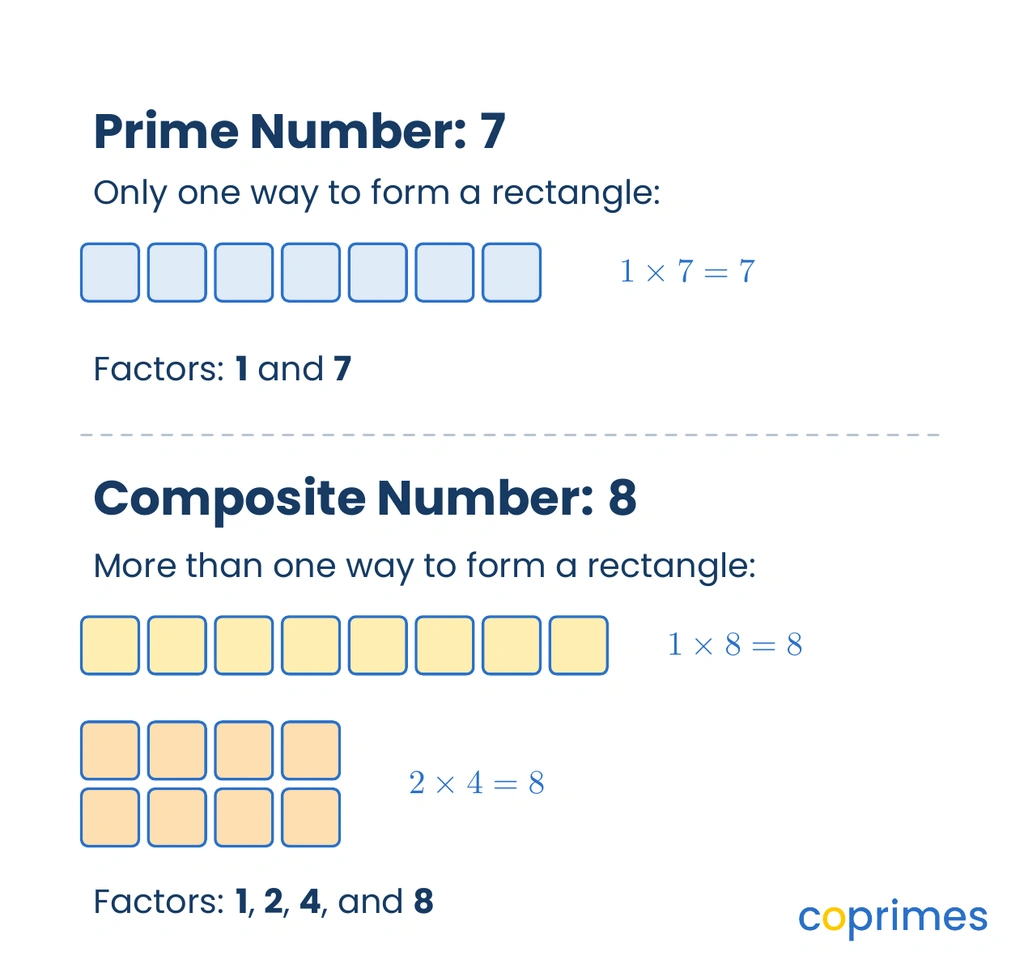
You can visualize prime numbers by arranging them into rectangular grids or arrays. A prime number can only form a single straight line. A composite number can be arranged into multiple different rectangles.

Worked Examples
You can identify whether a number is prime by methodically testing divisibility rules.
Example 1: Identifying a small prime number
Question: Is the number prime or composite?
Method:
- Check for factors other than and .
- Test divisibility by and . The number ends in , so it is not divisible by or .
- Test divisibility by . The sum of the digits is . Because is divisible by , is also divisible by .
Answer: The number is composite.
Check: Since , the factors of are , , , and . Because it has more than two factors, it cannot be prime.
Example 2: Testing a larger number
Question: Is a prime number?
Method:
- Check if it is even. It ends in , so it is odd and not divisible by .
- Check if it ends in or . It ends in , so it is not divisible by .
- Check divisibility by . The sum of the digits is , which is not divisible by .
- Check divisibility by . Dividing gives with a remainder of .
Answer: The number is prime.
Check: The largest prime you must check is the one just before the number's square root. Since , testing primes up to is sufficient to prove that has exactly two factors.
Example 3: Prime numbers greater than 100
Question: Is prime or composite?
Method:
- Test small primes. It is not even, does not end in , and the digits sum to , which means it is not divisible by .
- Test divisibility by . Divide by .
- Calculate . The division is exact with no remainder.
Answer: The number is composite.
Check: The factors are , , , and . Four positive factors means the number is composite.
Common Mistakes and Non-Examples
When identifying prime numbers, learners frequently fall into a few common traps regarding specific digits and rules.
- Thinking 1 is a prime number: The number only has one factor, which is itself. A prime number must have exactly two positive factors. Therefore, is a non-example; it is neither prime nor composite.
- Assuming all odd numbers are prime: Numbers like , , and are odd but they are composite because they are perfectly divisible by .
- Believing 2 cannot be prime: The number is the only even prime number in mathematics because its only factors are and . Every other even number is divisible by , giving it at least three factors.
- Checking negative numbers: By definition, prime numbers are strictly positive whole numbers greater than . Negative numbers are never classified as prime.
Real-World Connections
Prime numbers are the mathematical backbone of modern digital security. When you send a secure message, use a banking application, or purchase items online, the encryption algorithms securing your data rely on enormous prime numbers.
Computers create public keys by multiplying two massive prime numbers together. Because it is incredibly difficult and time-consuming for computers to work backwards and find the original prime factors of a number that is hundreds of digits long, prime numbers keep your digital information completely safe from unauthorized access.
A learning plan shaped by your child, not the class
State-aligned Math plus our own Logic and English curriculum. An adaptive baseline test finds the gaps and fills them.
Practice questions
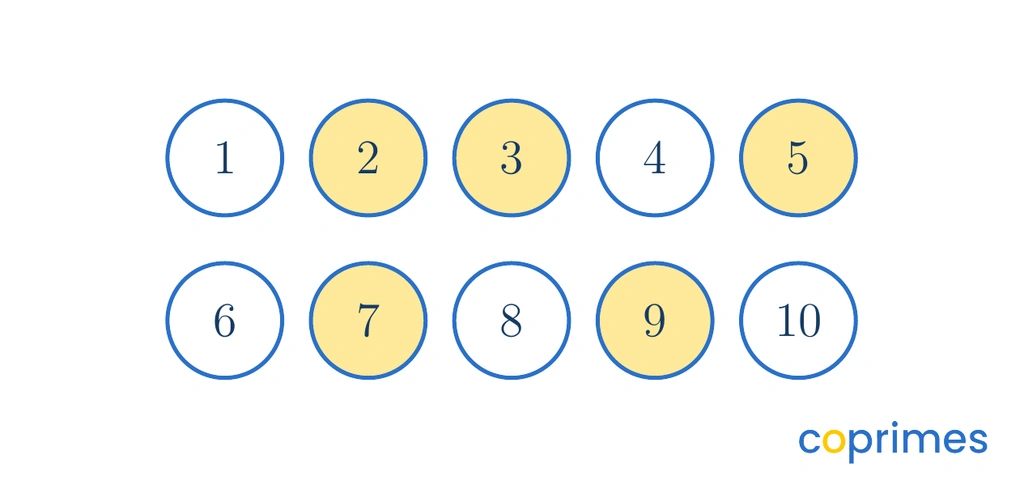
The grid highlights five different numbers. Which highlighted number is a composite number rather than a prime number?
Is the number considered a prime number?
Yes, because it can be divided evenly by and itself.
Yes, because it is an odd number.
No, because it has exactly one positive factor.
No, because it is considered a composite number.
No, because it has exactly one positive factor.
Which of the following lists contains ONLY prime numbers?
By checking divisibility rules, determine which of the following numbers is prime.
A student observes that is the only even prime number. Why are there no other even prime numbers?
Even numbers larger than are always multiples of .
All even numbers greater than are divisible by , giving them at least three factors.
Prime numbers must always end in the digits , , , or .
Odd numbers are prime by definition.
All even numbers greater than are divisible by , giving them at least three factors.