
Factor Pairs: Guide and Examples
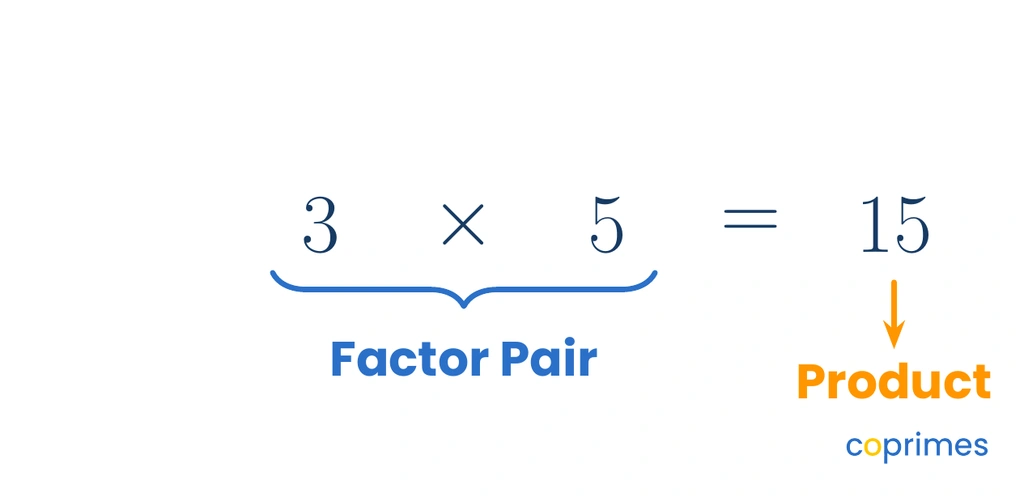
A factor pair is a pair of whole numbers whose product is the given number. When you multiply the two numbers in a factor pair together, they equal the target number perfectly, leaving no remainders. Finding these combinations helps us break down numbers into their basic building blocks.
What Is Factor Pairs?
To understand factor combinations, you first need to know about factors. A factor is a whole number that divides exactly into another number. Because multiplication involves two numbers being multiplied together, factors naturally come in pairs.
For example, if you want to make , you can multiply by . Together, the numbers and form a single factor pair for the number .
When to Use It
You use factor pairs whenever you need to divide a quantity into equal groups, arrange items in a rectangular grid, or simplify fractions. They also help differentiate factors vs multiples, which are often confused.
Exploring combinations of factors even leads to fascinating number theory concepts, such as finding perfect numbers, where the sum of a number's factors equals the original number.
Step-by-Step Method
Finding all factor pairs requires a systematic search to ensure you do not miss any combinations.
- Start with the number . Every whole number pairs with to make itself.
- Move up to . Check if the number is even. If it is, divide by to find its partner.
- Test the next numbers in sequence (, , , etc.), writing down successful pairs.
- Stop searching when you reach a number that has already been listed as a partner in a previous pair.
This method guarantees you find every pair without creating duplicates.
A learning plan shaped by your child, not the class
State-aligned Math plus our own Logic and English curriculum. An adaptive baseline test finds the gaps and fills them.
Visual Worked Examples
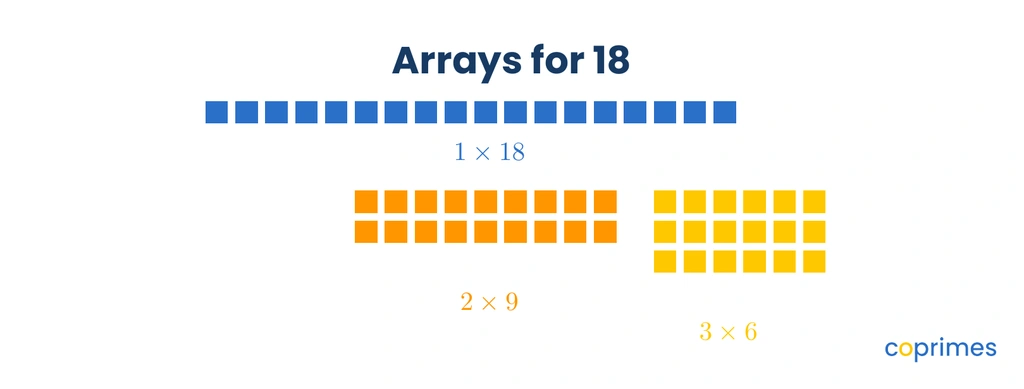
A helpful way to visualize these combinations is by drawing arrays. An array arranges objects into equal rows and columns. The number of rows and the number of columns form a factor pair.
Example 1: Finding pairs for an even number
Question: Find all the factor pairs for .
Method:
- Start with . We have the pair and .
- Try . Because is even, .
- Try . The number cannot be divided evenly by .
- Try . Since , this is a valid pair.
- Try . We have already listed with , so we stop checking.
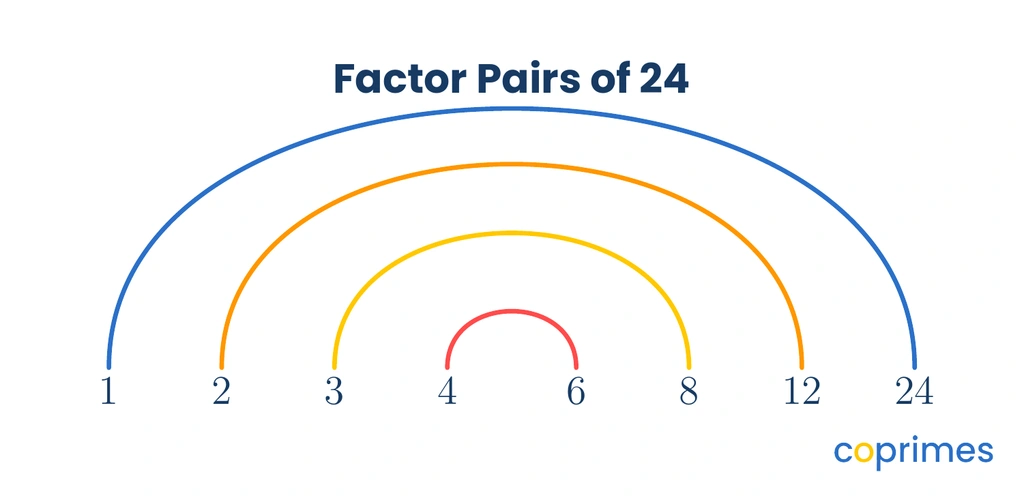
Answer: The factor pairs of are , , and .
Check: Multiply the pairs: , , and .
Example 2: Finding pairs for a square number
Question: List all the factor pairs for .
Method:
- Try : .
- Try : is even, so .
- Try : , so .
- Try : , so .
- Try : does not end in or , so is not a factor.
- Try : . The number multiplies by itself, meaning we have reached the square root and can stop.
Answer: The factor pairs are , , , , and .
Check: Every combination multiplies to . Because we reached , we know no other pairs exist.
Example 3: Finding pairs for an odd number
Question: Find all the factor pairs for .
Method:
- Try : .
- Try : is odd, so is not a factor.
- Try : divided by is , so .
- Try : cannot be halved evenly twice, so is skipped.
- Try : ends in , so . The pair is .
- Try , , and : None of these divide evenly into .
- Try : We already listed with , so we stop.
Answer: The factor pairs of are , , and .
Check: , , and .
How to Check the Answer
To verify your list of pairs, simply multiply each combination together. The product of every single pair must exactly equal your target number. If any pair results in a different total, you must remove or recalculate it.
Additionally, verify that you searched until the numbers began to repeat or you reached the square root of the target. This ensures you did not skip any valid multiples along the way.
Common Mistakes
A very frequent mistake is failing to include the number and the target number itself. For instance, stating that the only pairs for are and is incorrect because it misses .
Another common error is listing the same pair twice. In mathematics, a factor pair order does not matter. The pair is identical to . You only write it once.
Finally, avoid forcing numbers that do not divide evenly. If there is a remainder, the numbers do not form a factor pair.
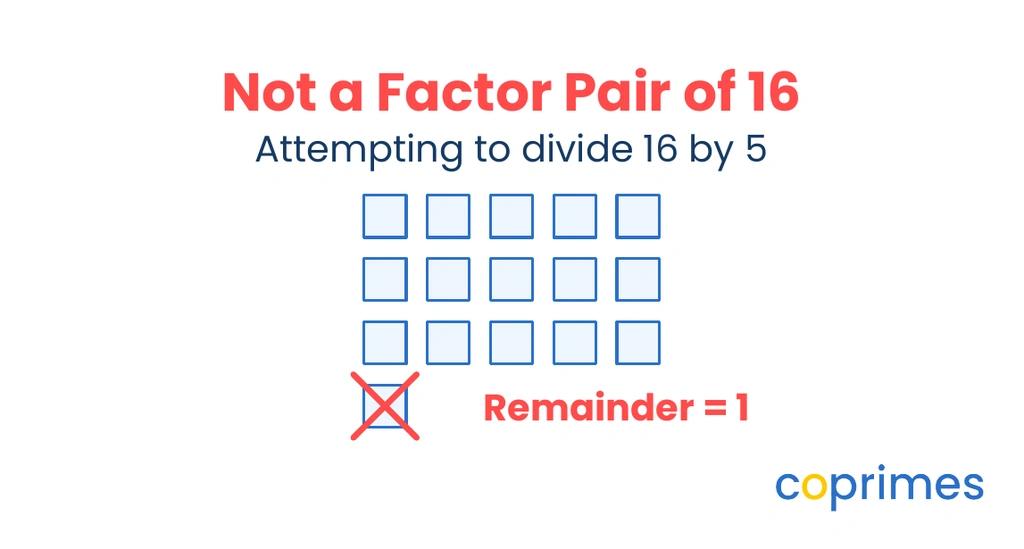
If you have leftover pieces when making an array, the numbers do not form a factor pair.

Practice questions

Which factor pair does the array above represent?
If is a factor pair of , what is the value of ?
Why do we stop searching for factor pairs of after finding ?
Because has no other factors at all.
Because is an even number.
Because any factor pairs after will be combinations we already listed.
Because divided by has a remainder.
Because any factor pairs after will be combinations we already listed.
Which of the following is not a valid factor pair for the number ?
How many total factor pairs does the prime number have?