
Multiples: Guide and Examples
A multiple of a number is the product of that number and an integer, so positive multiples continue without end.
When you multiply a whole number by another whole number, the answer is a multiple.
For example, if you multiply by , and , you get , and . These results are all multiples of .
What Is Multiples?
To understand how to find multiples, you can think of them as the answers in a multiplication table.
When you choose a base number and multiply it by any integer, the product is a multiple of that base number.
You can also think of multiples as times-table numbers.
If you know how to skip count by a certain number, such as counting , and , you are successfully listing its multiples.
Key Ideas and Vocabulary
Understanding how multiples behave makes it easier to work with them in mathematics.
- Infinite lists: Because you can multiply a number by an endless set of integers, every number has an infinite list of multiples.
- The number itself: Every number is a multiple of itself because any number multiplied by equals itself.
- Zero as a multiple: Multiplying any number by results in . Therefore, is a multiple of every number. However, you usually focus on finding positive multiples.
- Negative multiples: If you multiply a positive number by a negative integer, you get a negative multiple. For example, is a multiple of because .
It is helpful to know prime numbers and understand their multiples.
A prime number has only two factors, but like all other numbers, it still has an infinite number of multiples.
Visual Explanation
A number line is one of the best ways to visualize multiples through skip counting.
Imagine starting at zero and making equal forward jumps along the number line.
Each landing spot represents a multiple of the size of the jump.
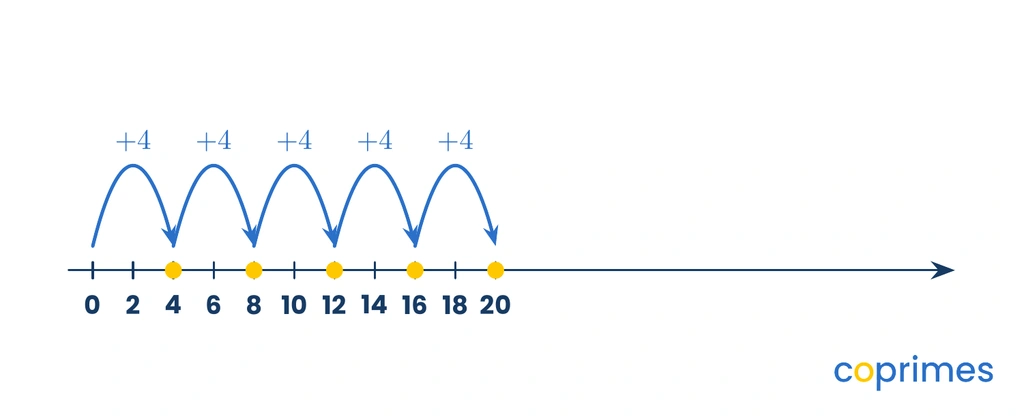
By jumping in intervals of , you land on , and .
These are the first five positive multiples of . The list will continue as long as you keep jumping.
A learning plan shaped by your child, not the class
State-aligned Math plus our own Logic and English curriculum. An adaptive baseline test finds the gaps and fills them.
Worked Examples
These multiples examples show different ways to find and check your answers.
Example 1: Finding a sequence of positive multiples
Question: What are the first five positive multiples of ?
Method:
- Multiply the given number by .
- Multiply by , and .
Answer: The first five positive multiples are , and .
Check: You can use skip counting to verify. Start at , add to get , add to get , add to get , and add to get .
Example 2: Verifying a larger multiple
Question: Is a multiple of ?
Method:
- Divide the larger number by the smaller number.
- If the result is a whole number with no remainder, it is a multiple.
Calculate .
The result is the whole number .
Answer: Yes, is a multiple of .
Check: Multiply to confirm the product equals .
Example 3: Identifying negative multiples
Question: Find three negative multiples of .
Method:
- Choose three negative integers.
- Multiply by each integer.
Answer: Three negative multiples of are , and .
Check: Divide each answer by . The results (, and ) are all integers without a remainder.
Common Mistakes and Non-Examples
The most frequent error is confusing a multiple with a factor. This usually happens when students do not completely understand factor pairs.
A factor divides evenly into a number, while a multiple is created by multiplying that number.
Factors are smaller than or equal to the original positive number, but positive multiples are larger than or equal to the original number.
Non-Example: Identifying factors incorrectly as multiples
The number divides evenly into .
However, it is incorrect to say that is a multiple of . The correct relationship is that is a factor of , and is a multiple of .
Learning the differences when comparing factors vs multiples prevents this common confusion.
Real-World Connections
Multiples appear frequently in daily life when items are packaged in equal groups.
If juice boxes are sold in packs of , you can only purchase them in multiples of .
Buying pack gives you boxes, packs give you , and packs give you . You cannot buy exactly juice boxes because is not a multiple of .
Multiples are also useful in scheduling.
If a bus arrives at a station every minutes starting at noon, it will arrive at , and minutes past the hour.
This pattern continues predictably because it relies on the multiples of . Understanding multiples will also help you if you explore properties of perfect numbers in the future.

Practice questions
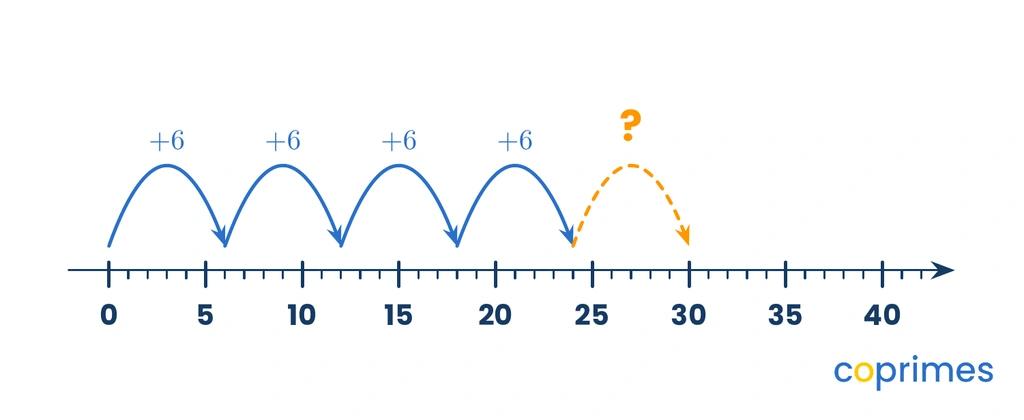
Based on the pattern of multiples shown by the jumps, which number replaces the question mark?
What are the first three positive multiples of ?
Is a multiple of ?
Yes, because plus equals .
Yes, because multiplied by equals .
No, because is an even number.
No, because is a factor of , not a multiple.
Yes, because multiplied by equals .
Which of the following numbers is a negative multiple of ?
Apples are sold in bags of . If a store manager wants to buy some full bags, which total number of apples is possible to purchase?