
Factors vs Multiples: Guide and Examples
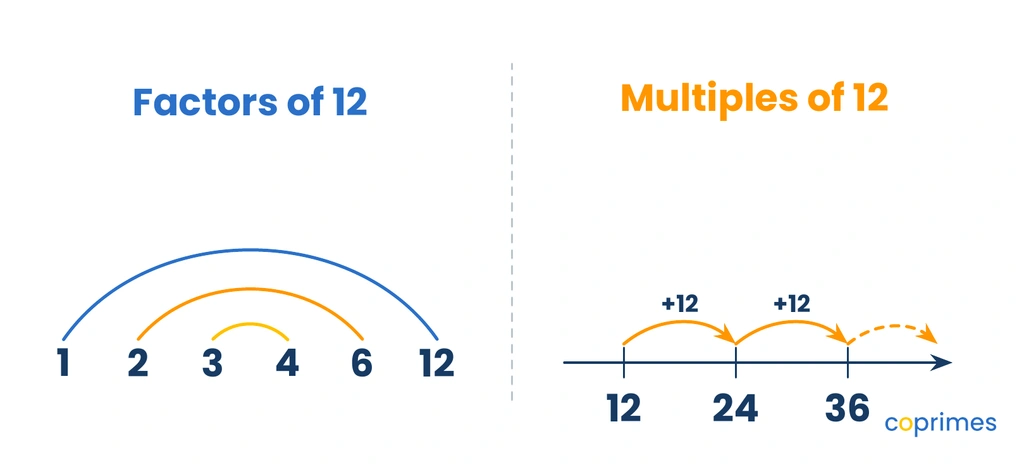
Factors divide a number exactly without leaving a remainder and are finite for any positive whole number, while multiples are the products of that number and continue indefinitely.
Understanding the difference between these two concepts is essential for solving division problems, simplifying fractions, and working with patterns in mathematics.
What Are Factors vs Multiples?
When learning about mathematical relationships, factors and multiples act like opposites. Factors are the smaller building blocks that multiply together to create a target number. They must divide exactly into the number without leaving any remainder.
On the other hand, if you take a target number and multiply it by counting numbers like , or , the resulting products are called multiples. Multiples represent the target number growing larger and larger in equal steps.
Key Differences
The most important difference is that factors are finite, while multiples are infinite. Every number has a limited, fixed set of factors. A number that has exactly two factors is one of the prime numbers. A number with more than two factors is one of the composite numbers.
However, the list of multiples goes on forever. Because you can always multiply a number by a larger integer, there is never a final, largest multiple.
Comparison Table
This table summarizes the core differences between the two concepts.
Feature | Factors | Multiples |
Meaning | Numbers that divide evenly into the target number. | Numbers created by multiplying the target number by an integer. |
Operation | Division (breaking down). | Multiplication (building up). |
Size Limits | Always less than or equal to the target number. | Always greater than or equal to the target number. |
Quantity | Finite. A number has a limited set of factors. | Infinite. The list of multiples goes on forever. |
Examples for |

Visual Examples
Visualizing the mathematics helps clarify whether a problem is asking you to break a number down into groups or to stack multiple groups together.
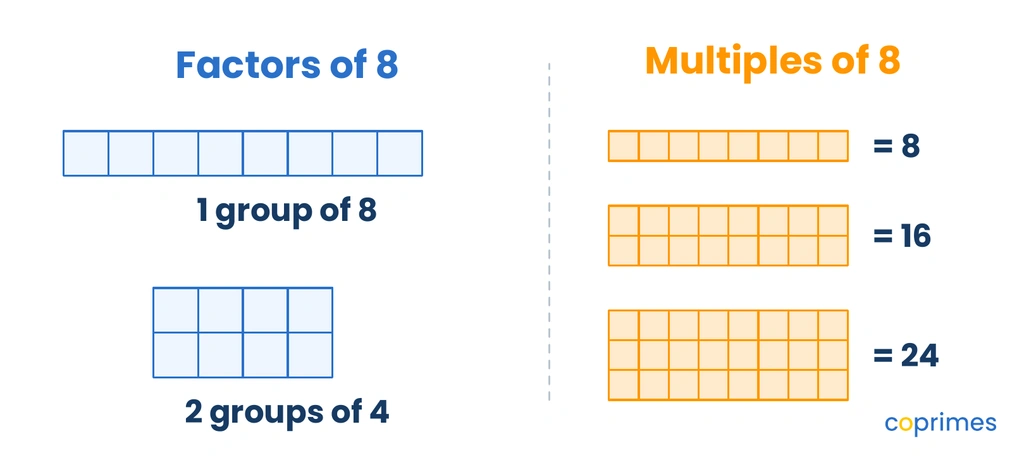
Example 1: Finding factors and multiples
Question: List all the factors and the first four multiples of .
Method:
- To find the factors, look for numbers that divide exactly into .
- Check numbers starting from . The factor pairs are and .
- To find the multiples, multiply by the first four counting numbers: , , , and .
Answer: The factors are , and . The first four multiples are , and .
Check: Use division. with no remainder, confirming is a factor. with no remainder, confirming is a multiple.
Example 2: Classifying relationships
Question: Is a factor or a multiple of ? Is a factor or a multiple of ?
Method:
- Compare the sizes. The number is smaller than , so test if it is a factor.
- Since , divides evenly into .
- Now, check in relation to . The number is larger than , so test if it is a multiple.
- Since , is a product of .
Answer: The number is a factor of . The number is a multiple of .
Check: Use factor pairs to ensure no numbers are missed. The pair proves both relationships simultaneously.
Example 3: Counterexamples and true/false
Question: Determine whether the following statement is true or false: is a multiple of .
Method:
- Recall the definition of a multiple. A multiple is created by multiplying the target number by an integer.
- The multiples of are , and so on.
- The number is smaller than , meaning it cannot be a multiple. Instead, divides evenly into .
Answer: The statement is false. The number is actually a factor of .
Check: Divide by . Because the result is a decimal () rather than a whole number, is not a multiple.
How to Choose or Classify
To determine whether a number is a factor or a multiple of another number, first compare their sizes.
If the number in question is smaller than the target number, test if it is a factor by dividing the target number by it. If the number in question is larger than the target number, test if it is a multiple by dividing the larger number by the target number.
Every number is both a factor and a multiple of itself. For example, is the largest factor of , and it is the very first multiple of .
Common Mistakes
Confusing the definitions
Students often list multiples when asked for factors, or factors when asked for multiples. Remember that factors break a number down into smaller pieces, while multiples build a number up into larger totals.
Thinking a number cannot be both
Because factors are usually smaller and multiples are usually larger, it is easy to forget that a number is both a factor and a multiple of itself. For instance, divides exactly into , making it a factor, and , making it a multiple.
Forgetting the number
The number is a factor of every positive integer because it divides evenly into every whole number. However, is only a multiple of .
A learning plan shaped by your child, not the class
State-aligned Math plus our own Logic and English curriculum. An adaptive baseline test finds the gaps and fills them.
Practice questions
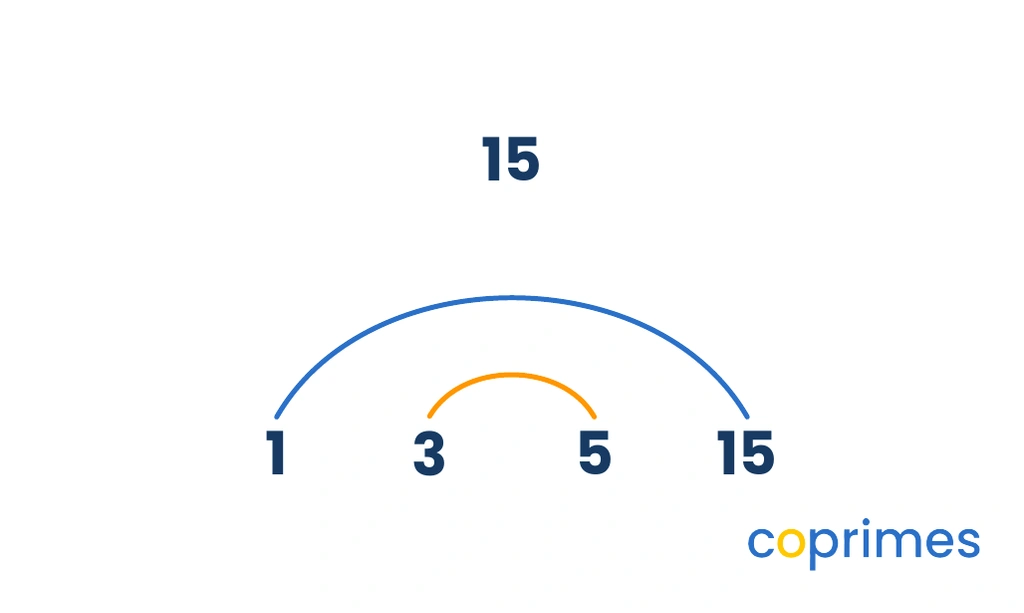
Based on the diagram, which of the following statements is true?
The numbers , and are factors of .
The numbers , and are multiples of .
The diagram shows the first four multiples of .
The number is a factor of and .
The numbers , and are factors of .
What is the mathematical relationship between and ?
The number is a multiple of .
The number is a factor of .
The number is a factor of .
Both numbers are multiples of .
The number is a factor of .
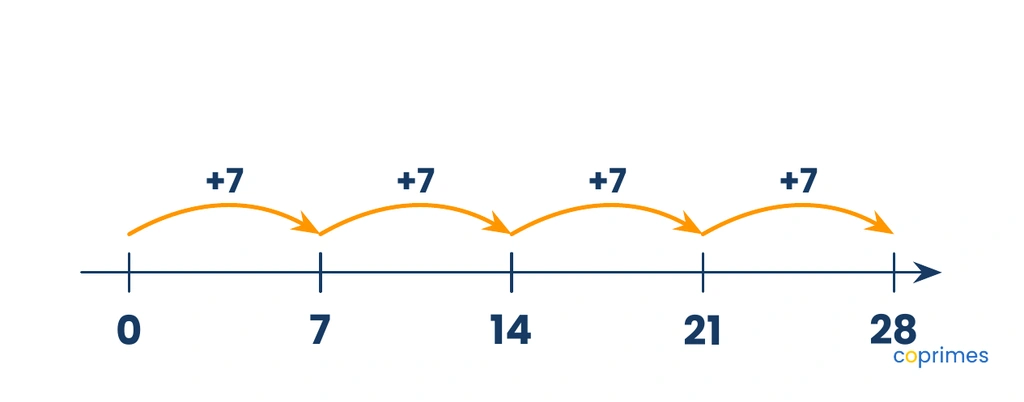
What mathematical concept does the number line representation show?
The factors of .
The multiples of .
The factors of .
The multiples of .
The multiples of .
Which of the following statements accurately describes the number ?
The number can only be a factor of other numbers.
The number can only be a multiple of other numbers.
The number is a factor of and a multiple of .
The number is a factor of and a multiple of .
The number is a factor of and a multiple of .
A baker places cupcakes in every box. They fill exactly boxes. The total number of cupcakes is . In this situation, the number is a:
Factor of
Multiple of
Factor of
Multiple of
Multiple of