
Multiplying and Dividing Decimals by Powers of Ten
Multiplying or dividing a decimal by a power of ten scales the value by shifting the digits within the place-value system. This decimal scaling powers of ten makes each digit ten times as valuable per factor of ten during multiplication, while division makes each digit one tenth as valuable.
What happens to decimals when scaling by powers of ten?
When scaling decimals by ten, one hundred, or one thousand, the magnitude of the number changes according to the base-ten system. Every time a number is multiplied by a powers of ten, its value increases tenfold per zero. Every time it is divided by , its value is reduced to one tenth of its previous size.
Understanding decimal place value is essential because these decimal place value shifts dictate exactly where each digit belongs after scaling. The decimal point remains completely fixed as a reference marker between whole numbers and fractions, while the digits themselves shift to new positions.
Use a place-value chart
A place-value chart clearly models how digits change value. Instead of visualizing the decimal point moving, observe how the digits shift across the fixed decimal point.
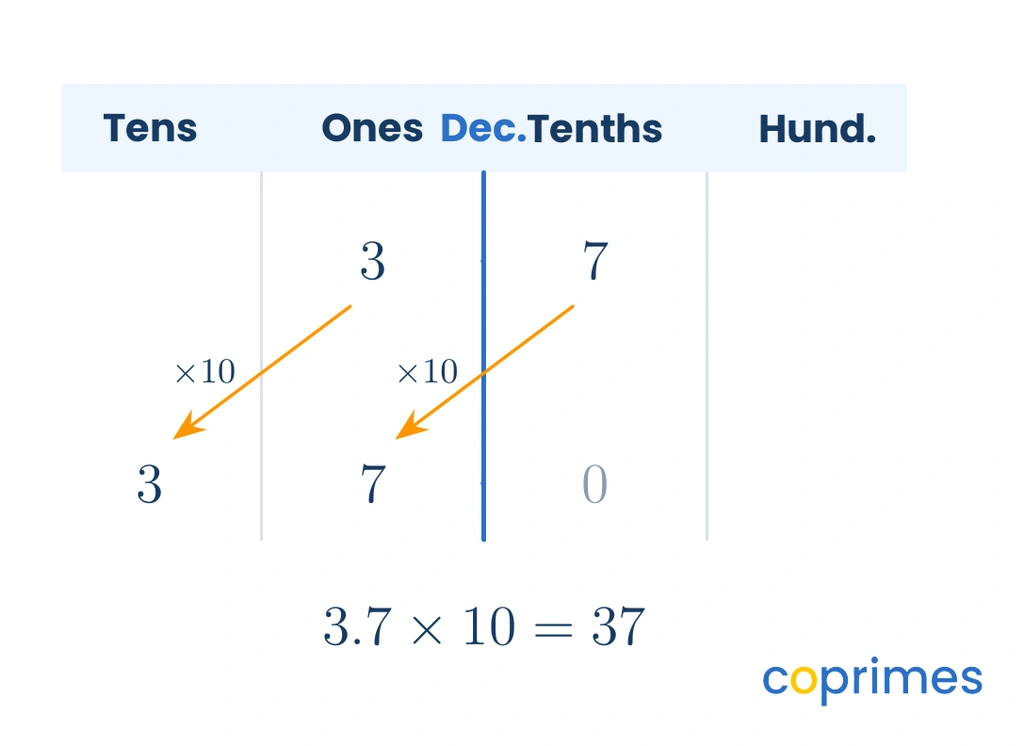
When a digit shifts one position to the left, it becomes ten times larger. When it shifts one position to the right, it becomes ten times smaller.
Multiply decimals by 10, 100 and 1,000
When you multiply decimals by 10 100 1000, the overall value increases. Every digit shifts to the left on the place-value chart by one position for each factor of ten.
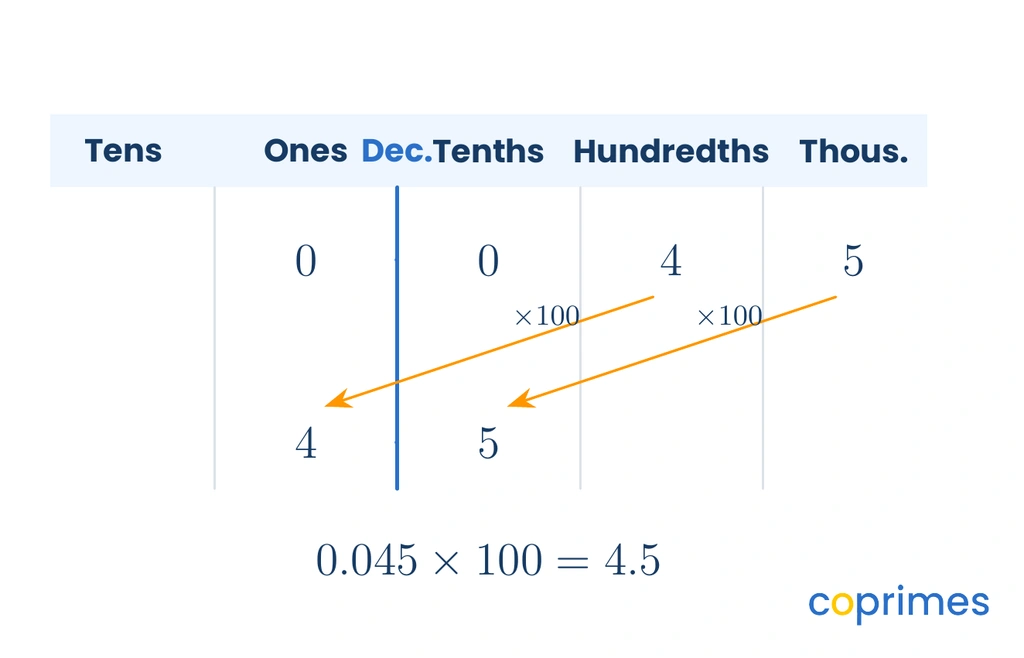
- Multiplying by : Digits shift place to the left.
- Multiplying by : Digits shift places to the left.
- Multiplying by : Digits shift places to the left.
This process is a fundamental part of multiplying by 10 100 and 1000 and forms the basis for more advanced multiplying decimals. Empty spaces created before the decimal point as digits shift are always filled with placeholder zeros.

Divide decimals by 10, 100 and 1,000
Division is the inverse operation of multiplication. Similarly, when you divide decimals by 10 100 1000, the overall value decreases. Every digit shifts to the right on the place-value chart.
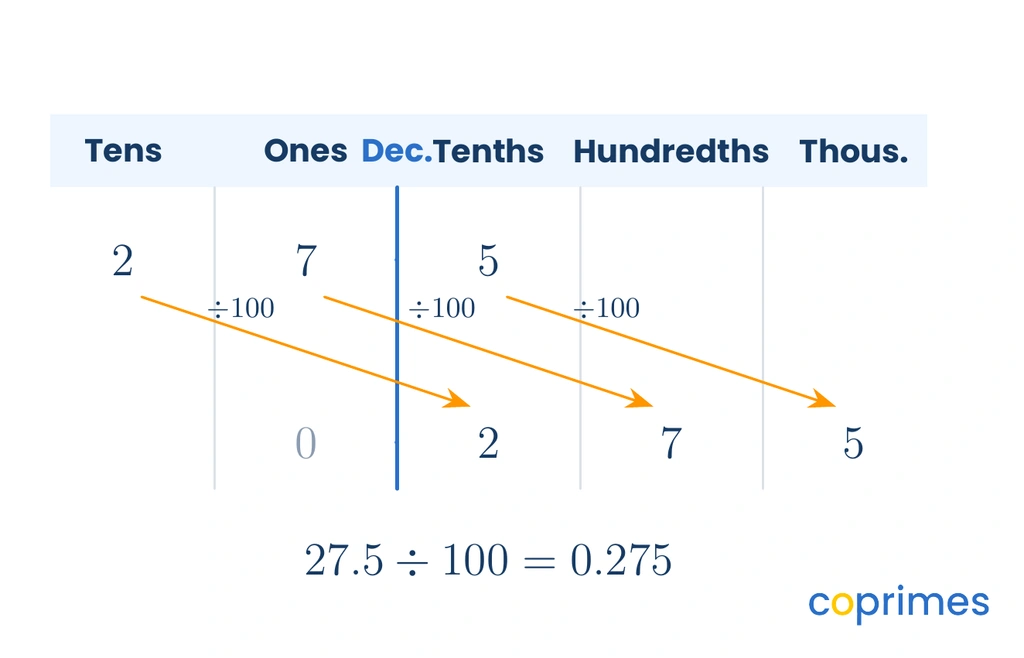
- Dividing by : Digits shift place to the right.
- Dividing by : Digits shift places to the right.
- Dividing by : Digits shift places to the right.
When applying this to dividing decimals, any empty spaces between the decimal point and the shifted digits must be filled with a placeholder zero. A leading zero is also written before the decimal point if there is no whole number.
Explain the shortcut
A reliable shortcut relates the number of zeros in the power of ten directly to the number of place-value shifts.
The number of zeros in a power of ten tells you exactly how many places the digits shift.
- has one zero, so digits shift place.
- has two zeros, so digits shift places.
- has three zeros, so digits shift places.
Many mathematical shortcuts rely on decimal point movement to teach this concept. While moving the decimal point to the right gives the correct answer for multiplication, focusing on decimal shifts instead builds stronger mathematical reasoning because the digits represent the actual value being scaled.
Worked examples
Example 1: Multiplying by a power of ten
Question: What is the result of ?
Method:
- Identify the operation and power of ten: multiplication by means the value increases.
- Count the zeros in . There are two zeros, so the digits shift places to the left.
- Shift the digits and two places to the left across the place-value chart.
Answer: .
Check: is slightly less than , and . The answer is reasonable.
Example 2: Dividing by a power of ten
Question: What is the result of ?
Method:
- Identify the operation: division by means the value decreases.
- Count the zeros in . There are three zeros, so the digits shift places to the right.
- Shift the digits , , , and three places to the right.
- Add a placeholder leading zero before the decimal point.
Answer: .
Check: Multiplication reverses division: .
Example 3: Applying multiplication to measurements
Question: A wire is meters long. What is its length in centimeters? (There are centimeters in meter).
Method:
- To convert meters to centimeters, multiply the length by .
- The expression is .
- Multiply by shifting the digits places to the left.
Answer: The wire is centimeters long.
Check: meters is centimeters, so meters must be centimeters.
A learning plan shaped by your child, not the class
State-aligned Math plus our own Logic and English curriculum. An adaptive baseline test finds the gaps and fills them.
Common mistakes
Mistake: Shifting in the wrong direction
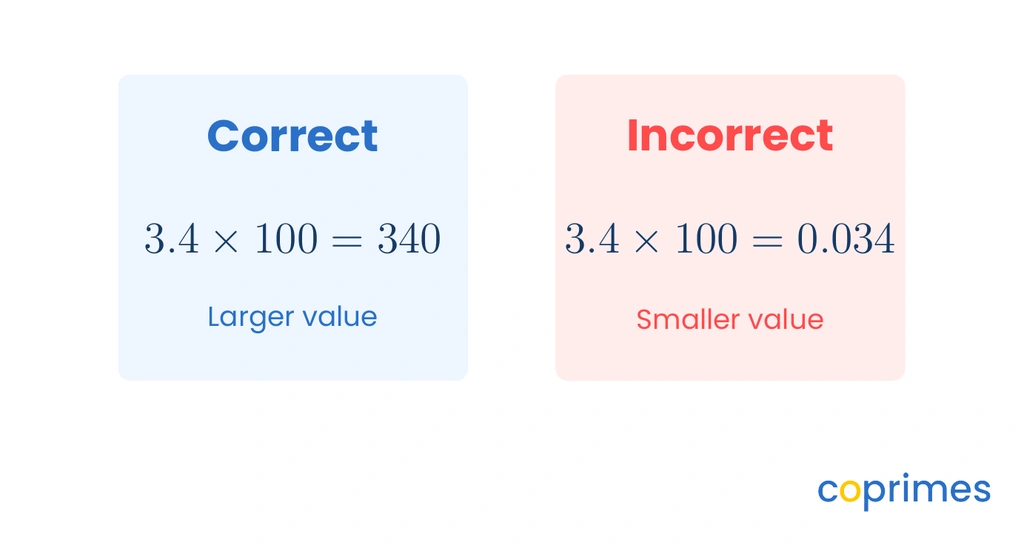
When multiplying, students sometimes accidentally shift digits to the right, making the number smaller instead of larger. Always verify that a multiplication answer is greater than the starting decimal, and a division answer is smaller.
Mistake: Forgetting placeholder zeros
When digits shift far enough that empty columns appear between the number and the decimal point, you must insert placeholder zeros. For instance, shifting the digits of two places to the left results in , not .
Frequently asked questions
How do you multiply decimals less than ?
The rules are exactly the same. Multiply by a power of ten by shifting the digits to the left. For example, . The original leading zeros keep their respective place values until they are shifted in front of the new leading whole number, where they can be dropped.
Do trailing zeros matter?
Once you have shifted the digits across the place-value chart, any extra zeros at the far right end of a decimal fraction do not change the mathematical value and can usually be dropped. For example, , which is completely equal to .
What happens if you run out of digits when shifting?
If a whole number or decimal has no more visible digits, you can assume invisible zeros indefinitely. For example, to evaluate , shift the digits three places to the left. The first shift places the in the Ones column to make , and the next two shifts require placeholder zeros to track the position, making .
Practice questions
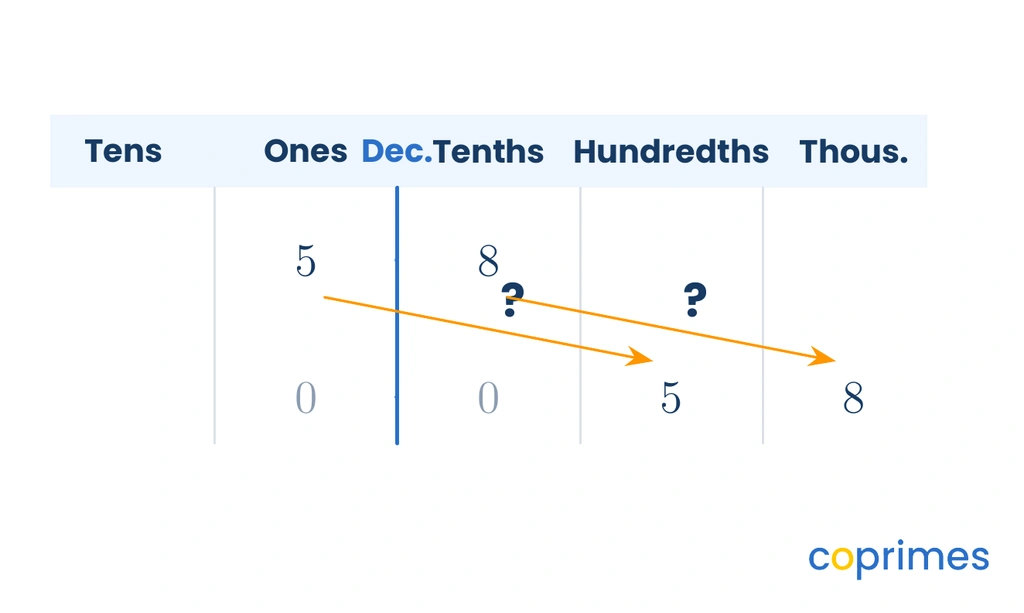
Which mathematical operation is represented by this place-value chart shift?
Divide by
Divide by
Multiply by
Multiply by
Divide by
Calculate the product:
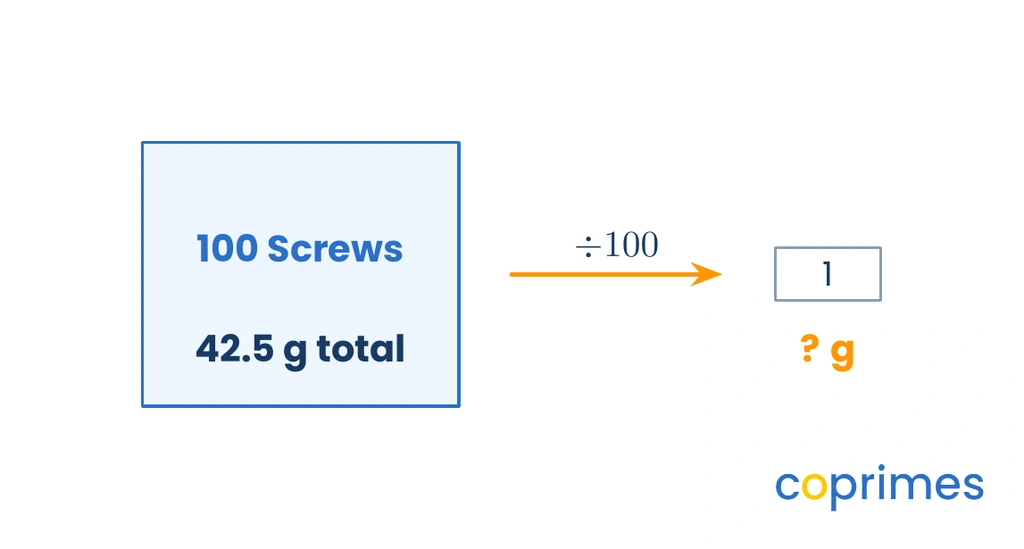
A full box of identical screws weighs grams. What is the weight of a single screw?
grams
grams
grams
grams
grams
What is the missing factor in the equation ?
Which of the following mathematical statements is correct?