
Properties of Integers: Rules and Examples
Integer properties describe how addition and multiplication behave under order, grouping, distribution, identity, and closure. These mathematical rules ensure that calculations remain consistent and provide reliable strategies for solving expressions. While addition and multiplication share many algebraic properties, subtraction and division often do not, which requires careful attention when working with signed numbers.
What are the properties of integers?
The core properties of integers form the foundation for all integer operations. They determine whether the order of numbers can be changed, how groups of numbers can be combined, and which operations always produce another integer.
These rules are closely related to the general properties of addition and properties of multiplication, but they apply specifically to the entire set of positive numbers, negative numbers, and zero.
The main properties are:
- Closure property: Determines if an operation always results in an integer.
- Commutative property: Determines if the order of the numbers changes the result.
- Associative property: Determines if the grouping of the numbers changes the result.
- Distributive property: Describes how multiplication interacts with addition or subtraction.
- Identity property: Identifies a value that leaves another integer unchanged.
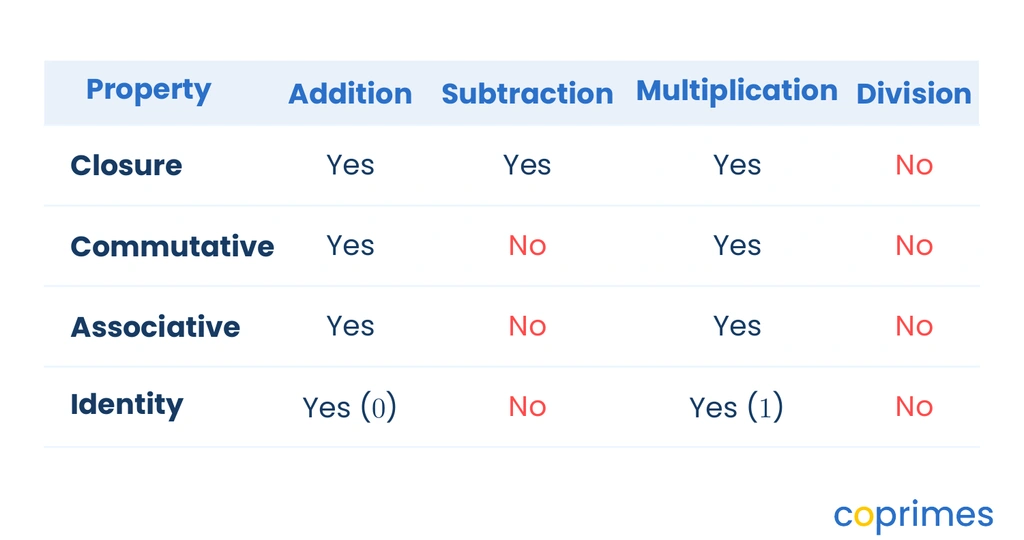
Closure property
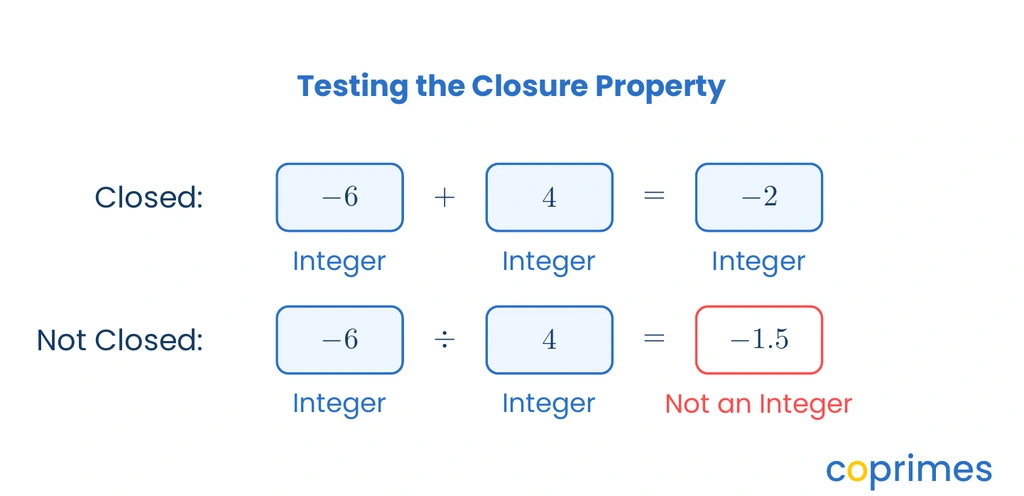
The closure property of integers states that when an operation is performed on any two integers, the result is always another integer.
If and are integers, then for the operation to be closed, the answer must also belong to the exact same numerical set. Addition, subtraction, and multiplication are all closed operations.
- Addition:
- Subtraction:
- Multiplication:
Division is not closed because dividing two integers often results in a fraction or decimal, which is not an integer. For example, .
The closure property applies to addition, subtraction, and multiplication, but not division.
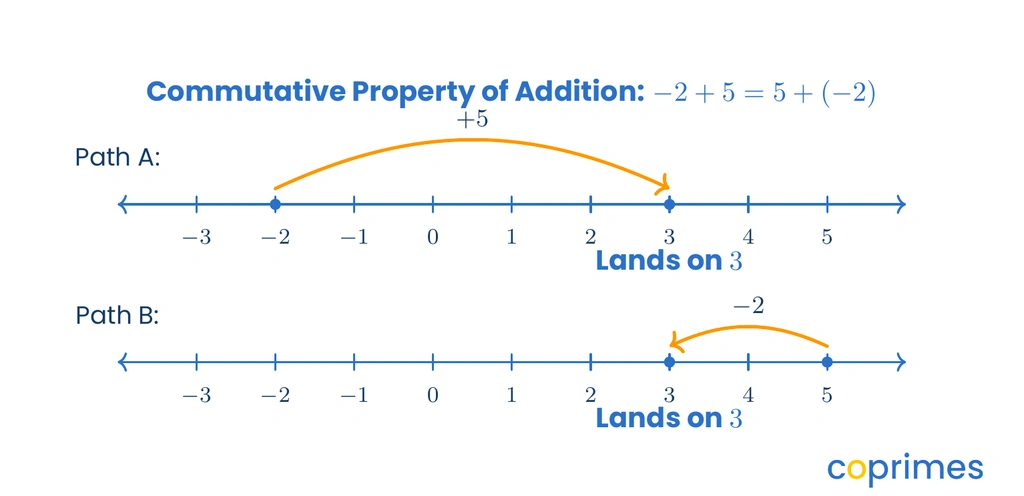
Commutative and associative properties
The commutative property states that the order of the numbers does not change the result. For any integers and , this rule applies to addition and multiplication:
- Addition:
- Multiplication:
For example, , and . The sum is identical regardless of which integer is written first.
The associative property states that the grouping of three or more numbers does not change the final result. Grouping is typically shown using parentheses. For any integers , , and :
- Addition:
- Multiplication:
For example, evaluates to . Changing the grouping to evaluates to . The final sum remains exactly the same.
A learning plan shaped by your child, not the class
State-aligned Math plus our own Logic and English curriculum. An adaptive baseline test finds the gaps and fills them.
Distributive property
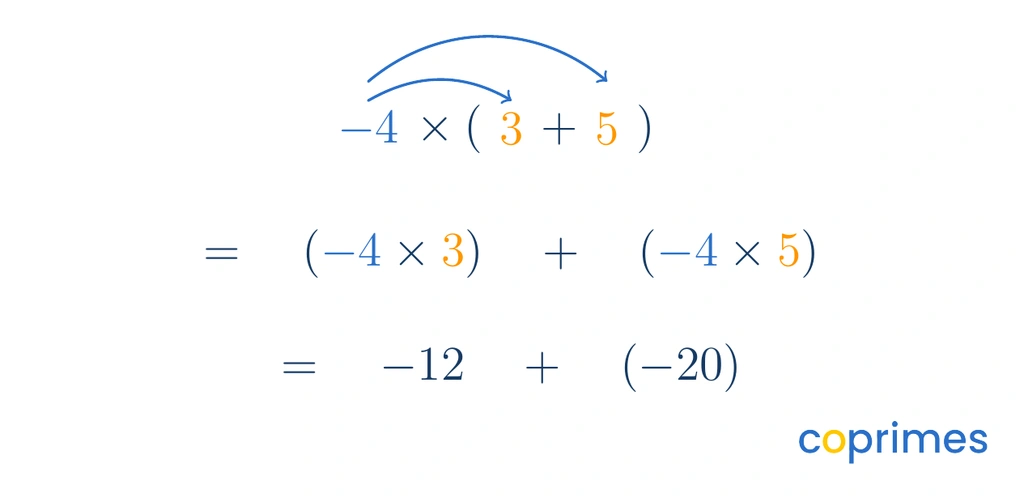
The distributive property of multiplication states that multiplying a number by a sum or difference gives the same result as multiplying the number by each part separately and then adding or subtracting the individual products.
For any integers , , and :
- Over addition:
- Over subtraction:
This property breaks complex calculations into simpler mental steps. To calculate , you can rewrite as a sum inside parentheses, :
.
Identity and additive inverse
An identity element is a specific value that leaves another integer perfectly unchanged when an operation is applied to it.
- Additive identity: The number is the additive identity because adding zero to any integer does not change its value. For any integer , the absolute rule is and .
- Multiplicative identity: The number is the multiplicative identity because multiplying any integer by one does not change its value. The rule is and .
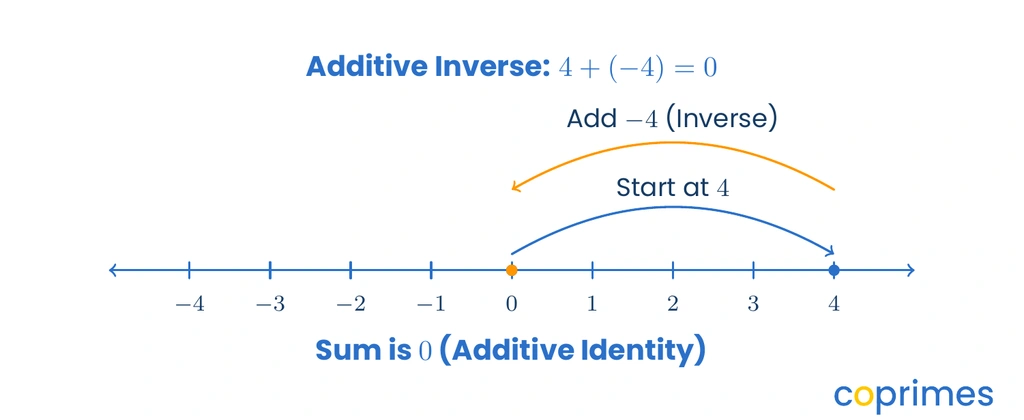
The additive inverse of an integer is its exact opposite value on the number line. When you add any integer to its additive inverse, the result is always the additive identity, which is .
For example, the additive inverse of is , because .
Which properties do not apply?
Subtraction and division behave fundamentally differently from addition and multiplication. They are rigidly ordered, meaning they do not share all the same algebraic flexibility.
- No commutative property: Changing the order of subtraction or division changes the mathematical result. For example, , but . Similarly, , but .
- No associative property: Changing the grouping of subtraction or division alters the final answer. For example, , but .
- No identity element: Subtracting zero only works correctly in one direction. While , the reverse equation changes the original value.
Because these operations lack these properties, you must always evaluate subtraction and division strictly from left to right unless mathematical grouping symbols specify otherwise.

Worked examples
Example 1: Identifying the integer property
Question: Which integer property is demonstrated by the equation ?
Method:
- Examine the values on both sides of the equals sign. Both sides contain and .
- Identify the mathematical operation. Both sides use multiplication.
- Notice what has changed. The order of the integers is reversed, but the grouping has not changed.
- Match this observation to the correct property rule.
Answer: The equation demonstrates the commutative property of multiplication.
Check: Evaluate both sides. . The order of multiplication does not change the result.
Example 2: Using the distributive property
Question: Use the distributive property to mentally calculate .
Method:
- Rewrite the large number as a simple subtraction involving a multiple of . Write as .
- Substitute this expression into the original problem: .
- Multiply the outside integer by each inside value separately.
- Multiply to get .
- Multiply to get .
- Subtract the second product from the first: .
Answer: .
Check: Standard multiplication confirms that .
Example 3: Proving division is not commutative
Question: Provide a counterexample to show that the commutative property does not apply to the division of integers.
Method:
- Choose two different integers that divide evenly in one direction, such as and .
- Write the equation with the larger integer first: .
- Calculate the quotient. .
- Reverse the order of the integers to test the commutative rule: .
- Calculate the new quotient. .
Answer: Because is not equal to , the equation is false. The order matters.
Check: Any pair of distinct non-zero integers will produce different quotients when reversed.
Frequently asked questions
What are the four main properties of integers?
The four most frequently used properties of integers are the closure property, the commutative property, the associative property, and the distributive property.
Why are the properties of integers important?
These properties act as the fundamental rules of arithmetic. They allow you to safely rearrange terms, simplify mental math, and solve complex algebraic expressions without altering the final value of the equation.
Is division closed for integers?
No, division is not a closed operation for integers. Dividing two integers frequently results in a fraction or decimal. For example, , which is not an integer.
Practice questions
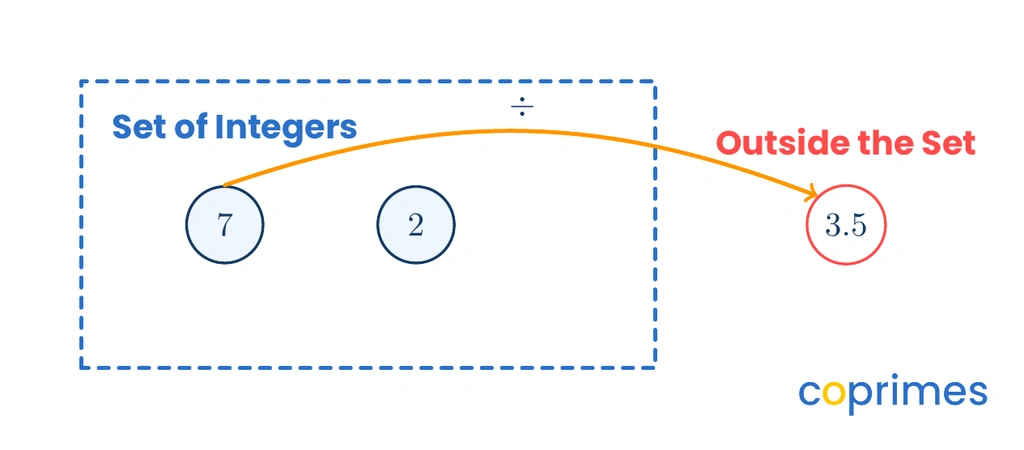
The visual shows an example where dividing two integers results in a decimal. Which property does this visual prove does NOT apply to the division of integers?
Closure property
Commutative property
Associative property
Identity property
Closure property
Which equation perfectly demonstrates the commutative property of multiplication?
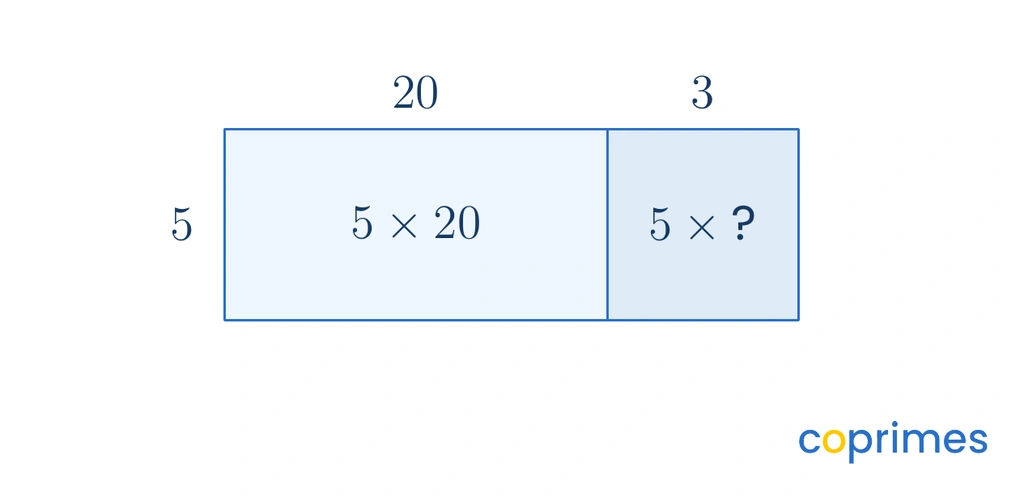
What integer completes the distributive property expression shown in the second section of the area model visual?
Which statement correctly describes the additive identity property of integers?
Adding an integer to its opposite always equals zero.
Adding zero to an integer leaves its value perfectly unchanged.
Multiplying an integer by one leaves its value perfectly unchanged.
The sum of any two integers is always another integer.
Adding zero to an integer leaves its value perfectly unchanged.
Why does the associative property NOT apply to the subtraction of integers?
Subtracting zero from a number changes its mathematical sign.
Changing the grouping of the integers changes the final value.
The result of subtracting two integers is not always an integer.
Changing the order of the numbers reverses the mathematical sign.
Changing the grouping of the integers changes the final value.