
Multiplying and Dividing Integers
When multiplying or dividing integers, equal signs give a positive result and different signs give a negative result; divide only when the divisor is nonzero and note that the quotient may not be an integer.
Understanding how to multiply and divide positive and negative numbers is a foundational skill in mathematics. Building on basic addition and subtraction, these integer operations allow us to solve problems involving repeated scaling, grouping, and opposite directions. Learning the correct integer sign rules prevents common mistakes in negative multiplication and division.
What are multiplication and division of integers?
Multiplication of integers represents repeated addition or scaling, while division involves grouping integers into equal parts.
When working with positive integers, multiplication is straightforward. For example, means adding three times to reach . When negative numbers are introduced, the operation still represents scaling, but it incorporates a change in direction. Multiplying means adding three times, which results in .
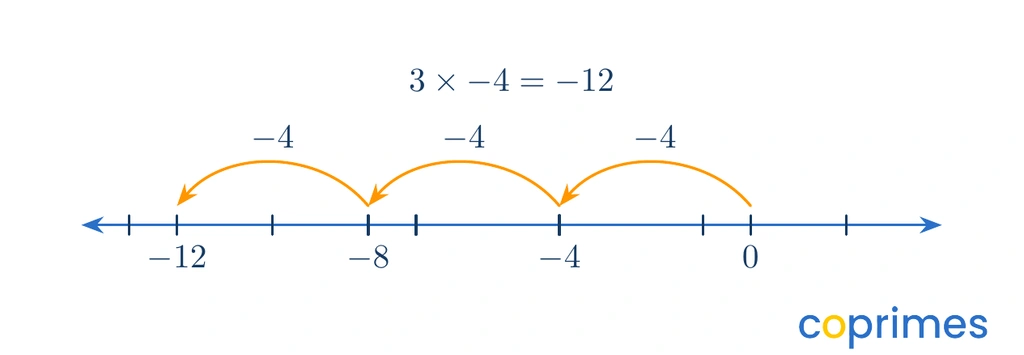
Division is the reverse process. Dividing by asks how to separate into equal groups. The calculation confirms that each group contains exactly .
Sign rules
The sign of the product or quotient is determined entirely by whether the two integers share the same sign.
When multiplying or dividing any two integers, evaluate their signs first. If both numbers are positive or both are negative, the result is positive. If one number is positive and the other is negative, the result is negative.
Equal signs yield a positive result, and different signs yield a negative result.
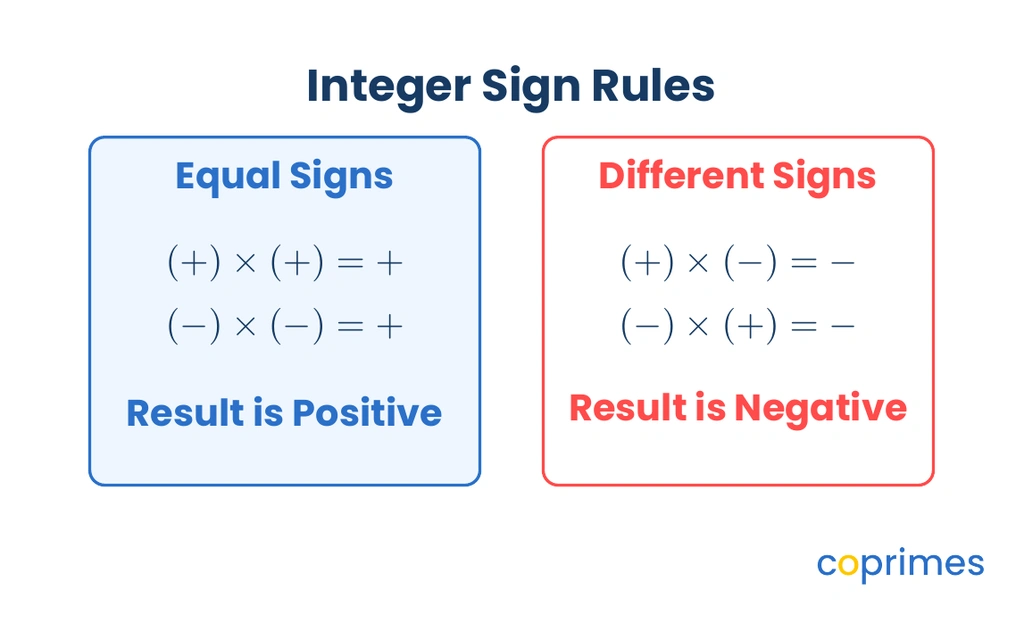
These rules govern both multiplication and division perfectly. The magnitudes of the numbers behave exactly as they do in arithmetic with whole numbers.
Multiply integers
To multiply two integers, find the product of their absolute values and apply the sign rules to the result.
The process involves two reliable steps:
- Ignore the signs temporarily and multiply the numbers as if they were positive.
- Attach a positive or negative sign to the product based on whether the original signs match.
For example, to multiply and : the product of their absolute values is . Because one integer is negative and the other is positive, the signs are different. Therefore, the final answer is .
When both integers are negative, such as , the absolute values multiply to . Since the signs are identical, the answer is , which is normally written simply as .

Divide integers
To divide two integers, divide their absolute values and apply the identical sign rules used in multiplication.
The steps mirror the multiplication process:
- Divide the numbers as if they were positive whole numbers.
- Determine the sign of the quotient using the integer sign rules.
For example, to evaluate , first calculate , which equals . Because both integers share the negative sign, the final quotient is positive .
When evaluating , divide by to get . Since the dividend is positive and the divisor is negative, the differing signs make the final answer .
Remember that division by zero is undefined. No integer can be mathematically divided by .
More than two factors
When multiplying three or more integers, the number of negative factors determines whether the final product is positive or negative.
You do not need to calculate the signs step-by-step for a long string of numbers. Instead, simply count how many negative integers are in the problem:
- If the count of negative factors is an even number, the final product is positive. Every pair of negative factors cancels out into a positive.
- If the count of negative factors is an odd number, the final product is negative. After pairing them up, one negative factor will remain unmatched, turning the entire product negative.
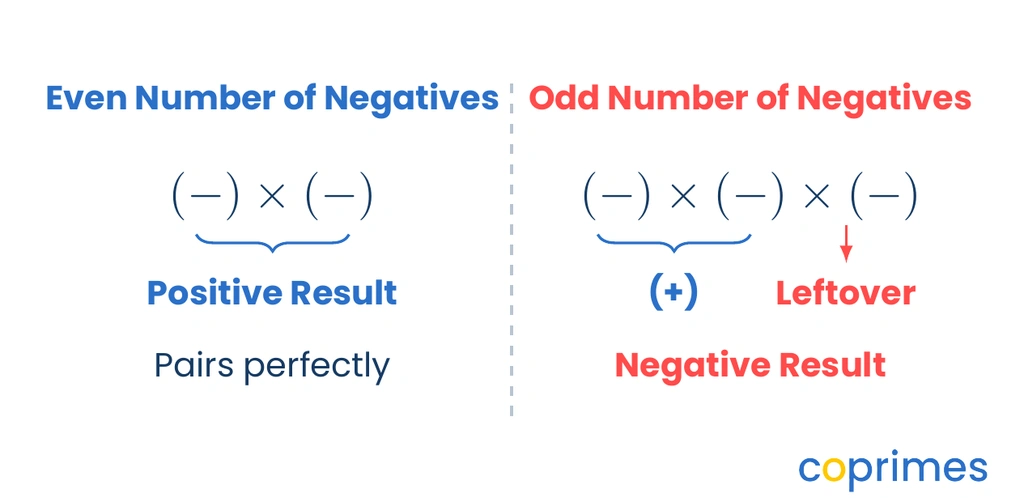
The count of positive factors does not change the sign. Only the negative numbers matter.
When division leaves the integers
Not all integer division results in another integer.
Multiplication is a closed operation, meaning the product of any two integers is always an integer. However, dividing one integer by another frequently creates a remainder.
When you divide by , the quotient is exactly , which is an integer. But when you evaluate , the result does not divide evenly.
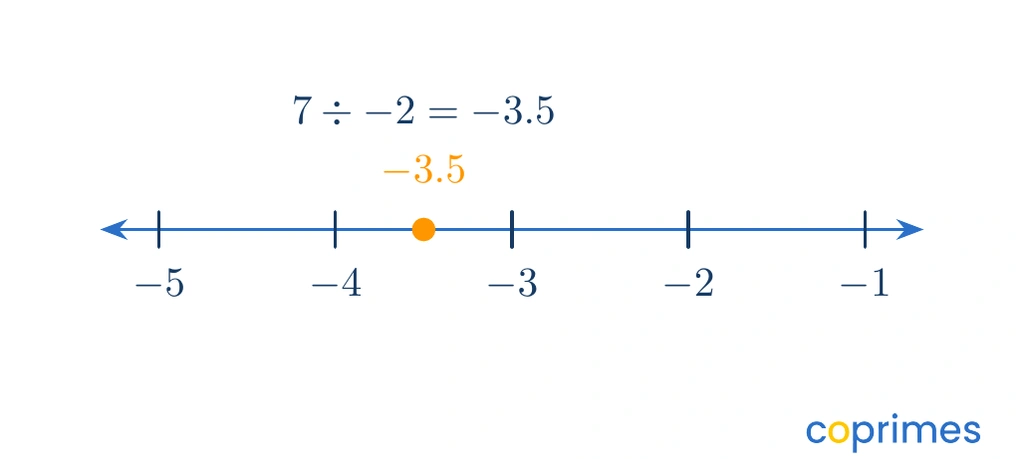
The answer is , which is equivalent to the fraction . Because integer division often results in non-integers, these quotients form the broader category of rational numbers. The integer sign rules still apply exactly: a positive divided by a negative always gives a negative rational number.
A learning plan shaped by your child, not the class
State-aligned Math plus our own Logic and English curriculum. An adaptive baseline test finds the gaps and fills them.
Worked examples
Review these examples to understand how to apply the sign rules accurately in different mathematical contexts.
Example 1: Dividing negative integers
Question: Calculate the value of .
Method:
- Divide the absolute values: .
- Compare the original signs: both the dividend and divisor are negative.
- Apply the rule: dividing two negative integers results in a positive quotient.
Answer: .
Check: Multiply the quotient by the divisor to see if it matches the dividend. . The calculation is correct.
Example 2: Multiplying more than two factors
Question: Evaluate the expression .
Method:
- Multiply the absolute values left to right: , and .
- Count the negative numbers in the original expression. There are two: and .
- Because the count of negative factors is even, the final product is positive.
Answer: .
Check: Evaluate step-by-step: . Then, multiply the result: .
Example 3: Non-integer division
Question: What is the quotient of ?
Method:
- Divide the absolute values. does not divide evenly by . The result is with a remainder of , or the decimal .
- Check the signs. The dividend is negative and the divisor is positive.
- Different signs result in a negative quotient.
Answer: .
Check: Multiply by . First, . Next, . The sum is . Applying the sign rules gives .
Frequently asked questions
These answers address common questions about integer operations and mathematical properties.
Are there specific properties for multiplying integers?
Yes. The properties of integers show that multiplication is commutative (the order does not matter) and associative (grouping does not matter). For example, and both equal . Division, however, is neither commutative nor associative.
How does multiplication work with the order of operations?
When an expression contains multiple steps, you must follow the order of operations with integers. Multiplication and division are performed from left to right, strictly before any addition or subtraction unless parentheses indicate otherwise.
What happens if I multiply by zero?
Multiplying any integer by always results in . Zero is neither positive nor negative, so no sign is attached to the final answer.
Practice questions
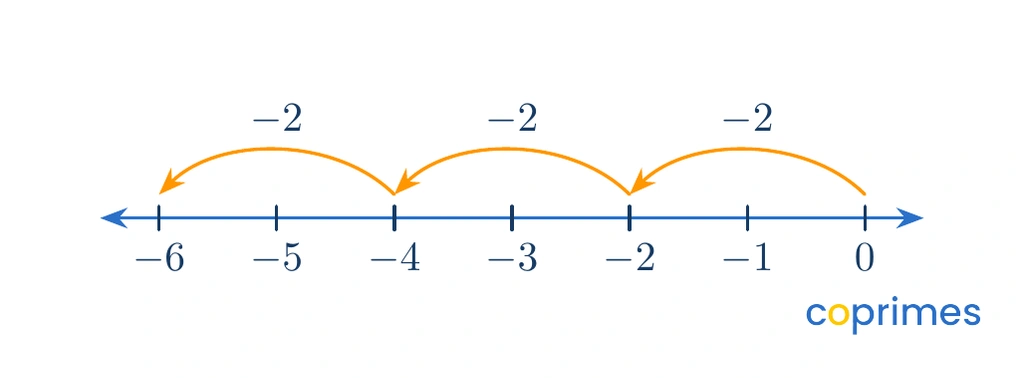
Which mathematical equation does the number line represent?
Evaluate the expression .
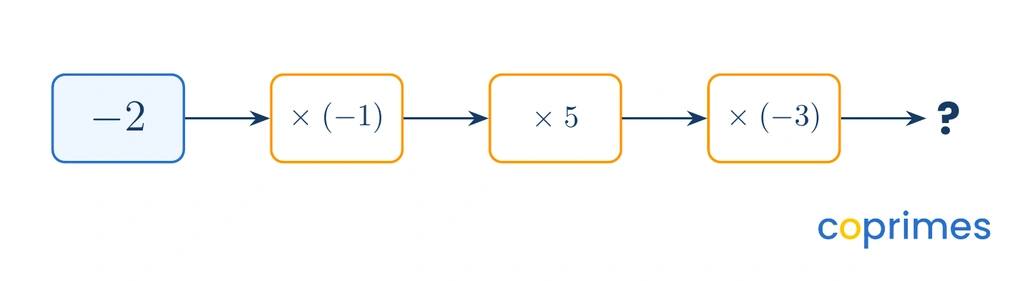
Determine the final output of the multiplication sequence shown.
A student incorrectly states that . What rule did they forget?
When the factors have different signs, the answer is always negative.
When one factor is positive, the product is always positive.
When multiplying two negative integers, the product is always positive.
When multiplying numbers, you must subtract the absolute values.
When multiplying two negative integers, the product is always positive.
Calculate the exact decimal value of .